

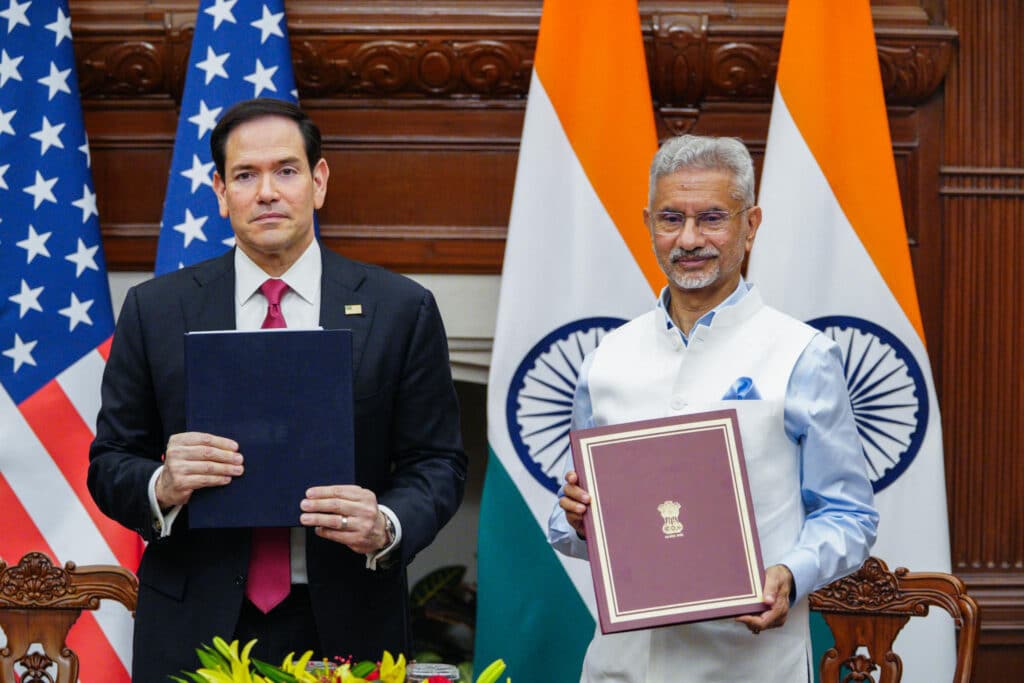
India and the United States have signed a sweeping critical minerals agreement during the Quad Foreign Ministers’ Meeting in New Delhi, marking one of the most significant strategic and economic partnerships between the two countries in recent years as both governments intensify efforts to reduce dependence on China’s dominance over global rare earth supply chains.
The agreement, formally titled the “Framework on Securing of Supply in the Mining and Processing of Critical Minerals and Rare Earths,” was signed by External Affairs Minister S. Jaishankar and U.S. Secretary of State Marco Rubio during wider Quad discussions involving India, the United States, Japan and Australia. The framework covers cooperation across mining, processing, refining, recycling, financing, investment and long-term supply chain management for strategic minerals considered essential to future industrial and military technologies.
The agreement comes at a pivotal moment in global geopolitics as governments worldwide compete to secure access to the raw materials powering artificial intelligence systems, semiconductor manufacturing, electric vehicle batteries, renewable energy infrastructure, advanced telecommunications networks and next-generation defence technologies.
Rare earth elements and critical minerals such as lithium, cobalt, nickel and graphite are increasingly being treated not simply as industrial commodities but as strategic assets central to national security, economic resilience and technological sovereignty. Analysts say the India-US framework reflects a broader global shift in which control over supply chains and industrial resources is becoming as important as conventional military or financial power.
China currently controls more than 60% of global rare earth mining and nearly 80% of refining and processing capacity, giving Beijing extraordinary leverage over industries driving the future global economy. Recent Chinese export restrictions on strategic minerals and rare earth magnets intensified concerns in Washington, New Delhi and other Indo-Pacific capitals over industrial vulnerability, supply disruptions and economic coercion.
Diplomatic officials involved in the negotiations described the framework as one of the most consequential economic security agreements signed between India and the United States in decades, underscoring rapidly expanding cooperation across trade, technology, infrastructure and Indo-Pacific strategy.
China’s Strategic Grip
China’s overwhelming dominance over global critical mineral processing remained the defining issue behind the Quad discussions in New Delhi. While Beijing controls a major share of mining operations across several rare earth categories, strategic experts say its real power lies in refining and downstream processing infrastructure that converts raw materials into usable industrial components.
This specialised infrastructure forms the backbone of industries critical to future technological and military competition. Semiconductor manufacturing, electric mobility, aerospace systems, renewable energy platforms, missile technologies, telecommunications infrastructure and artificial intelligence hardware all depend heavily on refined rare earth materials.
Governments across the world have become increasingly concerned that concentrated processing networks could expose industrial economies to geopolitical pressure or strategic supply disruptions during periods of rising international tension.
Rubio described the India-US agreement as part of a larger effort to secure trusted industrial supply chains and reduce exposure to what he called “single-source monopolies.” He stated, “We cannot afford to leave the foundational materials of these industries vulnerable to single-source monopolies.”
The US Secretary of State further said, “We are two countries who have a strategic interest in ensuring reliable long-term access to critical minerals and supply chains that are important for our innovation economy.”
Diplomatically, the language reflected growing Western concerns over China’s ability to exert influence through industrial supply chain dominance without directly naming Beijing as the target.
Chinese officials criticised the Quad once again as an “exclusive grouping” designed to contain China’s regional influence. However, officials from Quad countries maintained that the initiative was focused on economic resilience, industrial stability and secure maritime trade routes rather than confrontation.
The discussions also reflected wider concerns over tensions in the South China Sea and broader Indo-Pacific strategic competition. Quad members reiterated support for freedom of navigation, international law and opposition to unilateral actions threatening regional stability.
Strategic analysts increasingly compare the geopolitical importance of rare earths and critical minerals today to the role oil reserves played during the twentieth century, arguing that the future balance of global power may depend heavily on who controls advanced industrial supply chains.
Quad’s Economic Expansion
The New Delhi summit demonstrated how rapidly the Quad is evolving beyond a maritime security grouping into a broader geopolitical and economic coalition focused on industrial resilience, strategic infrastructure and advanced technology coordination.
One of the most important outcomes of the summit was a proposed investment framework expected to mobilise more than $30 billion in public-private financing, investments and industrial partnerships linked to critical minerals and strategic supply chain projects across the Indo-Pacific region.
Officials said the investment push would support mining operations, refining facilities, recycling systems, logistics infrastructure and advanced manufacturing ecosystems designed to reduce global dependence on Chinese industrial networks.
The agreement also builds upon the United States-led “Forum on Resource Geostrategic Engagement,” or FORGE, launched earlier in 2026 to strengthen strategic coordination among partner nations on mineral security and industrial supply chain resilience.
Diplomatic officials said the India-US framework represents a major extension of FORGE’s broader objective of creating trusted resource partnerships among democratic economies.
The discussions additionally connected with the wider Pax Silica initiative, a US-backed strategic industrial framework aimed at reducing reliance on Chinese-controlled technology ecosystems and strengthening cooperation in semiconductors, advanced manufacturing and emerging technologies.
Rubio described India and the United States as “strategic allies” working together to secure long-term economic resilience and trusted supply chains.
The Quad also expanded cooperation on maritime surveillance systems and Indo-Pacific operational coordination. Officials confirmed plans to strengthen maritime domain awareness capabilities designed to monitor suspicious vessel activity, illegal fishing operations and strategic maritime movements across key trade corridors stretching from the Indian Ocean to the Pacific.
In addition, Quad countries announced infrastructure coordination projects in Pacific Island nations, including a major port development initiative in Fiji viewed by analysts as the grouping’s first major collective infrastructure operation in the Pacific region.
India’s Industrial Challenge
For India, the agreement represents both a strategic necessity and a potentially transformative industrial opportunity.
Although India possesses reserves of several strategically important minerals, including rare earth elements and graphite, the country remains heavily dependent on imported processed materials because of limited domestic refining and downstream manufacturing capacity.
Industry experts have repeatedly argued that India’s greatest vulnerability lies not in resource availability but in industrial processing infrastructure. China’s dominance stems largely from decades of investment in refining ecosystems, advanced manufacturing networks and vertically integrated industrial supply chains.
The issue became particularly urgent after Indian industries experienced shortages of rare earth magnets following Chinese export restrictions, exposing vulnerabilities across manufacturing sectors dependent on imported strategic components.
The India-US framework is expected to support technology transfers, industrial partnerships, financing mechanisms and investment in domestic refining infrastructure aimed at strengthening India’s manufacturing competitiveness.
Officials believe the agreement could accelerate India’s ambitions to become a major global manufacturing centre for semiconductors, electric vehicles, renewable energy systems and advanced electronics.
Jaishankar described the agreement as “very timely and critical” amid growing geopolitical uncertainty and increasing pressure on industrial supply chains worldwide.
The discussions also reflected rising concerns over energy security and shipping vulnerabilities linked to instability in West Asia and the Strait of Hormuz, one of the world’s most critical maritime energy corridors.
India remains heavily dependent on imported crude oil, liquefied natural gas and fertiliser shipments transported through strategically sensitive sea routes, making supply chain resilience increasingly central to economic and national security planning.
Battle for the Future
The India-US critical minerals framework reflects a much larger transformation underway in global geopolitics where industrial supply chains, strategic resources and technological ecosystems are emerging as the defining foundations of international power.
Artificial intelligence systems, advanced semiconductors, clean energy technologies, aerospace manufacturing and modern military platforms all rely heavily on stable access to specialised minerals and trusted industrial networks.
As a result, governments worldwide are now competing aggressively to secure reliable access to raw materials, refining infrastructure and advanced manufacturing systems necessary for future economic and technological leadership.
Analysts say critical minerals are increasingly becoming the “new oil” of the twenty-first century because of their central role in shaping industrial competitiveness, geopolitical influence and strategic autonomy.
Rubio said the Quad partnership was focused on delivering “practical outcomes for regional stability, economic resilience and secure growth.” Officials involved in the negotiations described the New Delhi agreement as part of a wider effort to construct durable industrial alliances capable of withstanding geopolitical shocks, trade disruptions and economic coercion.
The framework also highlights deepening strategic convergence between India and the United States despite their historically different geopolitical traditions. Washington increasingly views India as indispensable to its Indo-Pacific strategy, while New Delhi continues expanding strategic partnerships without formally abandoning its long-standing approach of strategic autonomy.
Former and current US policymakers, including Donald Trump, have repeatedly argued that the United States must reduce dependence on Chinese-controlled industrial supply chains and secure long-term access to strategic resources essential for advanced manufacturing and defence production.
The New Delhi summit ultimately demonstrated that the defining geopolitical contest of the coming decades may not be fought primarily through conventional military confrontation or traditional trade wars. Increasingly, it will be determined by which nations control the minerals, technologies, industrial supply chains and strategic infrastructure powering the future global economy.


