

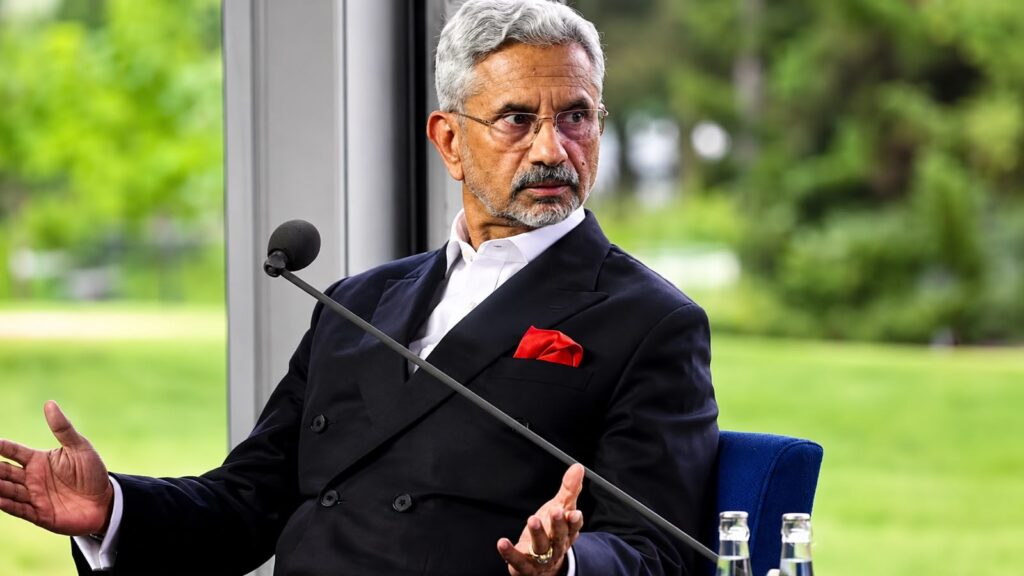
India’s External Affairs Minister S. Jaishankar has delivered one of New Delhi’s strongest defences yet of its continued relationship with Russia, pushing back sharply against European criticism over India’s purchase of discounted Russian oil and accusing Western nations of applying selective standards on war and security. Speaking at the Kultaranta Talks in Finland, Jaishankar said India’s decisions were shaped by national interest, energy needs and economic realities, while also highlighting Europe’s own record of supplying weapons to Pakistan.
His remarks come at a time when the Ukraine war continues to reshape diplomatic ties, energy markets and the global balance of power. The exchange has underlined India’s increasingly assertive foreign policy as it seeks to preserve strategic autonomy while balancing ties with both Western capitals and Moscow.
Oil First
Jaishankar defended India’s Russian oil imports by arguing that the purchases were driven by practical necessity rather than political alignment.
He said when the Ukraine war broke out in 2022, global energy markets were disrupted almost immediately. European countries moved quickly to secure crude from the Middle East, tightening supply and increasing competition for countries like India.
“I buy oil based on what is available in the market and what is best for my country,” Jaishankar said.
India imports more than 85% of its oil, making stable and affordable energy supplies a critical concern for its economy. As Russia offered crude at discounted rates following sanctions, Indian refiners significantly increased purchases.
The move helped shield India from inflationary shocks and stabilised domestic fuel prices at a time when global oil prices were rising sharply.
Jaishankar’s comments reinforced New Delhi’s position that energy security for a population of 1.4 billion cannot be sacrificed to fit another country’s geopolitical expectations.
India remains one of the largest buyers of Russian oil, even as Western governments continue efforts to reduce Moscow’s revenue from energy exports.
US Role
One of the most significant parts of Jaishankar’s intervention was his claim that the United States itself had encouraged India to keep buying Russian oil in the early phase of the war.
According to him, Washington’s concern at the time was avoiding a wider supply shock in global energy markets.
“There was a point when the US wanted the market to remain stable,” he said, suggesting that India’s continued imports were once seen as part of that stability.
The statement adds a new dimension to the debate because it highlights how Western positions have shifted over time.
At the start of the conflict, the focus was on preventing economic disruption. As the war dragged on, political pressure on countries like India increased.
Jaishankar used that contradiction to argue that powerful nations often act according to convenience.
He also referenced changing tariff policies and sanctions frameworks to make the broader point that global powers adjust their positions when necessary. His message was direct: India reserves the same right.
Arms Question
The sharpest moment came when Jaishankar turned the discussion toward Europe’s long history of military exports to Pakistan.
Responding to criticism of India’s Russia ties, he challenged what he called moral inconsistency.
The statement was widely seen as a reference to decades of arms sales from Europe to Pakistan, some of which have been used in military conflicts and border tensions with India.
When asked to explain further, Jaishankar made his position even clearer.
“European weapons have been used against us for many, many years.”
The remark struck at a core Indian grievance.
For New Delhi, Western criticism often overlooks India’s own security concerns in South Asia. India has fought multiple wars with Pakistan and continues to face cross-border tensions.
Jaishankar’s intervention highlighted India’s belief that international standards on morality should apply equally across all conflicts, not only in Europe.
Europe Responds
The exchange took place during a panel on global geopolitical competition, with Finnish Foreign Minister Elina Valtonen also participating.
Valtonen acknowledged that India’s Russian oil imports remain within the legal framework of the G7 price cap mechanism.
That system allows countries to buy Russian oil below a fixed ceiling, with the aim of limiting Moscow’s revenues while keeping supply in the market.
Her comments were important because they effectively recognised that India has not broken sanctions.
This remains one of the central contradictions in the debate.
Politically, many European governments are uncomfortable with India’s growing energy ties with Moscow. Legally, however, those purchases remain within the rules created by Western powers themselves.
That distinction strengthens India’s case that criticism of its oil policy is political rather than procedural.
It also reflects a wider tension in the global response to the Ukraine war, where economic necessity often clashes with diplomatic messaging.
India’s Line
Beyond oil and arms, Jaishankar’s remarks were a broader defence of India’s foreign policy doctrine of strategic autonomy.
India has maintained a carefully balanced approach since the war began. It has increased Russian oil imports, preserved defence cooperation with Moscow, expanded trade ties with Europe and strengthened strategic relations with the United States.
This balancing act reflects India’s rise as an independent power unwilling to be tied to rigid alliance structures.
Jaishankar made clear that disagreement with Europe on Russia does not mean a breakdown in ties.
“Our relations with Europe continue to grow in trade, technology and mobility,” he said.
That balance remains central to India’s global strategy.
Russia continues to play an important role in defence and energy. At the same time, Europe and the US remain vital economic and strategic partners.
As the global order becomes more fragmented, India is making it clear that its decisions will be guided by national interest above all else.
Jaishankar’s remarks in Finland showed that New Delhi is no longer quietly defending those choices. It is now doing so openly, directly and with increasing confidence.


