

India has marked two major advances in its clean energy strategy, commissioning the world’s first nuclear process heat-based hydrogen production facility at Kalpakkam in Tamil Nadu and completing the final speed trial of its first indigenous hydrogen-powered train in Haryana.
The two developments, though separate, point to a broader shift in India’s energy and transport policy. One focuses on hydrogen production through advanced nuclear technology. The other tests hydrogen as a fuel for railway mobility. Together, they place India among a small number of countries pushing hydrogen beyond policy and into operational use.
The announcements come as New Delhi expands its National Green Hydrogen Mission and looks to reduce industrial emissions while cutting fossil fuel dependence.
Nuclear hydrogen
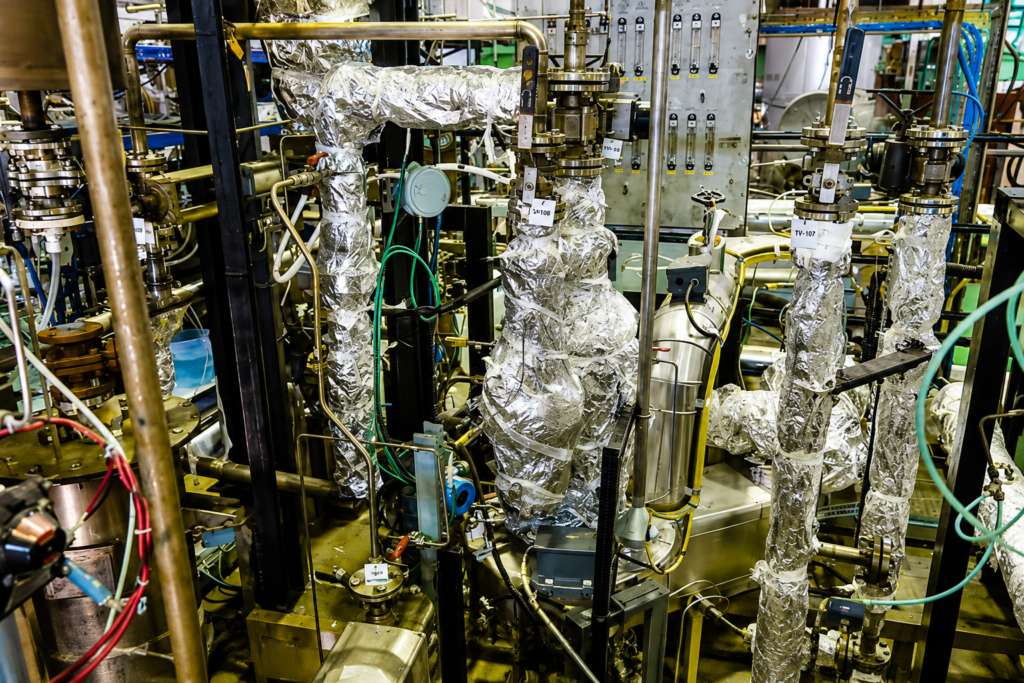
At the Indira Gandhi Centre for Atomic Research in Kalpakkam, scientists have commissioned a hydrogen production facility using process heat from the Fast Breeder Test Reactor. The facility is being operated as a technology demonstrator designed to validate nuclear-assisted hydrogen production before industrial scaling.
Officials say it marks India’s first direct integration of a live nuclear reactor with hydrogen generation. It is also being described as the world’s first operational demonstration of nuclear process heat-based hydrogen production using the Copper-Chlorine thermochemical cycle, an indigenous technology developed by the Bhabha Atomic Research Centre.
Unlike conventional electrolysis, which relies entirely on electricity to split water molecules, the Cu-Cl process uses both thermal and electrochemical reactions, reducing the overall electricity requirement.
The development is being seen as a strategic expansion of nuclear energy into industrial decarbonisation.
Strategic shift
The facility was inaugurated by Ajit Kumar Mohanty, Secretary of the Department of Atomic Energy and Chairman of the Atomic Energy Commission.
“The integration of nuclear energy with emerging clean energy technologies such as hydrogen production represents a strategic pathway towards a sustainable energy future,” Mohanty said during the inauguration.
Officials say the stable heat generated by nuclear reactors gives the process a major advantage over renewable-powered hydrogen systems, which can face intermittency challenges due to weather dependency.
Hydrogen demand is expected to rise sharply in sectors such as steel, fertilisers, refining and heavy transport. These industries remain among the largest contributors to industrial carbon emissions.
The Kalpakkam project is expected to serve as a proof-of-concept for future industrial-scale hydrogen hubs.
How it works
The Copper-Chlorine thermochemical cycle is one of the most advanced hydrogen production methods currently under development. It is considered one of the most promising hydrogen production pathways because of its lower operating temperature and higher thermodynamic efficiency compared with many competing systems.
It works through a multi-stage chemical process to split water into hydrogen and oxygen. Unlike the Sulfur-Iodine cycle, which requires temperatures above 850°C, the Cu-Cl cycle operates at around 530°C. Scientists say this lower temperature threshold makes it more practical for integration with advanced nuclear reactors.
The process also includes an electrochemical stage that runs at just 0.5 to 1 volt, significantly lower than the 1.23 volts typically needed in standard electrolysis. This reduces electricity consumption and improves efficiency.
The Fast Breeder Test Reactor at Kalpakkam provides a continuous high-temperature heat source, allowing round-the-clock hydrogen production without direct carbon emissions.
The Department of Atomic Energy says the technology could reshape future hydrogen economics if scaled successfully.
Rail trial
In a separate development, Indian Railways has completed the final speed trial of India’s first indigenous hydrogen-powered train on the Jind-Sonipat route in Haryana.
Built by Integral Coach Factory in Chennai, the train reached 120 kilometres per hour during testing on the 90-kilometre non-electrified corridor under Northern Railway.
Passenger operations are expected after final safety and regulatory approvals.
The train uses a 1200-kilowatt hydrogen fuel cell propulsion system. Instead of burning fuel like diesel engines, the system generates electricity through a chemical reaction between hydrogen and oxygen.
The only emission from the process is water vapour.
Officials say the project is aimed at cutting diesel dependence on routes where electrification is not yet practical.
Railways’ hydrogen push
Indian Railways has positioned hydrogen fuel cell technology as part of its wider net-zero roadmap.
Earlier official statements described the hydrogen train as a significant move towards cleaner regional transportation.
“Hydrogen fuel cell technology generates electricity through a chemical reaction using hydrogen, with water vapour as the only emission,” the Ministry of Railways said.
The train places India in a small global group including Germany, Japan and China that are actively testing hydrogen-based rail systems.
The pilot is expected to help evaluate hydrogen storage, refuelling logistics and operational safety under Indian conditions.
Railway officials say hydrogen trains may become particularly useful on long non-electrified routes where battery-powered systems could face range limitations.
Bigger picture
Taken together, the Kalpakkam hydrogen facility and the hydrogen train trial represent two different parts of the same emerging energy chain, production and consumption.
For India, the significance lies not only in innovation but in building domestic hydrogen capability from source to application.
The Kalpakkam project also expands the practical scope of India’s three-stage nuclear programme. Until now, breeder reactor infrastructure has largely focused on electricity generation and long-term thorium utilisation. Hydrogen production now adds an industrial layer to that strategy.
Officials say operational knowledge from the Fast Breeder Test Reactor has already laid the foundation for India’s 500 MWe Prototype Fast Breeder Reactor, the flagship of the second stage of the country’s long-term nuclear energy programme.
Officials have identified steel, petroleum refining, fertiliser manufacturing and heavy transport as the sectors likely to drive early hydrogen demand.
Both projects remain at the demonstration stage. But together they signal a clear policy direction.
As countries race to establish hydrogen supply chains, India’s decision to combine nuclear technology with transport deployment could shape its next phase of industrial and energy transition.


