

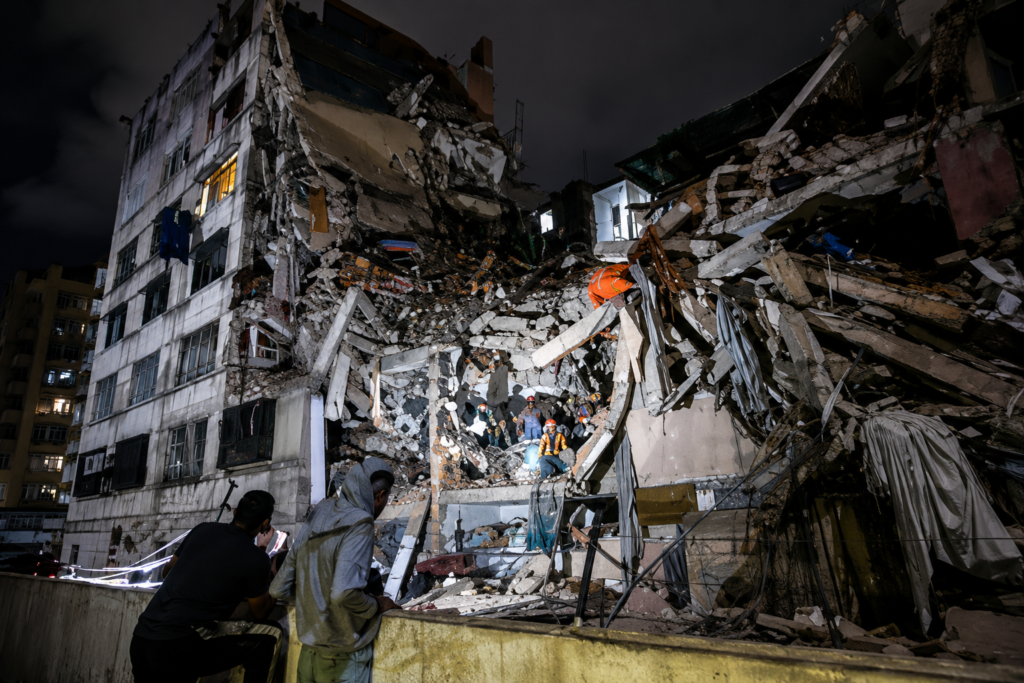
Venezuela is facing one of the worst natural disasters in its modern history after two powerful earthquakes struck the country’s northern coast within less than a minute, killing at least 589 people and injuring 2,980, according to acting President Delcy Rodríguez. Authorities say thousands remain unaccounted for as rescue workers continue digging through collapsed apartment towers, hospitals and government buildings across the country. The twin earthquakes, measuring 7.2 and 7.5 magnitude, hit just 39 seconds apart late Wednesday, causing widespread destruction in La Guaira and parts of the capital Caracas.
The disaster has triggered a major international response, with India launching Operation Amistad and deploying military medical teams, emergency supplies and a field hospital. At least 17 countries have now joined relief efforts as Venezuela enters a critical phase of rescue and humanitarian stabilisation. Officials have warned the death toll could rise sharply as more trapped victims are located.
Twin Quake Impact
The first earthquake struck off Venezuela’s northern coastline at a shallow depth, intensifying ground shaking in heavily populated areas. Less than a minute later, a stronger second quake struck the same region, creating what seismologists describe as an earthquake doublet.
This rare phenomenon significantly increased the destruction, as buildings weakened by the first tremor had no time to stabilise before the second impact.
The United States Geological Survey has classified it as one of the strongest seismic events to hit Venezuela in more than a century. More than 214 aftershocks have been recorded since the main quake, forcing thousands of survivors to remain in open spaces.
Emergency officials said the back-to-back impact caused immediate structural failures across La Guaira, where older buildings were especially vulnerable.
“The second shock intensified the collapse pattern across multiple urban zones,” a Venezuelan seismic official said during an emergency briefing.
Experts have warned that damaged structures remain unstable and could collapse if aftershocks continue.
La Guaira Devastation
La Guaira has emerged as the worst-hit region.
Satellite imagery released after the quake showed entire high-rise clusters reduced to rubble, fractured coastal roads and severe damage to port infrastructure. Thousands of displaced residents have set up temporary shelters in stadiums, schools and public parks.
Hospitals in the region are operating beyond capacity. Several medical centres suffered structural cracks, forcing emergency treatment to be shifted outside into temporary triage camps.
Caracas has also suffered major disruption, with power cuts, damaged water systems and intermittent communication blackouts reported across multiple districts.
Operations at Simón Bolívar International Airport were partially suspended after structural concerns were identified, slowing relief flights and evacuation efforts.
Eyewitnesses described scenes of panic and chaos.
“The building shook violently and then everything around us collapsed within seconds,” one survivor told local media.
Authorities estimate that over 3,000 families have been displaced.
India’s Operation Amistad
India has become one of the most visible international responders to the crisis.
Under Operation Amistad, two Indian Air Force C-17 aircraft have been dispatched carrying a 41-member Army medical team along with more than 35 tonnes of emergency aid. The cargo includes trauma kits, emergency medicines, portable ventilators, blood storage units and water purification systems.
The mission also includes a fully deployable military field hospital capable of performing emergency surgeries, intensive care and mass casualty treatment.
External Affairs Minister S. Jaishankar confirmed the deployment.
“India stands with the people of Venezuela in this difficult hour. Our teams are carrying urgent humanitarian and medical support,” Jaishankar said.
Prime Minister Narendra Modi also conveyed condolences and offered immediate assistance.
Acting President Rodríguez acknowledged India’s support.
“We thank India for its solidarity and swift response. This reflects true friendship in a moment of national pain,” she said.
Analysts say India’s quick deployment reflects its growing international disaster-response capacity following previous missions in Nepal, Turkey and Myanmar.
Global Response and Political Pressure
The earthquake has become the first major crisis for Rodríguez since taking office earlier this year following the removal of Nicolás Maduro.
In a televised national address, Rodríguez declared a state of emergency and ordered the militarisation of La Guaira to prevent looting and secure rescue corridors.
“Every institution of the Venezuelan state is focused on saving lives and restoring order,” she said.
The government also announced a $200 million emergency reconstruction fund aimed at rebuilding damaged infrastructure and housing.
International support has expanded rapidly. The United States has pledged $150 million in humanitarian aid, while China has announced immediate assistance.
Chinese President Xi Jinping said Beijing was prepared to support long-term reconstruction.
“China is prepared to provide all necessary humanitarian support and participate in rebuilding efforts,” Xi said.
The United Nations has deployed over 1,000 aid workers, while the Red Cross has delivered surgical kits, tents and emergency sanitation systems.
Search for Survivors
Rescue teams say the next 72 hours are critical.
Thermal scanners, acoustic sensors and sniffer dogs are being used to search for survivors trapped under debris. Emergency crews are working continuously despite unstable rubble and repeated aftershocks.
Officials estimate nearly 50,000 people remain unaccounted for, although communication outages may account for a large number of missing cases.
Structural engineers are inspecting hundreds of damaged buildings and warning that some could collapse even without additional seismic activity.
Experts say the high death toll was driven by three factors: the earthquake doublet effect, high population density near the impact zone and the structural weakness of older buildings.
Families remain gathered outside collapsed apartment blocks, waiting for news.
Across La Guaira, the sounds of rescue drills, sirens and search dogs continue through the night.
For Venezuela, the coming days will determine the full scale of the disaster. For India and the wider international community, the focus now remains on saving lives and preventing the humanitarian crisis from deepening further.


