

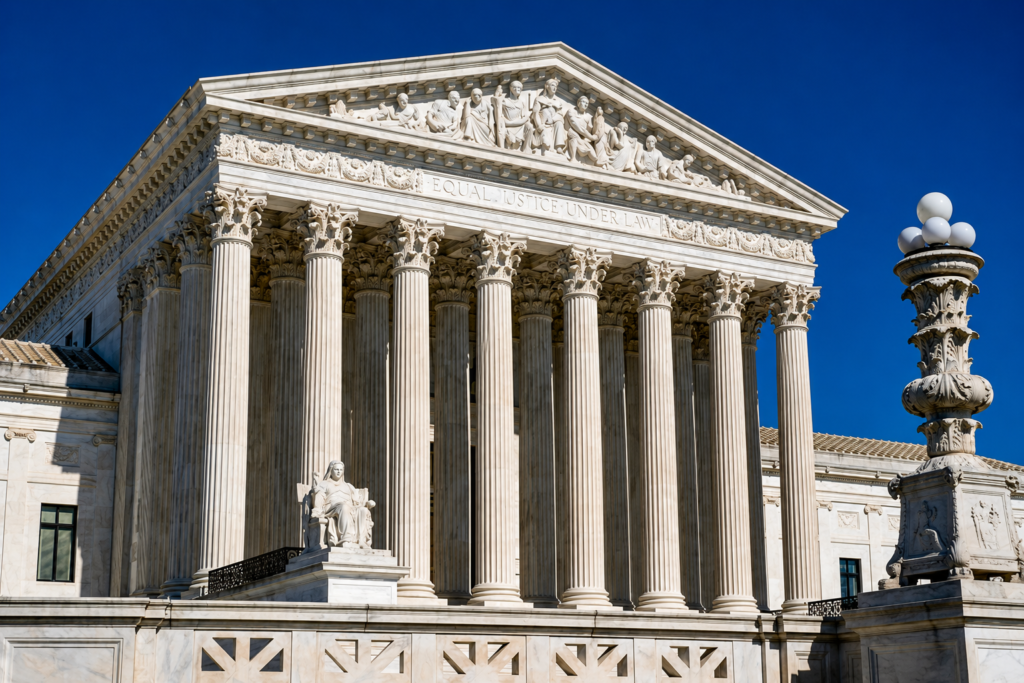
The United States Supreme Court has delivered one of the most significant constitutional rulings in recent years, striking down President Donald Trump’s attempt to limit birthright citizenship and setting off a wider political and legal debate over immigration, executive power and the meaning of American citizenship. The decision has preserved a constitutional principle that has stood for more than 150 years and has shaped the legal identity of millions of Americans.
In a 6-3 ruling, the court rejected Trump’s executive order that sought to deny automatic citizenship to children born on US soil if their parents were undocumented immigrants or temporary visa holders. The judgment not only reaffirms the long-standing interpretation of the 14th Amendment but also carries major implications for how federal courts can block presidential actions in the future.
The ruling comes at a time when immigration remains at the centre of US political discourse, with Trump making border security and citizenship reform key pillars of his second-term agenda. Legal analysts say the case, known as Trump v. CASA, could become one of the defining constitutional battles of the decade.
The Verdict
At the heart of the case was the Citizenship Clause of the 14th Amendment, ratified in 1868 after the Civil War. The clause states that all persons born or naturalised in the United States, and subject to its jurisdiction, are citizens.
The amendment was originally introduced to overturn the infamous Dred Scott decision of 1857, which denied citizenship to Black Americans and remains one of the darkest rulings in US legal history.
Trump’s administration argued that the phrase “subject to its jurisdiction” should not apply to children born to undocumented migrants or temporary visa holders. Government lawyers claimed that birthright citizenship had been interpreted too broadly for decades.
The Supreme Court disagreed.
Chief Justice John Roberts, writing for the majority, relied heavily on the 1898 United States v. Wong Kim Ark ruling, which established that nearly anyone born on US soil is entitled to citizenship regardless of their parents’ immigration status, except for limited categories such as foreign diplomats.
Roberts wrote, “The constitutional text leaves no room for executive reinterpretation where precedent has long settled the issue.”
Legal experts say the decision effectively closes the door on attempts to end birthright citizenship through executive action alone.
Immigration policy groups estimate that around 255,000 children are born each year in the United States to undocumented parents, meaning the ruling directly affects a large number of families.
Trump’s Order
Trump signed Executive Order 14160 on January 20, 2025, within hours of taking office for his second term.
The order instructed federal agencies, including the State Department and Department of Homeland Security, to deny citizenship documents such as passports and Social Security registrations to children whose parents did not hold permanent legal status.
The administration argued that the policy was designed to end what Trump repeatedly called “birth tourism” and prevent what he described as exploitation of American immigration laws.
During multiple campaign rallies, Trump said the US had become “the only country in the world giving away citizenship for free.”
That claim was heavily disputed by immigration experts, who note that more than 30 countries, including Canada and Mexico, have similar birthright citizenship laws.
Following the Supreme Court ruling, Trump sharply criticised the judgment.
“This decision protects a broken system, but we will continue this fight in Congress and beyond,” Trump said.
White House officials later confirmed that lawmakers aligned with Trump are preparing legislation to revisit citizenship standards.
The executive order had become one of the strongest symbols of Trump’s hardline immigration platform, alongside mass deportation proposals and expanded border enforcement.
Court Limits
Beyond the citizenship question, the ruling also delivered a major judgment on judicial power.
The Supreme Court ruled that lower federal courts had overreached by issuing nationwide injunctions that blocked Trump’s executive order across all 50 states.
This means district judges may now face tighter restrictions when attempting to halt executive orders on a national level.
Justice Amy Coney Barrett, whose opinion shaped much of this legal reasoning, wrote, “Federal courts must exercise authority within the bounds of the cases before them, not as supervisors of national policy.”
This part of the ruling could reshape how presidents exercise executive authority.
In recent years, both Democratic and Republican administrations have faced nationwide injunctions on immigration, healthcare and climate policies.
Legal scholars say limiting those injunctions could make it easier for future presidents to implement controversial policies before they are fully reviewed by higher courts.
Some constitutional experts have described this as one of the most powerful shifts in executive authority in decades.
Legal Fight
The original legal challenge was brought by Democratic-led states including Washington, New Jersey and Massachusetts, along with immigrant advocacy groups and civil liberties organisations.
They argued that Trump’s order would create legal chaos across hospitals, schools and welfare systems by leaving thousands of children without recognised citizenship.
The American Civil Liberties Union said the order was unconstitutional from the start and warned it could create a generation of children trapped in legal uncertainty.
Washington Attorney General Nick Brown called the ruling a major constitutional victory.
“The Constitution is not optional. It cannot be rewritten by executive order,” Brown said.
The court also made clear that broader challenges could continue through class-action lawsuits, allowing affected families to seek wider legal protection.
A temporary 30-day pause on enforcement remains in place, meaning the administration cannot immediately implement any revised version of the order.
That keeps the legal fight alive, even after the Supreme Court’s ruling.
What Next
The decision is expected to become a central issue in the 2026 midterm elections, with both Republicans and Democrats likely to use it as a rallying point.
Democrats hailed the ruling as a victory for constitutional rights and the rule of law.
Former House Speaker Nancy Pelosi said, “Birthright citizenship reflects the core promise of American democracy and equality.”
Conservative critics, however, argue the court missed an opportunity to revisit the original meaning of the 14th Amendment.
Justice Clarence Thomas, in dissent, wrote that the clause had been interpreted too broadly and deserved renewed constitutional scrutiny.
Justices Samuel Alito and Neil Gorsuch joined that dissent.
For now, the Supreme Court has made one thing clear.
Birthright citizenship remains protected.
But with Trump preparing a legislative push, conservative legal groups signalling fresh challenges and the court narrowing lower judges’ power to block presidential action, the national battle over immigration and citizenship is far from over.
The ruling may have settled one constitutional question for now, but it has opened another over how far presidential power can stretch in shaping America’s future.


