

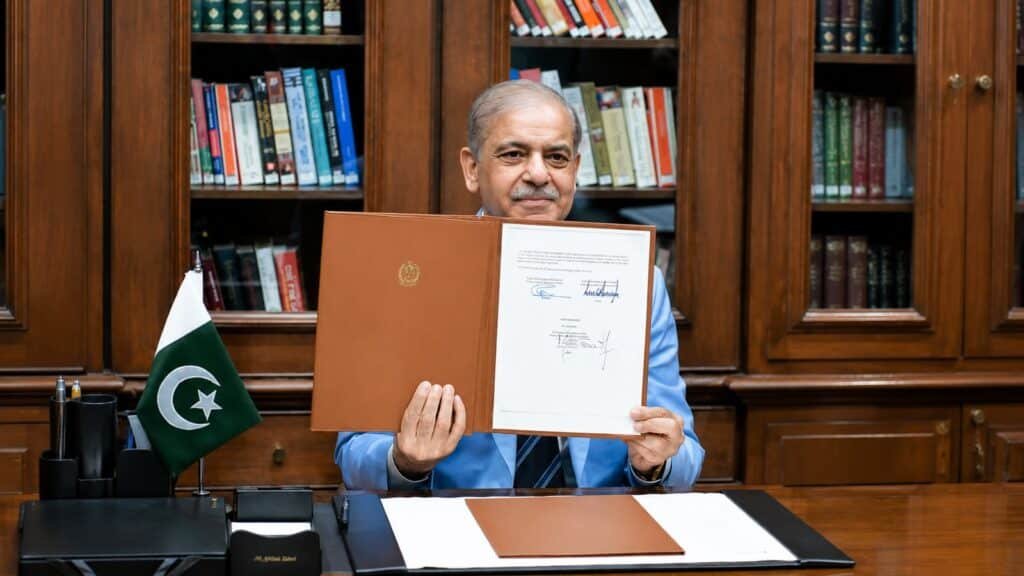
In one of the most consequential diplomatic developments in recent years, Pakistan Prime Minister Shehbaz Sharif has formally signed the Islamabad Memorandum of Understanding as guarantor to a breakthrough peace agreement between US President Donald Trump and Iranian President Masoud Pezeshkian. The move places Pakistan at the centre of a high-stakes geopolitical settlement that could reshape security calculations across the Middle East and directly influence global oil markets.
The agreement follows months of escalating military tensions between Washington and Tehran that brought the Gulf region dangerously close to wider conflict. The crisis had threatened the Strait of Hormuz, the world’s most vital oil transit route, sending fears through global markets and raising concerns over a prolonged energy shock. Now, with Pakistan stepping in as mediator and guarantor, the agreement is being seen as a critical effort to stabilise one of the world’s most volatile regions.
Diplomatic sources say secret backchannel talks began weeks ago in Muscat before being formalised under Pakistan’s supervision in Islamabad, adding an important but largely unreported layer to the negotiations.
The Deal
The Islamabad Memorandum is an interim peace framework designed to immediately stop hostilities and create a 60-day path toward a permanent agreement. Under the deal, both the United States and Iran have agreed to halt direct military operations and restore commercial security in the Strait of Hormuz.
The framework also includes phased sanctions relief for Iranian oil exports, gradual release of frozen Iranian assets, and renewed nuclear discussions under international supervision.
What makes this deal exceptional is Pakistan’s formal role.
As guarantor, Islamabad is now responsible for helping enforce communication between both sides, reducing the risk of sudden escalation and stepping in diplomatically if violations occur.
Shehbaz Sharif called the deal a “responsibility for peace”, saying, “Pakistan has stood for dialogue and stability. This agreement is a serious step toward preventing further destruction in the region.”
The formal naming of the agreement after Islamabad also underlines Pakistan’s central diplomatic role.
Trump’s Warning
For Donald Trump, the agreement represents a major political and strategic victory. His administration had increased military pressure on Iran in recent weeks, deploying naval assets and intensifying regional deterrence.
Trump framed the peace as proof that pressure worked.
That warning is one of the most critical parts of the framework.
US officials have confirmed that any breach by Iran could trigger an immediate return to military action, making the deal highly conditional.
At the same time, Washington has reportedly agreed to explore a reconstruction package for Iran worth up to $300 billion over the next several years, focused mainly on energy infrastructure and industrial recovery.
That proposal has already triggered criticism inside Washington, with opponents arguing it gives Tehran major economic breathing room without permanent guarantees.
Still, Trump’s team argues the deal prevented a wider war that could have severely disrupted global energy supplies.
Iran’s Terms
For Tehran, the agreement offers immediate economic relief at a critical time.
Years of sanctions, combined with war-related pressure and domestic inflation, have pushed Iran’s economy into severe strain. Restoring oil exports could provide billions in revenue and ease internal pressure.
But the deal also imposes temporary nuclear conditions.
Iran has agreed to freeze further uranium enrichment expansion while allowing existing stockpiles to remain under International Atomic Energy Agency oversight during the 60-day negotiation phase.
President Masoud Pezeshkian defended the agreement by saying, “Iran enters peace with dignity. We seek stability, but we will protect our sovereignty at every stage.”
That statement reflects the balance Tehran is trying to maintain.
Iranian hardliners remain suspicious that Washington could use the negotiation period to push for tougher restrictions on missiles and regional proxy groups.
That uncertainty makes the next two months highly sensitive.
Pakistan’s Risk
Pakistan’s role is now bigger than at any point in recent US-Iran diplomacy.
By becoming guarantor, Islamabad has effectively tied its own diplomatic credibility to the success of the agreement. This means if tensions rise again, Pakistan will likely be expected to intervene first.
Sharif acknowledged the pressure, saying, “Guaranteeing peace is never easy, but peace is always worth the burden.”
This role could significantly strengthen Pakistan’s strategic importance in Washington and Gulf capitals. It may also improve its influence in future regional security talks.
But the risks are equally serious.
If the agreement fails, Pakistan could face criticism from both sides and damage its standing as a neutral mediator.
Analysts say Islamabad’s ability to manage communication during the next 60 days will be crucial.
What Comes Next
Despite the breakthrough, the agreement leaves major questions unresolved.
Israel is not part of the memorandum, meaning the deal does not cover Israeli operations against Iranian-linked forces in Lebanon or Syria. That leaves one of the region’s biggest flashpoints untouched.
The next phase of negotiations is expected to take place in Switzerland, where both sides will attempt to convert the memorandum into a legally binding settlement.
Key issues include Iran’s long-term nuclear restrictions, ballistic missile limitations, sanctions timelines and verification mechanisms.
Oil markets are watching closely.
Nearly 20 per cent of global crude passes through Hormuz, and any sign of stability could ease price volatility. For countries like India, heavily dependent on imported oil, the agreement could offer economic relief if supply routes normalise.
For now, the Islamabad Memorandum has achieved what seemed impossible just weeks ago: a pause in one of the world’s most dangerous confrontations.
Whether it becomes a historic peace or only a temporary truce will depend on what happens next in Washington, Tehran and Islamabad.


