

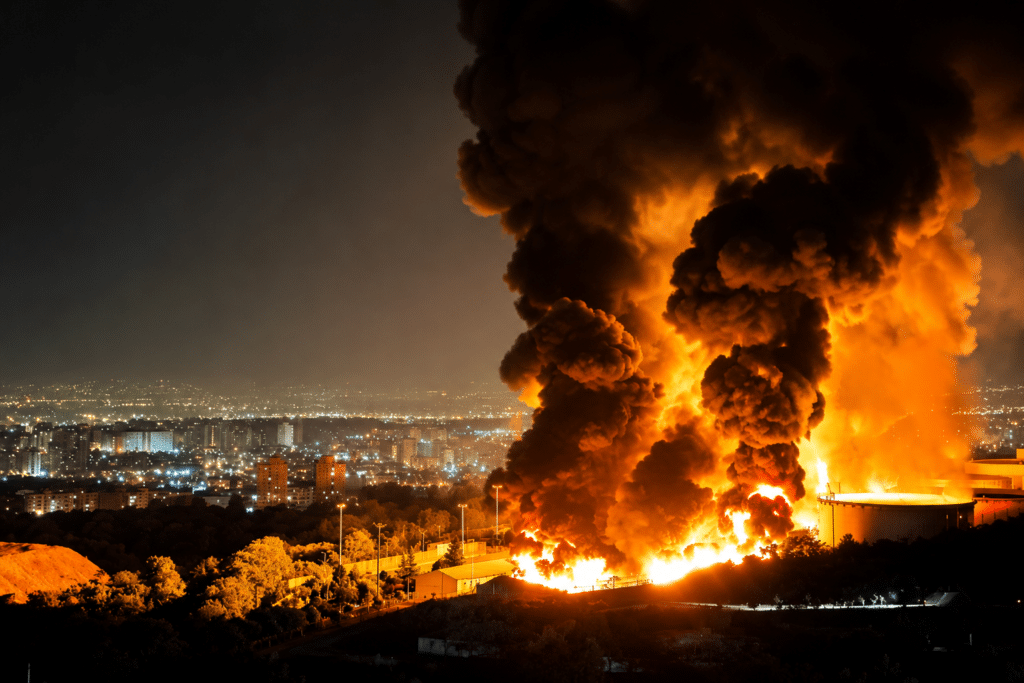
The United States has launched a second consecutive night of large-scale airstrikes against targets across Iran, pushing a fragile weeks-old peace process to the brink of collapse and dramatically escalating tensions across the Middle East. According to United States Central Command, American forces struck more than 170 military targets over a 48-hour period, with around 90 sites hit during the latest wave of attacks late on Wednesday after roughly 80 locations were targeted the previous night.
The renewed military campaign has severely disrupted commercial shipping through the Strait of Hormuz while raising serious concerns about the future of diplomatic negotiations aimed at securing a permanent peace agreement. The latest strikes stretched from Tehran to Iran’s southern coastline, focusing heavily on key port cities including Bandar Abbas, Jask, Chabahar, Kuhestak, Konarak, and Abu Musa Island. Explosions were also reported in Bushehr province, home to Iran’s only civilian nuclear power infrastructure. According to Iran’s Ministry of Health, the two days of airstrikes left at least 14 people dead and 78 others injured across five provinces, underscoring the growing human cost of the renewed conflict.
Strait of Hormuz
The immediate trigger for the renewed hostilities was a series of maritime incidents earlier in the week in the Strait of Hormuz. Washington accused Tehran of violating the interim memorandum of understanding signed on June 17 by attacking three commercial vessels navigating the strategic waterway. The ships involved were the Marshall Islands-flagged, Qatar-owned tanker Al Rekayyat, the Saudi Arabia-flagged Wedyan, and the Liberian-flagged Cyprus Prosperity.
In response, the United States revoked a key sanctions waiver on Iranian oil exports that had been one of the central incentives behind the June truce. According to TankerTrackers, Iranian authorities reacted by rapidly exporting nearly 10 million barrels of crude oil and fuel overnight in anticipation of renewed maritime restrictions. Shipping traffic through the Strait of Hormuz subsequently slowed to a near standstill, raising fresh concerns over global energy supplies and international trade.
Tehran-based analysts disputed Washington’s version of events, arguing that the commercial vessels may have unintentionally entered active maritime zones where Iranian naval teams were conducting mine-clearing operations. However, the White House viewed the incidents as a deliberate breach of the ceasefire. President Donald Trump reinforced that position by posting footage of explosions inside Iran on social media, warning, “This is in retribution for yesterday’s bombing of ships by Iran. If it happens again, it will get much worse.”
Transport Damage
The second wave of American strikes extended well beyond naval installations, causing significant damage to Iran’s transportation network. Iranian state media reported that cruise missiles destroyed two railway bridges on the main route linking Tehran with the northeastern city of Mashhad, forcing the national railway authority to suspend all passenger train services departing from the capital indefinitely while emergency repairs are carried out.
Among the major targets was the Ogtay Khan railway bridge in Golestan province, an important trade corridor connecting Tehran with China through Turkmenistan that has historically been used to move cargo during periods of Western maritime restrictions. Additional strikes hit airport infrastructure in Iranshahr near the Pakistani border, resulting in at least one confirmed fatality. Iran’s Mizan News Agency also confirmed that three members of the Islamic Revolutionary Guard Corps (IRGC) were among those killed. The attacks came during a sensitive period as millions of Iranians prepared for the final burial ceremonies of the late Supreme Leader Ayatollah Ali Khamenei at the Shrine of Imam Reza, further intensifying domestic tensions.
Regional Response
Iran responded by launching coordinated missile and drone attacks against military facilities hosting U.S. forces across several Gulf nations. Air defense sirens sounded in Bahrain, Kuwait, and Qatar as Iranian missiles and drones targeted American military assets, including Patriot missile defense systems, military facilities at Arifjan and Ali Al Salem in Kuwait, fuel depots in Bahrain, and a strategic satellite communications antenna in Qatar.
Kuwaiti defense officials said their air defense systems intercepted three ballistic missiles, one cruise missile, and ten suicide drones, although debris from the interceptions injured at least one civilian. The Islamic Revolutionary Guard Corps also announced that it had launched ten ballistic missiles toward the Azraq military base in Jordan, describing it as an American command-and-control center. Jordanian authorities reported intercepting eight incoming missiles before they reached their targets, preventing casualties inside the country.
Iranian military officials warned that any continuation of American airstrikes would significantly broaden Tehran’s military response, stating that if the “terrorist American army repeats its aggression, other American bases in the region will not be safe from our heavy fire.”
Peace at Risk
The latest escalation has placed the Pakistan-brokered peace process under severe strain. Under the memorandum of understanding signed in June, both sides had agreed to halt military operations across all active fronts, ease the U.S. naval blockade, and negotiate a permanent settlement during a 60-day diplomatic window scheduled to expire on August 21. Following the national mourning period for Ayatollah Ali Khamenei, negotiators had planned to begin discussions on the most contentious issues, including the future management of the Strait of Hormuz and the long-term status of Iran’s nuclear program.
However, the renewed fighting has cast serious doubt over whether those negotiations can continue. Speaking aboard Air Force One, President Trump questioned the viability of the diplomatic process, saying, “For me, I think it’s over,” while adding that although American diplomats would continue talks for the time being, “They can talk, but I think they’re wasting their time.”
Iran condemned the American air campaign as a “grave war crime” and submitted a formal complaint to the United Nations Security Council. Senior Iranian leaders also insisted that access to the Strait of Hormuz would not be dictated through Western military pressure. Parliament Speaker Muhammad Ghalibaf warned that “America still hasn’t learned that bullying and breaking promises are no longer cost-free. Let me put it plainly: if you strike, you’ll get hit,” while adding that “the Strait of Hormuz will only open with Iranian arrangements, not American threats.”
With both Washington and Tehran refusing to back down, commercial shipping through the Strait of Hormuz has nearly ground to a halt, military exchanges continue to expand across the Gulf, and the short-lived truce now appears to have given way to a highly volatile regional standoff, leaving the prospects for a lasting diplomatic settlement increasingly uncertain.


