

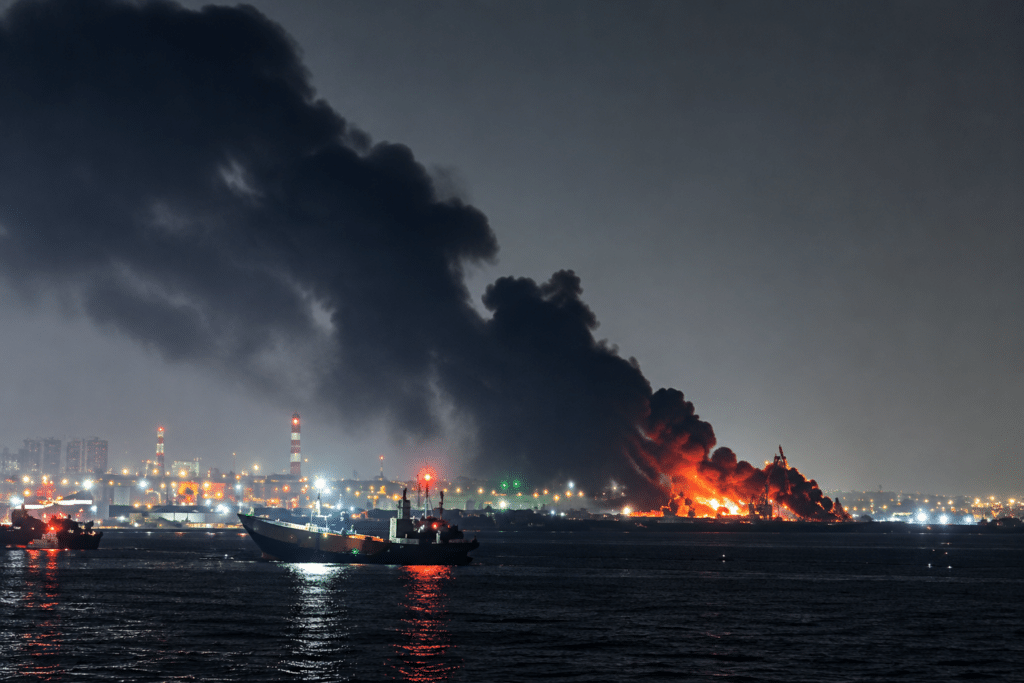
The United States has launched precision airstrikes on more than 80 locations across Iran following attacks on commercial vessels in the Strait of Hormuz. Alongside the military operation, the US Treasury Department revoked a key sanctions waiver that had allowed Tehran to sell crude oil on global markets. The combined military and economic response marks the most serious breakdown of last month’s ceasefire, raising fears of renewed conflict across the Middle East.
According to US Central Command, the overnight strikes targeted Islamic Revolutionary Guard Corps military assets used to threaten international shipping, including air defense systems, command-and-control networks, coastal radar sites, anti-ship cruise missile facilities, and more than 60 fast-attack boats near the Strait of Hormuz. US officials said the operation, carried out with precision munitions, was significantly larger than previous retaliatory strikes and aimed to cripple Iran’s ability to disrupt maritime trade.
Maritime Assaults
The sudden military action was initiated hours after three international commercial tankers were struck by projectiles and drones within a single day while transiting the vital energy corridor. The United Nations International Maritime Organization confirmed that this cluster of maritime assaults represents a severe escalation. The three commercial vessels hit during the coordinated maritime attacks were identified by naval tracking authorities as the Marshall Islands-flagged maritime tanker M/T Al Rekayyat, the Saudi Arabia-flagged M/T Wedyan, and the Liberian-flagged M/T Cyprus Prosperity.
The vessels were navigating a southern shipping route near the coast of Oman when they were struck. The Iranian state-run broadcaster reported that the Al Rekayyat tried to get through the waterway via the Oman route with the support of the US Navy but became the target of the attack after numerous warnings from coastal units. Qatar released an official diplomatic statement regarding the maritime disruptions, holding Iran legally responsible for the incident.
“The targeting of the Qatari vessel Al-Rekayyat while transiting near the Strait of Hormuz constitutes an unacceptable attack on the security and safety of international maritime navigation, the security of global energy supplies, and a grave and explicit violation of international law, particularly the rules guaranteeing freedom of navigation and safe passage through international waterways,” stated Majed Al Ansari, Advisor to the Prime Minister and official spokesperson for Qatar’s Ministry of Foreign Affairs.
Broken Truce
Iranian state media confirmed that the subsequent American retaliatory bombardment caused massive explosions across several southern coastal hubs and strategic islands, specifically near Bandar Abbas and Sirik. The military exchange represents a critical violation of the 60-day interim ceasefire agreement, known formally as the Islamabad Memorandum of Understanding, which was brokered in Switzerland last month between Washington and Tehran to halt the broader conflict that began in February.
US President Donald Trump, who arrived in Ankara for a critical NATO summit amid growing tensions with several European allies, issued a stern warning to the Iranian leadership from the summit venue.
“Iran has committed a terrible mistake by attacking these peaceful commercial vessels, and they are now seeing the full, unrestricted power of American military enforcement,” President Trump stated during a press briefing. “We signed a Memorandum of Understanding in good faith, but we made it absolutely clear that freedom of navigation is non-negotiable. If they break the truce, we will hit them eight times harder, and we will completely destroy their capacity to threaten global trade. The sanctions are back, the military is engaged, and we will not tolerate this lawless behavior in international waters.”
Military Retaliation
Following the US air raids, Iran escalated the conflict further by launching immediate retaliatory strikes against American military facilities located in neighboring Gulf countries. The Islamic Revolutionary Guard Corps confirmed it deployed an array of military drones and missiles targeting US forces stationed at the Sheikh Isa Air Base in Bahrain as well as sites inside Kuwait. Air raid sirens were activated across both countries as domestic air defenses successfully confronted the incoming missile and drone salvos.
The political atmosphere inside Iran remains volatile, as the ongoing tensions coincide with a period of intense public mourning and anger following the death of its former Supreme Leader, Ayatollah Ali Khamenei, who was killed during an earlier phase of joint military operations. Iranian authorities have insisted that any external European or American involvement in the administration of the channel constitutes a direct provocation, maintaining that Tehran holds exclusive rights over maritime security and transit rules within the strait.
Economic Penalties
The economic pressure on Tehran intensified simultaneously as the US Treasury Department revoked General License 10, the temporary sanctions waiver that allowed Iran to trade oil internationally. By stripping away this authorization, the United States has effectively blocked Tehran from legally clearing energy transactions through international banks, setting a strict 10-day compliance wind-down deadline for international buyers to terminate active purchases.
US oil prices jumped by nearly three percent in early financial trading on Wednesday as energy traders factored in a significantly tightened global supply and the potential for prolonged instability along the world’s most critical energy chokepoint.
“The US strikes are in response to Iranian attacks on three commercial vessels that were transiting the Strait of Hormuz,” read an official operational dispatch from US Central Command. “Iran’s demonstrated aggression was unwarranted, dangerous, and a clear violation of the ceasefire. The unwarranted aggression by Iranian forces is a clear and dangerous violation of the ceasefire and undermines freedom of navigation. CENTCOM forces remain postured and prepared to hold Iran accountable when the agreement is not adhered to or obeyed.”
Diplomatic Freeze
The diplomatic fallout from the dual military and economic actions has caused a total freeze in indirect negotiations, which had been occurring through international intermediaries. Iranian officials strongly rejected the Western narrative, accusing the United States of intentionally destroying the progress made under the Islamabad Memorandum of Understanding. Top Iranian negotiator and Parliament Speaker Mohammad Bagher Ghalibaf made a public statement via social media, condemning the re-establishment of the energy embargo and the heavy bombardment of southern Iranian territory.
“Major MOU Violations by the US: Violating Iranian adjustments in the Strait, persistent threats of further strikes, reinstating oil sanctions, attacks on southern Iran, continued Zionist aggression on Lebanon,” stated Mr. Ghalibaf in a formal declaration published online. “The era of bullying and extortion is over. It leads nowhere. We don’t fold.”
With commercial shipping volumes through the Strait of Hormuz already showing a sharp decline as international transport firms divert their fleets, security experts note that if the Islamabad Memorandum of Understanding collapses entirely, the region could face an unrestricted maritime conflict capable of permanently damaging global supply chains and driving energy costs to historic highs. The international community now faces the difficult task of restoring deterrence without triggering a full-scale regional war.


