

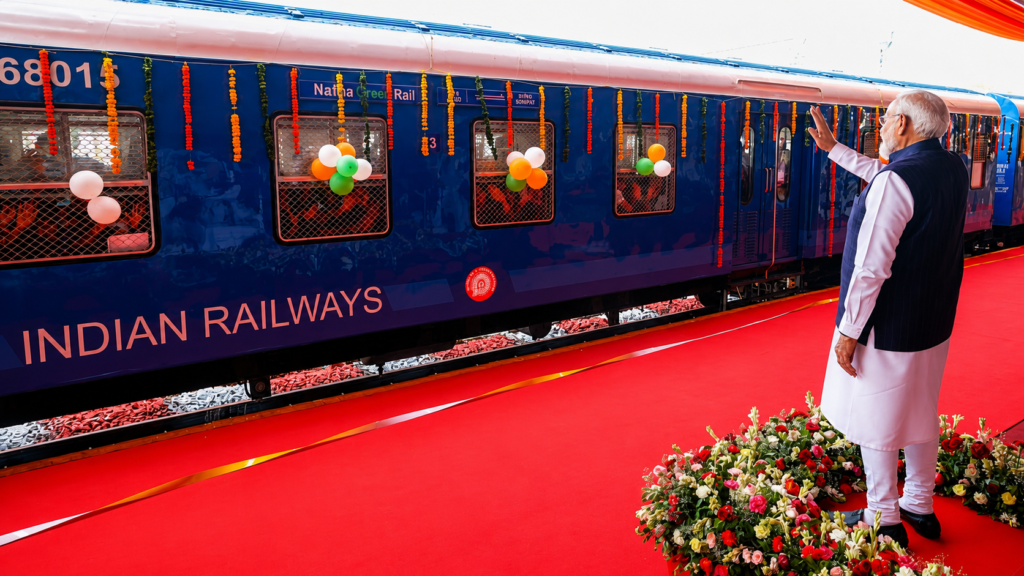
India took a historic leap towards sustainable transportation on Friday as Prime Minister Narendra Modi flagged off the country’s first hydrogen-powered passenger train between Jind and Sonipat in Haryana. The launch marks a major milestone in India’s clean energy transition and places the country among a select group of nations, including Germany, China, Japan and the United States, that have operationalised hydrogen fuel-cell technology for passenger rail services.
The inaugural service will operate along the 89-kilometre Jind-Sonipat corridor under Northern Railway, replacing diesel traction on a non-electrified route with an environmentally friendly alternative powered entirely by hydrogen fuel cells. The project is expected to serve as a pilot for wider deployment of hydrogen-powered trains across India’s railway network.
A New Chapter in Railway History
Addressing a large gathering at Jind railway station, Prime Minister Modi described the launch as a defining moment in India’s railway history and clean energy journey.
“If we look at the history of railways, the hallmark of the 19th century was the steam engine, the 20th century belonged to diesel and electricity, and now the 21st century belongs to hydrogen,” the Prime Minister said.
Drawing a historical comparison, he noted that just as the first railway journey between Bombay and Thane occupies a permanent place in Indian history, the names of Jind, Sonipat and Haryana would now be remembered as the birthplace of India’s hydrogen rail era.
Mr Modi said the project reflected the government’s vision of combining Make in India, Atmanirbhar Bharat, and the country’s ambitious green energy transition through indigenous technological innovation.
The launch was also accompanied by the inauguration and foundation laying of development projects worth over ₹14,000 crore across Haryana, covering railway infrastructure, highways, urban development and public utilities.
Why It Is a Landmark for Indian Railways
India’s first hydrogen-powered passenger train is more than just a technological demonstration. It represents one of the country’s most ambitious attempts to decarbonise rail transportation while reducing dependence on imported fossil fuels.
Indian Railways already operates one of the world’s largest electrified railway networks, with more than 99% of its broad-gauge network electrified. However, extending overhead electric infrastructure to remote, low-density, ecologically sensitive and heritage railway lines remains technically challenging and financially expensive.
Hydrogen-powered trains are intended to bridge this gap by offering a zero-emission alternative on routes where conventional electrification is not practical.
The Railway Ministry plans to deploy nearly 35 hydrogen-powered trains under its Hydrogen for Heritage initiative, including on scenic mountain railways such as the historic Kalka-Shimla route, replacing ageing diesel locomotives operating in environmentally sensitive regions.
How the “Water Train” Works
Among local residents gathered along the railway tracks, the new service has already earned the nickname “the train that runs on water.”
The description stems from the fact that the train’s only direct emission is water vapour.
Unlike diesel locomotives that burn fossil fuels or electric trains that draw power from overhead wires, the hydrogen train generates electricity onboard through a Proton Exchange Membrane (PEM) fuel-cell system.
Compressed hydrogen gas stored in high-pressure roof-mounted cylinders combines with oxygen drawn from the surrounding air inside the fuel cells. The resulting electrochemical reaction generates electricity that powers the train’s traction motors.
The system also charges Lithium Iron Phosphate (LFP) batteries, which provide additional power during acceleration and peak operating conditions.
Because the process relies on chemical conversion rather than combustion, the train produces no smoke, no carbon dioxide, no particulate pollution and no harmful exhaust gases. The only by-products released are water vapour and heat, making hydrogen one of the cleanest propulsion technologies currently available for rail transport.
The World’s Most Powerful Hydrogen Train
Officials say India’s hydrogen train also stands apart because of its scale.
During the launch, Prime Minister Modi described it as the world’s most powerful hydrogen-powered passenger train, highlighting its significantly larger capacity compared with hydrogen trains currently operating in several European countries.
The train consists of:
- Two hydrogen-powered driving power cars
- Eight passenger coaches
- Capacity for approximately 2,600 passengers
- Design speed of 110 kmph
- Operational pilot speed of 75 kmph
The train will initially operate as a daily passenger service between Jind and Sonipat, departing Jind in the morning and serving multiple rural and semi-urban stations along the route. Passenger fares have been kept highly affordable, ranging from ₹5 to ₹25, making the service accessible to daily commuters.
Building India’s Hydrogen Ecosystem
To support the new service, Indian Railways has established a dedicated hydrogen production and refuelling ecosystem at Jind.
The depot includes a specialised hydrogen refuelling station capable of storing approximately 3,000 kilograms of compressed hydrogen, along with dedicated safety systems designed specifically for railway operations.
Officials said the train underwent extensive technical validation before receiving operational clearance, including emergency braking trials, radio-frequency compatibility tests and comprehensive safety evaluations. Independent certification was also carried out by internationally recognised testing agencies to ensure compliance with global safety standards.
The hydrogen infrastructure developed for the Jind project is expected to serve as a model for future hydrogen rail operations elsewhere in the country.
Supporting India’s Green Hydrogen Mission
The launch aligns closely with the National Green Hydrogen Mission, one of the government’s flagship programmes aimed at making India a global hub for the production and use of green hydrogen.
The initiative supports India’s broader commitment to achieve net-zero carbon emissions by 2070 while strengthening domestic manufacturing and reducing dependence on imported fossil fuels.
Speaking at the ceremony, Prime Minister Modi also linked hydrogen technology with India’s long-term energy security. He observed that global conflicts and disruptions to major oil shipping routes have repeatedly exposed the risks associated with dependence on imported fuel.
He noted that before the rapid electrification of Indian Railways over the past decade, such global fuel disruptions could have severely affected railway operations because of the network’s heavy reliance on diesel locomotives. Hydrogen and renewable energy, he said, would help make India’s transport system more resilient in the future.
Joining an Exclusive Global Club
With the launch of the Jind-Sonipat service, India joins a small group of countries that have successfully introduced hydrogen-powered passenger trains.
Germany was among the earliest adopters of commercial hydrogen rail technology, while China, Japan and the United States have also developed hydrogen-powered train systems for selected routes.
India’s entry into this group reflects not only its growing technological capabilities but also its ambition to become a manufacturer and exporter of advanced hydrogen mobility technologies under the Make in India programme.
The Road Ahead
While Friday’s inauguration marks a historic milestone, railway officials acknowledge that hydrogen rail technology is still at an early stage of commercial deployment.
Scaling the technology nationwide will require continued investment in hydrogen production, storage infrastructure, refuelling facilities and workforce training. The long-term success of the programme will also depend on expanding the availability of affordable green hydrogen produced using renewable energy sources.
Nevertheless, the successful launch of India’s first hydrogen-powered passenger train signals a major shift in the country’s transportation strategy.
As the inaugural service begins regular operations between Jind and Sonipat, it represents far more than a new railway route. It demonstrates India’s determination to build a cleaner, technologically advanced and energy-secure transport system while moving closer to its long-term climate commitments.
For Indian Railways, which carries more than 20 million passengers every day, the hydrogen train is not just an engineering milestone but a glimpse into the future of sustainable public transport.


