

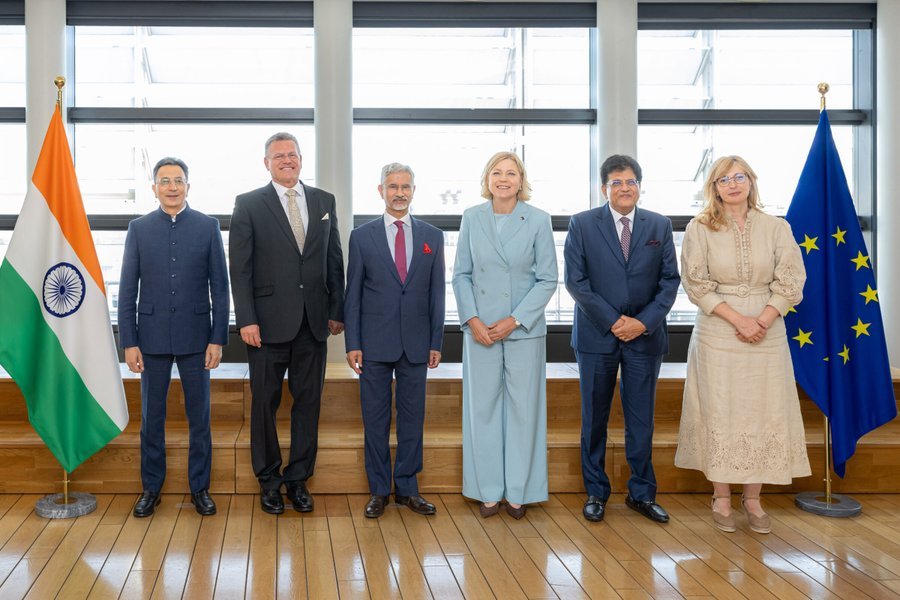
India and the European Union reaffirmed their commitment to strengthening economic, technological and strategic cooperation at the third ministerial meeting of the India-EU Trade and Technology Council (TTC), marking another significant step in a partnership that has rapidly expanded beyond trade into critical technologies, research, supply chain resilience and maritime security.
The meeting, held in Brussels, built on the momentum generated by the India-EU Summit in New Delhi earlier this year and reflected the growing convergence between the two partners as geopolitical tensions, supply chain disruptions and technological competition continue to reshape the global economy. Ministers from both sides reviewed progress made under the TTC and adopted an ambitious action plan for 2026-27 to accelerate cooperation across trade, investment, innovation and strategic security.
FTA Marks a Milestone
One of the central themes of the meeting was the recently concluded India-EU Free Trade Agreement (FTA), which leaders described as a defining milestone in bilateral relations. Addressing the media after the ministerial discussions, Union Commerce and Industry Minister Piyush Goyal said 2026 had become a historic year for India-EU ties, noting that the agreement represented a balanced outcome for both economies. “We concluded the mother of all trade deals, as Her Excellency Ursula von der Leyen called the EU-India Free Trade Agreement. This free trade agreement is fair, equitable and balanced, truly a win-win agreement for EU businesses, India businesses and the people of India,” he said.
Goyal added that Prime Minister Narendra Modi views the agreement as a partnership designed to deliver global public good rather than simply expanding bilateral commerce. He said both sides had agreed to align their policy frameworks to facilitate investments and would finalise a joint work programme on Foreign Direct Investment (FDI) screening to improve transparency and investor confidence. The discussions also reaffirmed a shared commitment to increasing bilateral trade and encouraging greater investment flows by creating predictable regulatory frameworks and strengthening institutional cooperation.
The FTA is expected to unlock new opportunities across manufacturing, services, digital trade and sustainable industries, while giving businesses on both sides greater market access. Officials also described the agreement as a foundation for broader economic cooperation, complementing the TTC’s work on technology and innovation.
Expanding the Technology Agenda
Beyond trade, the TTC continued to position itself as the primary platform for India and the EU to shape cooperation in advanced technologies. A major outcome of the meeting was the launch of formal negotiations for India’s association with Horizon Europe, the European Union’s flagship research and innovation programme. The two sides have set a target of completing the negotiations before the end of 2026, a move expected to provide Indian researchers, universities and technology companies greater access to collaborative research funding and innovation networks across Europe.
The ministers also unveiled several initiatives aimed at strengthening industry-to-industry collaboration. These include the establishment of the first EU-India Innovation Hub, which will focus on testing and standardising electric vehicle charging technologies, and the launch of the EU-India Startup Partnership to connect startups working in deep-tech and clean technology sectors.
The meeting also recorded progress in strategic areas such as semiconductors, high-performance computing, artificial intelligence, quantum technologies, digital public infrastructure and next-generation 6G communications. Highlighting the expanding scope of the technology partnership, Goyal said the discussions demonstrated a shared commitment to innovation-led growth. “Today’s discussions reaffirmed our shared vision for an innovation-driven, trusted and future-ready growth partnership. The progress achieved in areas such as semiconductor cooperation, artificial intelligence, high-performance computing and digital public infrastructure demonstrates the potential of our partnership,” he said.
The initiatives are expected to encourage greater collaboration between academic institutions, research organisations, startups and private industry, while also supporting efforts to establish common standards for emerging technologies. Officials said the focus would remain on translating research partnerships into commercially viable innovation.
Security Takes Centre Stage
The discussions also reflected the changing geopolitical environment in which the TTC now operates. Originally conceived as a platform for trade and technology cooperation, the council has increasingly assumed a strategic dimension as India and the European Union seek to reduce vulnerabilities in critical supply chains while responding to growing instability in several regions.
External Affairs Minister Dr. S. Jaishankar held separate meetings with European Council President Antonio Costa and European Union High Representative for Foreign Affairs and Security Policy Kaja Kallas, where the leaders exchanged views on regional conflicts, maritime security and economic resilience. In a social media post following the meetings, Jaishankar said the discussions acknowledged the substantial progress achieved since the India-EU Summit and emphasised the importance of maintaining momentum across trade and technology cooperation. Referring to his discussions with Kallas, he said, “Had useful discussions on West Asia and the need to ensure peace and stability. Exchanged views on the importance of safe and unimpeded maritime commerce.”
Maritime security emerged as another key pillar of the partnership. With global trade increasingly affected by disruptions in major shipping routes, both sides underscored the need to preserve freedom of navigation and strengthen coordination in the Indo-Pacific. Kaja Kallas described the current year as a turning point in India-EU relations, saying cooperation was expanding across trade, technology, security and defence. She added, “Together, we must defend freedom of navigation, protect open and resilient supply chains, as well as deepen cooperation between EU operations ATALANTA and ASPIDES and the Indian Navy to uphold security in the Indo-Pacific and beyond.”
The discussions also highlighted the importance of resilient logistics networks and secure maritime corridors in supporting global economic recovery. Both sides agreed that closer coordination on regional security would complement their expanding economic and technological partnership.
Backing a Rules-Based Order
The meeting also addressed broader concerns surrounding the global trading system. Ministers acknowledged that the international economic landscape continues to face significant uncertainty because of geopolitical fragmentation, protectionist tendencies and disruptions affecting critical supply chains. Against this backdrop, India and the European Union reiterated their support for a rules-based, open and non-discriminatory multilateral trading system anchored in the World Trade Organization.
Both sides agreed to intensify cooperation in reducing excessive dependence on single-source suppliers for strategically important sectors. Discussions covered collaboration in critical raw materials, resilient agri-food supply chains and active pharmaceutical ingredients, reflecting a broader effort to diversify production networks while ensuring long-term economic security.
The ministers also discussed the need for greater cooperation in strengthening global supply chains for critical technologies and industrial inputs. As governments around the world pursue economic de-risking strategies, India and the EU signalled that their approach would focus on diversification, trusted partnerships and transparent global trade practices rather than protectionism.
From Dialogue to Delivery
The adoption of the TTC Action Plan for 2026-27 marked another important outcome of the Brussels meeting. The roadmap outlines concrete deliverables across trade, investment, digital technologies, research collaboration and strategic resilience, signalling a shift from policy dialogue towards implementation-oriented cooperation. Officials from both sides indicated that future TTC meetings will place greater emphasis on measurable outcomes, industry partnerships and joint research initiatives.
The third ministerial meeting underscored how the India-EU relationship has evolved into a comprehensive strategic partnership that extends well beyond conventional trade negotiations. With the Free Trade Agreement concluded, Horizon Europe negotiations underway and cooperation expanding across emerging technologies and security, the TTC is increasingly becoming the principal mechanism through which India and the European Union are shaping a long-term partnership built on economic resilience, technological innovation and shared strategic interests.
As both sides navigate an increasingly uncertain global environment, the outcomes of the Brussels meeting signal a clear intent to translate political commitment into practical cooperation. The combination of a landmark trade agreement, deeper scientific collaboration, coordinated security engagement and a forward-looking implementation roadmap suggests that the India-EU partnership is entering a new phase, one defined not only by shared ambitions but also by concrete action across some of the world’s most strategically important sectors.


