

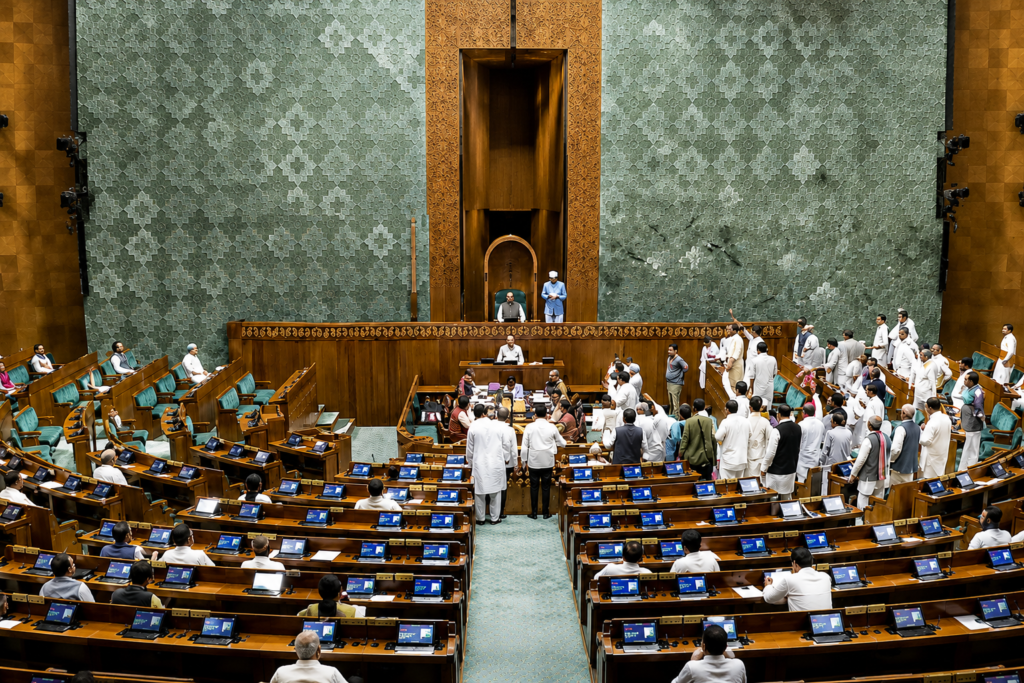
The Centre introduced the Public Examinations Prevention of Unfair Means Amendment Bill, 2026 in the Lok Sabha on Monday, proposing stiffer penalties and time bound trials for organised examination fraud, even as opposition members disrupted proceedings, forcing an adjournment till 2 p.m. The bill was cleared by the Union Cabinet on July 24 and comes just over a week after nationwide student protests over irregularities in the NEET UG 2026 examination brought the government’s handling of the issue under sustained scrutiny in both Houses. Its introduction marks the first legislative response since Union Education Minister Dharmendra Pradhan’s resignation on July 25 and Prime Minister Narendra Modi’s weekend announcement of a high powered task force to overhaul the examination system, and follows a Monsoon Session that had, until Monday, seen little else beyond repeated adjournments over the same controversy.
Union Minister of State Jitendra Singh moved the bill for introduction, consideration and passage. It amends the Public Examinations Prevention of Unfair Means Act, 2024, the law enacted after the 2024 NEET UG paper leak controversy, following renewed public anger over irregularities in the NEET UG 2026 examination.
What the amendment changes
Under the existing 2024 law, individuals convicted of unfair means face three to five years in prison. Those linked to organised cheating rackets face five to ten years and a minimum fine of one crore rupees. The 2026 amendment raises the financial penalty for organised syndicates to a maximum of ten crore rupees while retaining the ten year jail ceiling.
The bill introduces seven amendments in total, five of which have been detailed so far. Chief among them, every state and Union Territory will be empowered to designate any Court of Session as a Fast Track Court dedicated to paper leak cases. These courts are required to conduct day to day hearings, with trials expected to conclude within three months of the chargesheet being filed. A separate provision sets a two month deadline for police, central agencies or Special Task Forces to complete their investigation, aimed at preventing the procedural delays that have historically let such cases languish.
The bill also allows the Central government to constitute a Special Task Force to investigate paper leak cases wherever it deems necessary, a provision specifically aimed at rackets that operate across state lines, where jurisdictional handoffs between different state police forces have previously slowed down cases. States and Union Territories will additionally be authorised to appoint specialised legal counsel dedicated to prosecuting examination malpractice cases, rather than relying on general public prosecutors already stretched across unrelated criminal matters.
On penalties, the amendment enhances both the terms of imprisonment and the financial penalties applicable to individuals, coaching centres and service providers found guilty of organised paper leaks. The fine for organised syndicates rises from a minimum of one crore rupees under the 2024 Act to a ceiling of ten crore rupees, while the maximum jail term of ten years remains unchanged. Officials have indicated the amendments are designed to hit organised networks financially rather than only through imprisonment, since fines that fall well short of the money involved in a leak have previously done little to deter the rackets running them.
Uproar in the House
Proceedings were disrupted soon after the bill was introduced, with opposition members raising slogans over the alleged police action against students during the Cockroach Janata Party led march to Jantar Mantar on July 20. The march had been organised to demand accountability over the NEET UG 2026 leak and had drawn students from across the country before it was met with police restrictions.
The disruption came days after Union Education Minister Dharmendra Pradhan resigned from his post on July 25, a resignation opposition parties had been demanding through the march and subsequent protests. Pradhan, returning to Parliament on Monday, was greeted with slogans of his name by supporters. Prahlad Joshi took charge of the Education Ministry on Sunday. Speaking after being handed the portfolio, Joshi said, “I accept it with humility and a deep sense of duty.”
Lok Sabha Speaker Om Birla appealed to members to let the House take up the bill, noting that a discussion on paper leaks had been a long standing opposition demand. He said the government was open to incorporating suggestions raised during the debate and urged members against disrupting proceedings.
Parliamentary Affairs Minister Kiren Rijiju made a similar appeal ahead of the bill’s introduction, telling opposition benches that boycotting the debate over “a concrete Bill” meant to tackle paper leaks “will not send out a good message.”
Opposition response mixed
The opposition’s position on the substance of the bill remained undecided through the day. Congress MP Karti Chidambaram raised concerns that the amendment focused largely on punishment after a leak had already occurred rather than on preventing leaks at the source, such as during the drafting or printing of question papers.
Samajwadi Party Rajya Sabha MP Ram Gopal Yadav raised a similar point ahead of the bill’s introduction, arguing that stricter laws alone may not be sufficient and that leaks typically occur “where the paper is drafted, where it is printed,” pointing to gaps earlier in the examination process rather than at the punishment stage.
Not all opposition voices were critical of the process. An MP from West Bengal, Sayoni Ghosh, told reporters, “From the start, we wanted to have a discussion on this,” adding that the opposition’s reluctance to engage in debate had been a point of concern for her party.
Congress Leader of the Opposition in the Lok Sabha, Rahul Gandhi, has not stated a final position on the bill, with the party indicating it would decide its stance after internal consultations.
Government’s messaging push
The bill’s introduction followed a weekend intervention by Prime Minister Narendra Modi, who announced a high powered task force on examination reforms led by Infosys co-founder Nandan Nilekani. The panel also includes former ISRO chairman S. Somanath, former Intelligence Bureau director Tapan Deka, IIT Madras director V. Kamakoti, former Education Secretary Anita Karwal and logistics expert Amrit Lal Meena. In a short video message posted on social media, Modi said those responsible for the leak were already facing consequences, stating that those who tampered with students’ futures “are languishing in jail.”
The ruling alliance has fielded a slate of younger MPs to lead the debate on the treasury benches, including the BJP’s Bansuri Swaraj and Tejasvi Surya, Shiv Sena’s Shrikant Shinde, JD(U)’s Rajiv Ranjan Singh, NCP’s Sunil Tatkare, Apna Dal’s Anupriya Patel and LJP (Ram Vilas)’s Arun Bharti, alongside TDP’s Lavu Sri Krishna Devarayalu, a lineup seen as part of the government’s outreach to younger voters following the student led protests.
What comes next
The Business Advisory Committee has allotted between four and eight hours for the debate, according to visitors briefed by parliamentary sources, though the final duration will depend on how much time is lost to adjournments through the day. The House resumed at 2 p.m. as scheduled, with the bill’s consideration and passage expected to follow the debate.
The Public Examinations Prevention of Unfair Means Amendment Bill, 2026 is one of several contentious items on the Monsoon Session’s agenda, which also includes the Supreme Court (Number of Judges) Amendment Bill, 2026, moved by Union Law Minister Arjun Ram Meghwal to raise the sanctioned strength of the Supreme Court from 33 to 37 judges, excluding the Chief Justice of India, and the Prevention of Insults to National Honour (Amendment) Bill, 2026, concerning statutory protection for the national song Vande Mataram, which Union Home Minister Amit Shah has already moved in the Rajya Sabha. The judges bill is likely to face its own resistance, with MPs Sougata Ray, N.K. Premachandran and Dean Kuriakose expected to move a statutory resolution disapproving the ordinance the President promulgated on the matter in May.
Given the ruling National Democratic Alliance’s numbers in the Lok Sabha, the paper leak bill is widely expected to clear both the consideration and passage stages once the debate concludes, much as the original 2024 Act did after the Opposition’s amendments were rejected during voting. Several other pending items, including legislation on taxation, higher education and institutional reforms, are still queued up for the remainder of the session, which runs across 19 sittings and is scheduled to conclude on August 13. Question Hour on Monday also saw Education Minister Prahlad Joshi field queries on the sector for the first time since taking charge, while Minister of State Suresh Gopi separately placed eight statements before the House on the implementation status of Standing Committee recommendations on petroleum and natural gas dating back to 2019.


