

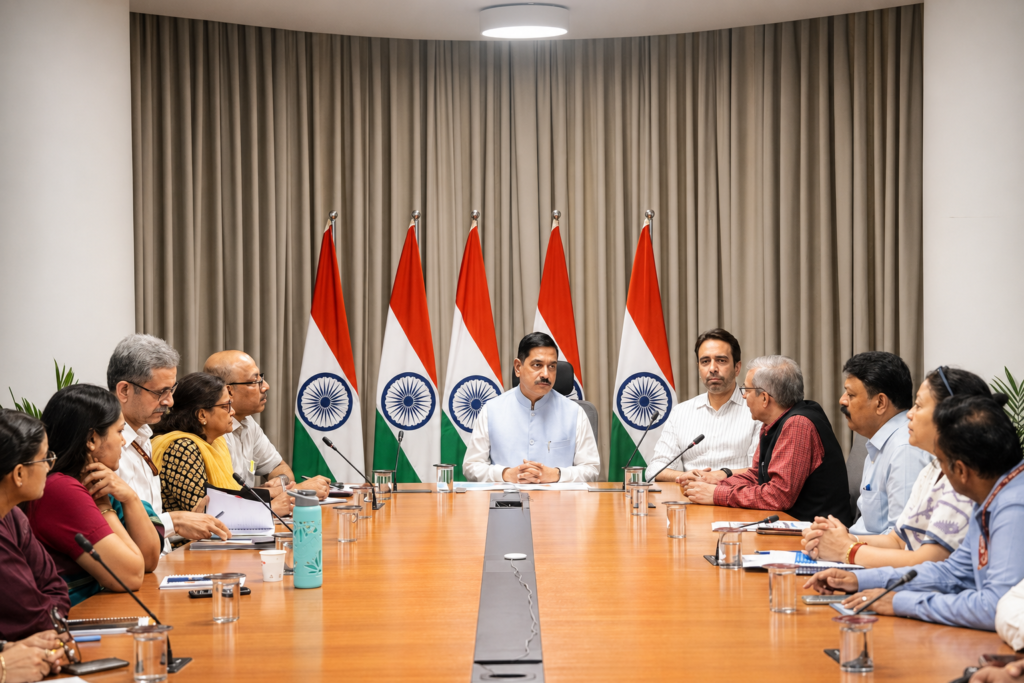
India has a new Education Minister. Pralhad Joshi, a five time BJP Member of Parliament from Dharwad in Karnataka, has been handed additional charge of the Ministry of Education after Dharmendra Pradhan stepped down amid the fallout from the NEET UG 2026 paper leak controversy. Joshi will continue to hold his existing portfolios of Consumer Affairs, Food and Public Distribution, and New and Renewable Energy while taking on the education brief, one of the most closely watched ministries in the current government.
The appointment comes at a turbulent moment for the ministry. The National Testing Agency, which conducts NEET UG and several other national entrance exams, has been under intense public and political scrutiny for weeks. Student protests, opposition attacks in Parliament and a Supreme Court monitored review of examination reforms have all added pressure on the government to act. Pradhan’s exit and Joshi’s swift elevation signal that the Centre wants a steady, experienced hand managing the ministry through the crisis.
Who Is Pralhad Joshi? Early Life and Education
Pralhad Venkatesh Joshi was born on November 27, 1962, in Vijayapura, formerly known as Bijapur, in Karnataka. He grew up in a modest household; his father worked with the Indian Railways. Joshi did his early schooling at a Railway school before moving to New English School in Hubballi. He went on to earn a Bachelor of Arts degree from K.S. Arts College, also known as Kadasiddeshwar Arts College, in Hubballi, which is affiliated with Karnataka University, Dharwad. He completed his graduation in 1983.
Unlike many of his cabinet colleagues, Joshi does not hold a postgraduate or professional degree. His political grounding instead came through years of organisational work. He became associated with the Rashtriya Swayamsevak Sangh at a young age and later moved into public life through party and community activities in North Karnataka, a region where he has remained politically rooted throughout his career.
A Five Time MP’s Long Political Journey
Joshi’s rise within the BJP has been built almost entirely through organisational work rather than state government service. He held responsibilities within the party’s Dharwad unit before being elected to the Lok Sabha from Dharwad for the first time in 2004. He has retained that seat in every general election since, winning in 2009, 2014, 2019 and again in 2024, making him one of Karnataka’s longest serving BJP parliamentarians.
Between his election wins, Joshi steadily climbed the party hierarchy. He served as General Secretary of the Karnataka BJP from 2006 to 2013 before being made the party’s state president in 2013. He entered the Union Cabinet in 2019 as Minister of Parliamentary Affairs, Coal and Mines, portfolios that gave him significant floor management experience in Parliament. After the 2024 general election, he was reassigned as Union Cabinet Minister for Consumer Affairs, Food and Public Distribution, along with New and Renewable Energy. The Education Ministry now becomes his latest, and arguably most sensitive, charge.
NTA Officials Summoned as Scrutiny of Exam Body Intensifies
Within days of taking over, Joshi moved to get a direct briefing from the agency at the centre of the controversy. He summoned officials of the National Testing Agency to his residence for consultations, a signal that he intends to personally assess the extent of the damage before the government’s next steps are finalised. The move follows a period in which the NTA has faced sustained criticism over lapses linked to the NEET UG 2026 examination.
The scrutiny has not been limited to the ministry alone. A Parliamentary Standing Committee on Education, Women, Children, Youth and Sports has separately summoned NTA leadership and senior Education Ministry officials to review the implementation of reforms recommended after earlier controversies surrounding national entrance tests. More than 47 officials linked to the agency have reportedly already been removed as part of a wider overhaul, and the government has indicated that NEET UG will shift to computer based testing from next year in an effort to reduce the risk of paper leaks.
Notably, none of the 41 questions listed for the Education Minister to answer in the Lok Sabha on Monday relate directly to the NEET question paper leak, even as the issue continues to dominate public conversation outside Parliament. That gap has already drawn attention, with critics questioning whether the government is keen to keep the most contentious exam related issue off the formal record inside the House while addressing it through administrative channels instead.
Key Challenges Awaiting the New Education Minister
Joshi’s most immediate task will be restoring public confidence in India’s examination system. The NEET UG controversy has raised uncomfortable questions about the security, transparency and fairness of high stakes national exams that determine the futures of millions of students each year. Simply announcing technological fixes or removing officials may not be enough. Joshi will need to demonstrate that structural reform within the NTA is genuine and lasting, rather than a temporary response designed to calm the immediate storm.
Beyond the exam crisis, Joshi inherits a ministry with a long list of unfinished business. The rollout of the National Education Policy 2020 remains incomplete in several states, and questions around curriculum reform, higher education access and vocational training continue to demand attention. He will also have to navigate parliamentary debates on a proposed law that seeks to impose stricter punishment for those found guilty of examination paper leaks, a bill that opposition parties are likely to use as another opportunity to press the government on its handling of the NTA.
Taking charge of the ministry, Joshi said he would work to the best of his ability and try to live up to the expectations set by Prime Minister Narendra Modi. Whether that translates into durable reform of India’s examination and education systems, or simply another chapter in a prolonged crisis of trust, will become clearer in the weeks ahead as Parliament, the courts and millions of anxious students keep a close watch on the ministry’s next moves.


