

India has firmly rejected criticism from US Congressman Riley Moore over the proposed Foreign Contribution (Regulation) Amendment Bill, 2026, asserting that the regulation of foreign funding is an internal matter under the jurisdiction of the Indian Parliament. Moore had raised concerns that the proposed changes could affect Christian organisations operating in India and potentially strain India-US relations.
The Ministry of External Affairs (MEA) maintained that India has the sovereign right to frame and amend its laws in accordance with national priorities and its constitutional framework. The government also stressed that the FCRA is aimed at ensuring transparency and accountability in the receipt and use of foreign contributions.
What The MEA Said
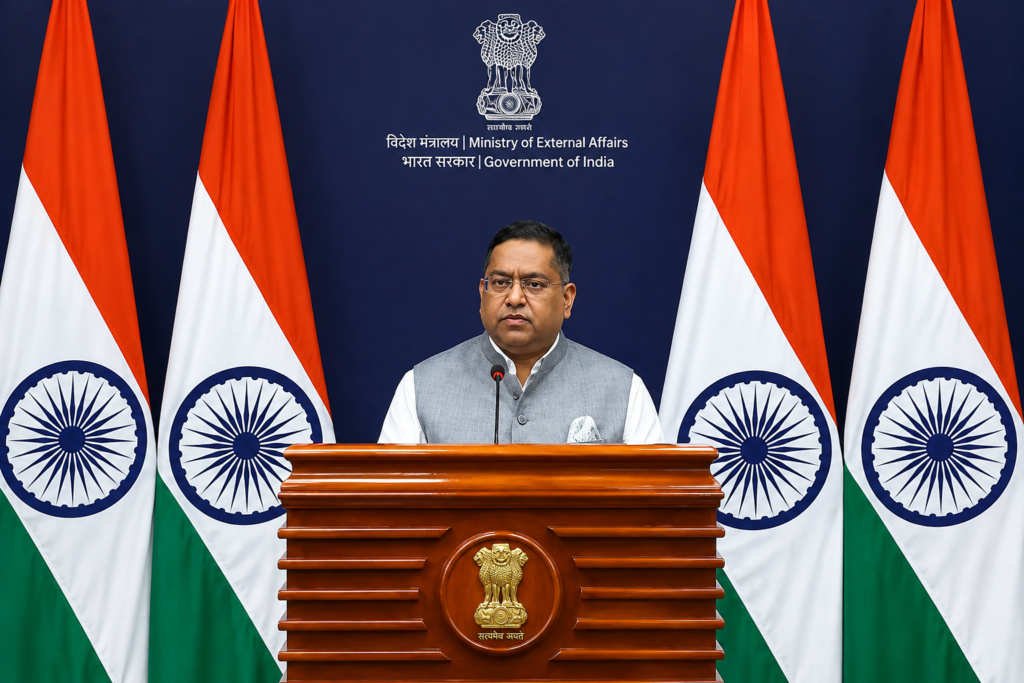
Speaking at a media briefing in New Delhi, MEA Spokesperson Randhir Jaiswal addressed the controversy directly, framing it as a matter of national sovereignty rather than an international concern.
He went further, pointing out that foreign fund regulation is not unique to India and that similar frameworks exist across the democratic world.
I would also like to tell you that there are several nations and countries in the world, including America, that regulate foreign funds and foreign contribution, he added.
The comments were seen as a calibrated but clear message to Washington that New Delhi does not welcome external commentary on its domestic policymaking, particularly on legislation still under parliamentary debate.
Background On The Congressman’s Remarks
The controversy began when Riley Moore took to social media to voice concerns over the proposed amendments to the FCRA. According to reports, Moore argued that certain provisions of the Bill could open the door to government intervention in the functioning of churches and religious charities across India.
Moore also acknowledged the long history of Christianity in India, tracing its roots back to the arrival of St Thomas the Apostle on the Malabar Coast centuries ago. Despite this, he expressed apprehension that the new legislation could disproportionately impact faith based organisations.
He cautioned that if the Bill proceeds in its current form, it could become a significant point of friction in the broader India US relationship, and urged the American administration to raise the issue with New Delhi, describing religious freedom as a value that should remain central to ties between the two nations.
Understanding The FCRA Amendment Bill 2026
The Foreign Contribution (Regulation) Amendment Bill, 2026 was introduced in the Lok Sabha on March 25 and is scheduled to come up for discussion in Parliament on August 12. The legislation seeks to strengthen the regulatory framework governing how non governmental organisations and other entities receive and use funds from overseas sources.
Among its more debated provisions is a proposal to empower the central government to appoint a designated authority. This authority would oversee foreign contributions and any assets created from such funds in cases where an organisation’s FCRA registration has been cancelled, surrendered, or allowed to lapse.
Importantly, the Bill also includes a safeguard clause. If the assets in question include a place of worship, the designated authority is required to preserve its religious character. At the same time, the proposed law seeks to reduce the maximum penalty for certain statutory violations, bringing it down from five years of imprisonment to one year.
Union Home Minister Amit Shah has also weighed in on the matter, clarifying during interactions in Mizoram that the FCRA amendments, once passed, would not apply retrospectively, addressing one of the key concerns raised by civil society groups.
Domestic Reactions To The Bill
The proposed amendments have not only drawn attention from abroad but have also sparked debate within India. Union Minister Kiren Rijiju, during a visit to Kerala, said that any misunderstandings surrounding the Bill would be addressed and that organisations genuinely working for the country’s welfare would not face disruption.
Rijiju also stated that concerns raised by Christian missionary groups would be taken into account as the legislation moves forward. He accused certain opposition parties of spreading misinformation about the Bill for political gain, while reaffirming that all foreign contributions entering India are subject to regulation under the existing FCRA framework.
Civil society organisations, including international rights groups, have separately voiced apprehension that tighter restrictions under the amended Act could further limit the operational space for non governmental organisations that depend on international funding for their work.
A Pattern Of Pushback On Foreign Criticism
This is not the first time the Ministry of External Affairs has taken a firm stance against international commentary on India’s internal legislative processes. Similar responses have previously been issued in relation to laws such as the Citizenship Amendment Act, where the ministry maintained that such matters fall squarely within India’s sovereign right to legislate.
The consistent position taken by New Delhi reflects a broader diplomatic approach, one that draws a clear line between routine engagement with foreign governments and what it considers unwarranted interference in matters that are constitutionally the domain of the Indian Parliament.
What lies Ahead
With the Bill set to be taken up for discussion in Parliament on August 12, attention will now shift to how the debate unfolds domestically. Lawmakers, religious organisations, and civil society groups are expected to present their views during the parliamentary session, while the government is likely to continue defending the legislation as a necessary step to strengthen transparency in the use of foreign funds.
For now, the Ministry of External Affairs has made its position unambiguous. India intends to legislate on its own terms, and any external commentary, however well intentioned, is unlikely to alter the course of a Bill that New Delhi insists is entirely a matter for its own Parliament to decide.
The episode also highlights the delicate balance both countries continue to navigate as they deepen cooperation across trade, defence, and technology while occasionally clashing over questions of sovereignty and internal governance. Diplomatic observers note that such exchanges, while sharp in tone, rarely disrupt the broader trajectory of India US relations, which have grown steadily over the past decade.
As the August 12 parliamentary session approaches, both supporters and critics of the Bill are expected to intensify their public messaging. For religious organisations operating in India, the outcome of the debate could shape how they manage foreign funding in the years ahead, making this one of the more closely watched legislative moments of the year.


