

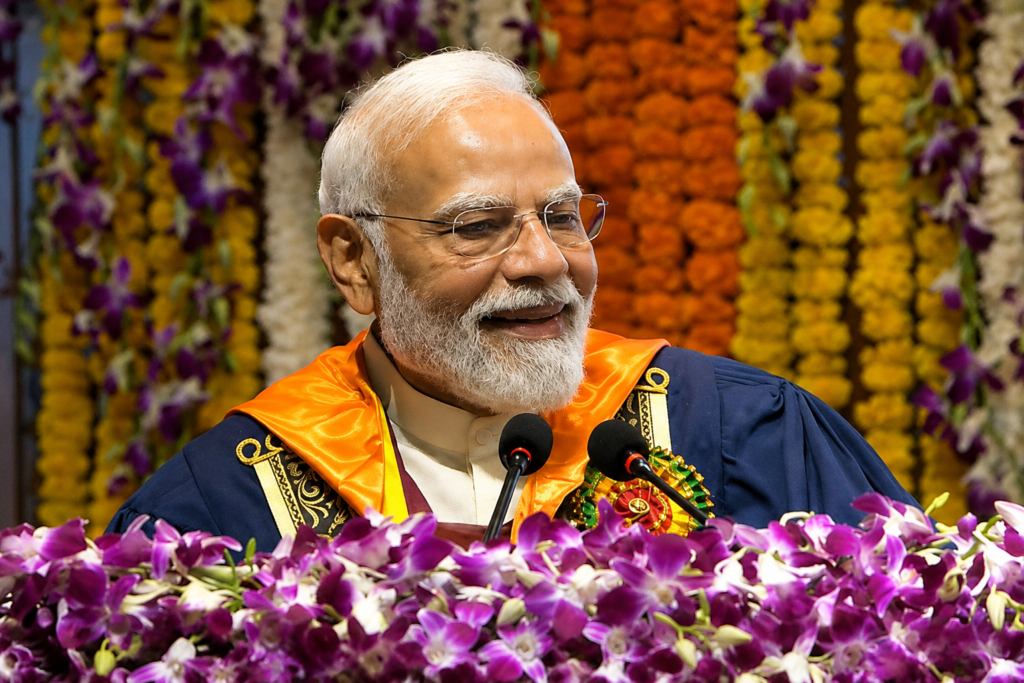
Prime Minister Narendra Modi on Saturday addressed the 57th convocation ceremony of the Indian Institute of Technology (IIT) Delhi, urging graduating students to keep the national interest at the heart of their career decisions. Speaking as the chief guest at the ceremony, Mr Modi asked students to constantly reflect on how their work and choices could benefit the country and address its emerging needs.
The convocation saw more than 3,000 students, including 587 PhD scholars, conferred their degrees. This year’s batch also included the first graduating cohorts of the Bachelor of Design programme, the Executive MBA, and the MSc in Biological Sciences, marking a significant academic milestone for the institute.
Every Generation Carries Its Own National Responsibility
During his address, the Prime Minister said that every generation faces distinct challenges shaped by its own era, and each carries a responsibility toward the nation that is unique to its time. He told the graduating students that the work they undertake over the next 30 to 35 years will play a defining role in shaping India’s journey toward becoming a Viksit Bharat, or a developed nation, by the middle of the century.
Reflecting on the pace of change facing the graduates, Mr Modi noted that the world could look markedly different two to three decades from now, and that the ability to keep learning would matter more than any single degree. “The one who learns will win,” he told the students, encouraging them to build the courage to find new solutions to challenges that have not yet emerged.
Emerging Sectors Offer Fresh Opportunities for Youth
The Prime Minister highlighted a range of emerging sectors now opening up for young professionals in India, including semiconductors, space technology, drones, artificial intelligence, data centres, critical minerals, quantum computing, electric mobility, and energy storage. He said the country is working steadily toward becoming self-reliant across these sectors, and that this drive toward self-reliance would serve as a strong foundation for building a developed India.
Mr Modi also pointed to India’s expanding startup ecosystem and digital economy, crediting the innovation and enterprise of young Indians for much of that growth. He described research as another major avenue of opportunity for graduates, referring to government initiatives such as the Prime Minister’s Research Fellowship, the Research, Development and Innovation Scheme, and the Anusandhan National Research Foundation, while calling for greater commitment from young researchers to strengthen the country’s research ecosystem.
Life Is Not a Leaderboard, PM Tells Graduates
In a segment of his speech that resonated widely with the young audience, the Prime Minister cautioned students against the pressure of comparing themselves with peers over salaries, job titles, or the companies and sectors they join, particularly the comparisons fuelled by social media. He reminded them that their real competition lies not with others but with their own past selves.
“Life is not a leaderboard. Your real race is not with someone else; it is with yourself,” Mr Modi said, urging the graduates to focus on personal growth, stay curious, and aim to become a little better each day than they were the day before. He also drew a contrast between academic examinations, which follow a defined syllabus, and the challenges of life beyond campus, where circumstances rarely follow a set script.
Education Minister Praises Learner-Centric Reforms
Speaking on the occasion, Union Education Minister Pralhad Joshi said that the Prime Minister’s vision has made India’s education ecosystem more learner-centric, research-driven, and future-ready. He added that Mr Modi has instilled fresh confidence in the country’s academic institutions, positioning Indian campuses as places capable of producing not just graduates but innovators, researchers, and nation-builders.
The ceremony was also addressed by IIT Delhi Director Professor Rangan Banerjee, who had earlier briefed the press on the scale of this year’s graduating batch. Ahead of the event, Banerjee had confirmed that the Prime Minister would present the institute’s highest academic honours, including the President’s Gold Medal, the Director’s Gold Medal, the Dr Shankar Dayal Sharma Gold Medal, and the Perfect Ten Gold Medals, to the institute’s most meritorious students. Chairperson of the Board of Governors, senior advocate Harish Salve, was also present at the ceremony.
Param Pragya Supercomputing Facility Inaugurated
Alongside his convocation address, the Prime Minister inaugurated Param Pragya, a new high-performance, AI-powered supercomputing facility established at IIT Delhi’s Sonepat campus. The facility is expected to strengthen the institute’s research capabilities across artificial intelligence, data-intensive computing, and advanced scientific modelling, reinforcing India’s broader push toward building indigenous computing infrastructure.
The Sonepat campus has seen steady expansion in recent months, with the completion of a large new research and academic building and the setting up of dedicated centres of excellence in healthcare technologies and handloom technology. IIT Delhi has also been expanding its footprint beyond India, with its Abu Dhabi campus recording growth during the current academic year through the launch of new undergraduate and doctoral programmes.
A Milestone Convocation for IIT Delhi
This year’s convocation stands out not only for the scale of the graduating batch but for the range of new academic programmes reaching their first milestone. With degrees awarded across engineering, design, management, and the sciences, and with new research infrastructure now operational at the Sonepat campus, IIT Delhi’s 57th convocation reflects the institute’s continuing expansion as one of India’s leading centres for technology and research.
For the graduating class, the Prime Minister’s message was less about the degrees they were receiving and more about the responsibility that comes with them: to keep learning, to stay grounded, and to see their individual careers as part of a larger national journey.


