

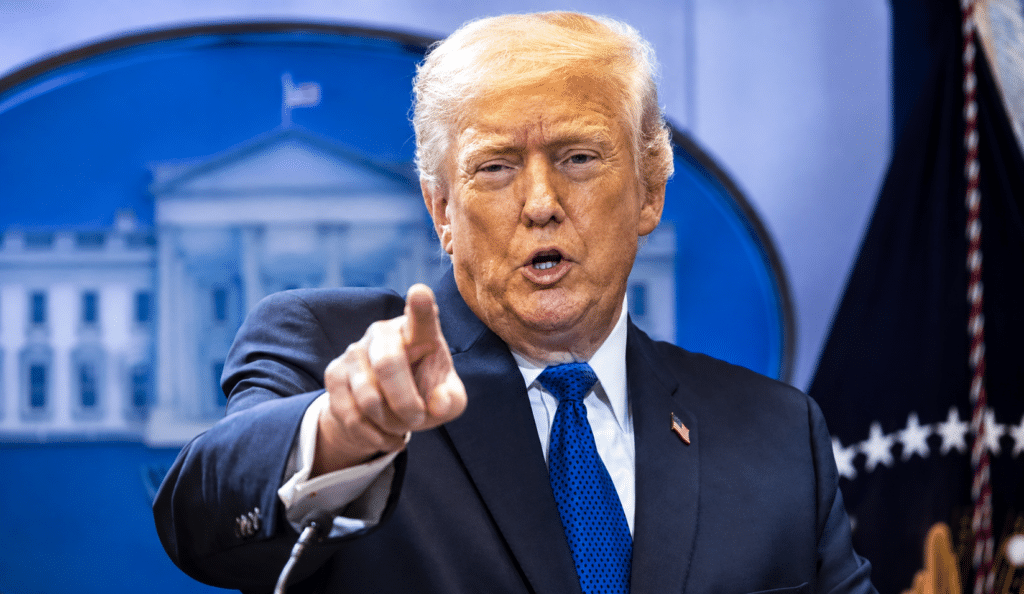
President Donald Trump has warned Oman that the United States would strike the Gulf nation if it interferes with American efforts to control the Strait of Hormuz, one of the most aggressive statements he has made toward a traditionally neutral Gulf partner since the war with Iran began nearly six months ago. The warning, delivered in blunt terms during a television interview, represents a marked shift in tone from an administration that had until now largely reserved its harshest rhetoric for Tehran itself, and it raises fresh questions about how far Washington is willing to go to keep the strait open on its own terms. Oman has long been viewed as one of the few actors in the region capable of talking to both sides, making the threat all the more notable to diplomats watching the conflict unfold.
The comments landed on the same day a sixty day memorandum of understanding between Washington and Tehran expired, leaving the region bracing for what comes next in a conflict that has already reshaped the Middle East and rattled global energy markets.
What Trump Said About Oman
Speaking to Fox News correspondent Trey Yingst on Monday, Trump made clear his patience with Gulf intermediaries was running out. According to the network, the president said the U.S. response would be severe if Oman got in the way of American operations in the strait.
“If Oman gets in the way, we’ll bomb the s— out of them,” Trump reportedly told Fox News.
He added that he was in no rush to end the standoff with Iran, saying he had no fixed timeline for a resolution. Trump also reaffirmed his central objective in the conflict in a post on Truth Social earlier that day, stating that Iran must never be allowed to obtain a nuclear weapon in any form.
Oman, positioned along the southern edge of the strait opposite Iran, has spent decades cultivating a reputation as a quiet, trusted go-between in the region. It maintains close security ties with Washington while keeping open lines to Tehran, a balancing act that has made it useful during nearly every major U.S.-Iran crisis of the past two decades. Trump’s threat marks the first time he has directed language of that kind at Muscat specifically.
How the Conflict Reached This Point
To understand why Oman now finds itself in Trump’s crosshairs, it helps to look back at how the war unfolded. The conflict began on February 28, 2026, when the United States and Israel launched a joint strike on Iranian military targets, an operation that also killed Iran’s Supreme Leader, Ayatollah Ali Khamenei. Iran retaliated within days by closing the Strait of Hormuz to foreign shipping and attacking vessels attempting to pass through, sending global shipping traffic through the waterway plunging.
Direct talks between U.S. Vice President JD Vance and Iranian parliament speaker Mohammad Baqer Qalibaf in Islamabad in mid April, the highest level contact between the two countries since the 1979 revolution, failed to produce a breakthrough. Trump responded by ordering a full naval blockade of Iranian ports on April 13, later launching an aerial campaign in May aimed at reopening the strait by force.
A ceasefire brokered with Chinese and Pakistani involvement briefly took hold in June. On June 17, Trump and Iranian President Masoud Pezeshkian signed a memorandum of understanding committing both sides to end hostilities, lift the blockade and give Iran sixty days to reach a lasting agreement over its nuclear program. That truce did not last. Fighting resumed in early July, the blockade was reinstated, and Iran again moved to restrict the strait, this time threatening to impose its own transit fees on passing vessels.
Monday’s expiration of that sixty day window represents the second major deadline the two countries have failed to meet, and it is against that backdrop that Trump’s warning to Oman should be read.
Oman’s Balancing Act as Mediator
Even as Trump escalated his rhetoric toward Muscat, Omani officials were deep in separate talks with Tehran aimed at working out how shipping through the strait should function going forward. Iran’s foreign ministry said earlier Monday that the two countries had reached an understanding on a transit route map through the waterway, though officials offered few specifics publicly.
For weeks, Oman has tried to broker a workable arrangement that would allow commercial traffic to resume without directly triggering a new confrontation with Washington. Both Tehran and Muscat have floated the idea of transit fees for ships using the route, an idea that has drawn criticism from U.S. officials who see it as Iran attempting to reassert control over a waterway it does not have the right to tax.
Vessels have piled up in the region as a result of the standoff. Ships including large bulk carriers and tankers have sat anchored off Muscat for weeks, unable to transit the strait safely, illustrating just how disruptive the conflict has become to ordinary commercial shipping even when active combat is paused.
Oman’s willingness to keep negotiating with Iran, even as Trump warns against it getting in the way, underscores the difficult position small Gulf states occupy in a conflict between two much larger powers.
Iran’s Response to the Threat
Tehran has not stayed silent amid Trump’s hardening rhetoric. Iranian Deputy Foreign Minister Kazem Gharibabadi pushed back over the weekend after Trump suggested the Strait of Hormuz could effectively fall under U.S. control once the war with Iran concluded.
“Trump needs to accept the reality” that the strait will remain under Iranian control, Gharibabadi wrote on social media, dismissing the president’s comments as unrealistic.
Trump, for his part, said there remains a direct backchannel between U.S. officials and members of Iran’s Islamic Revolutionary Guard Corps, though he did not detail what those conversations have produced. He characterized Iranian negotiators as skilled but under mounting strain, language that suggests Washington believes economic pressure from the blockade is beginning to take a toll on Tehran.
Independent estimates have suggested the blockade is costing Iran hundreds of millions of dollars a day in lost trade, compounding an economic crisis that predates the current war and further straining the government’s ability to import staple goods.
Economic and Regional Fallout
The Strait of Hormuz is not a peripheral waterway. In ordinary times it carries roughly a fifth to a third of the world’s seaborne oil and a significant share of global liquefied natural gas shipments, making it one of the most important chokepoints in the global energy system. Disruptions there ripple quickly through fuel prices worldwide.
Despite the intensity of Trump’s language, oil futures showed little immediate reaction on Monday, trading close to flat. That relative calm may reflect market fatigue after months of an on again, off again conflict, or simply skepticism that the threat against Oman will translate into actual military action against a country with which Washington has generally friendly relations.
Still, Trump has been candid with American voters about the costs of his approach. At a campaign style rally on Friday, he argued that modestly higher gasoline prices were an acceptable trade-off for preventing what he called a dangerous adversary from acquiring nuclear weapons capability, a message aimed squarely at shoring up public support ahead of November’s midterm elections.
The broader Middle East picture remains fluid as well. U.S. officials, including Trump adviser Jared Kushner, have continued separate talks in Egypt aimed at implementing a postwar governance plan for Gaza, working to shift administrative control away from Hamas and toward a transitional body while coordinating the deployment of an international stabilization force, a reminder that the Iran conflict is unfolding alongside several other high-stakes negotiations across the region.
Current Status of the Standoff
As of Monday, the U.S.-Iran memorandum of understanding has lapsed for a second time, and neither government has announced a new framework to replace it. The Trump administration has not indicated whether it will take direct action against Oman, and Omani officials have not issued a public response to the president’s remarks.
Iran’s foreign ministry has confirmed only that it reached an understanding with Oman on a transit route map, without releasing further details or a timeline for implementation. The U.S. naval blockade of Iranian ports remains in place, and commercial vessels continue to sit anchored off Muscat awaiting clarity on when normal transit through the strait might resume.
Trump has said he does not consider himself bound by a timeline to resolve the standoff, and no further talks between U.S. and Iranian officials have been publicly scheduled at this time.


