

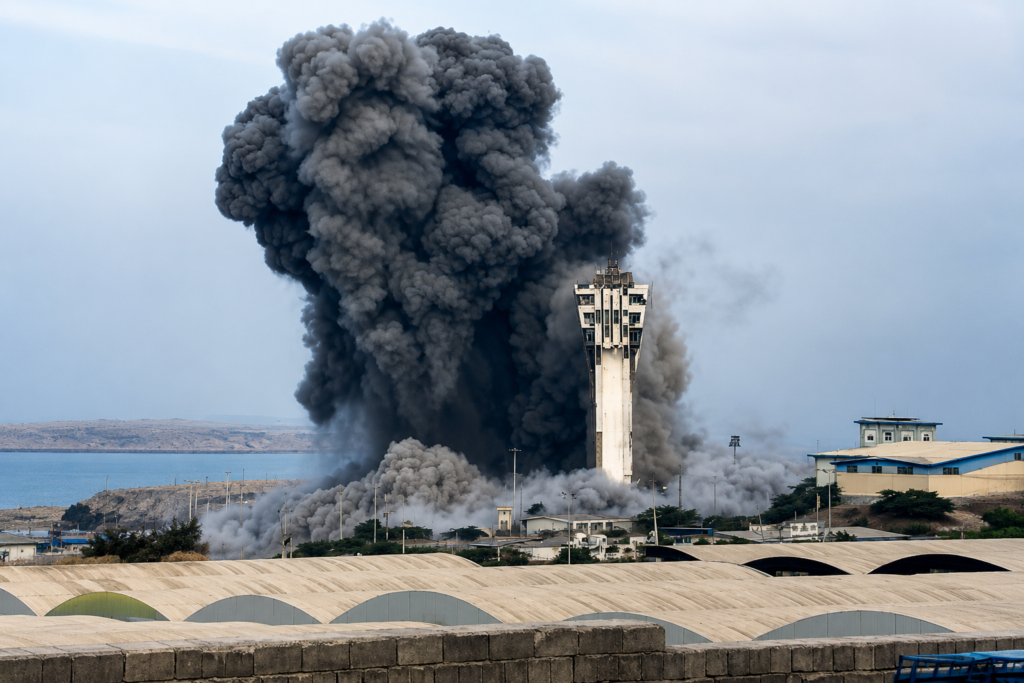
The United States has significantly expanded its military campaign against Iran by launching airstrikes on the southeastern port city of Chabahar, damaging critical maritime infrastructure at Iran’s only deep-water oceanic port. The strike marks the first known attack on Chabahar and signals a major escalation in the conflict, extending military operations well beyond the highly contested Strait of Hormuz.
According to local authorities, the precision strikes severely damaged the maritime traffic control tower at Chabahar Port, while a warehouse in the Chabahar Free Zone used for storing and offloading commercial vehicles was also hit. Temporary power outages were reported across parts of the city, although local officials said cargo operations resumed on a limited scale following the attack.
Iranian authorities strongly condemned the strike, insisting the damaged facilities served civilian purposes. In a statement, the Ports and Maritime Affairs authority in Sistan and Baluchestan province said, “The targeted watchtower is a purely civilian asset. Its primary functions are coordinating search-and-rescue operations for local fishermen at sea and securing the safe transit of international commercial vessels. This act of aggression directly endangers civilian lives and regional maritime safety.”
The United States, however, maintained that the targeted infrastructure was being used to support Iranian military surveillance and hostile operations against commercial shipping.
Chabahar’s Strategic Importance
The strike has drawn particular attention because of Chabahar’s strategic significance. Located on the Gulf of Oman, it is Iran’s only deep-water oceanic port and provides Tehran with direct access to the Indian Ocean without relying on the Strait of Hormuz.
Unlike Bandar Abbas and other Iranian ports inside the Persian Gulf, Chabahar allows international trade to continue without passing through the narrow maritime chokepoint, making it one of Iran’s most valuable commercial assets.
The port also serves as the cornerstone of the India-backed International North-South Transport Corridor (INSTC). India has invested heavily in developing Chabahar as a trade gateway connecting the country with Afghanistan, Central Asia and Russia while bypassing Pakistan.
The corridor has long been viewed by New Delhi as a strategic alternative to traditional regional trade routes. Although India later transferred operational responsibilities to an Iranian entity because of U.S. sanctions, damage to the port’s infrastructure represents a setback for the project’s long-term ambitions.
Trump Declares Ceasefire “Over”
The strikes on Chabahar came after U.S. President Donald Trump declared that the interim ceasefire with Iran had effectively ended following allegations that Iranian forces and their proxies had resumed attacks on commercial shipping.
Shortly after the strikes, Trump posted on Truth Social, “This is in retribution for yesterday’s bombing of ships by Iran. If it happens again, it will get much worse!”
Trump also warned that if Tehran refused to return to negotiations, Washington would intensify pressure by targeting additional strategic infrastructure, including Iran’s domestic power plants, bridges and Kharg Island, through which nearly 90 percent of the country’s oil exports move.
Speaking to reporters, Trump said Iranian leaders were eager to negotiate but questioned whether they could be trusted.
“They want to make a deal so badly, but I just don’t know if they are worthy of making a deal. I don’t know that they’re going to honor the deal.”
Vice President JD Vance reinforced the administration’s position with a blunt warning.
“The deal is very simple. If they shoot at ships, we’re going to knock the hell out of them.”
The White House has maintained that the military operation was intended to degrade infrastructure supporting Iranian attacks against commercial shipping in regional waters.
Iran Responds with Retaliation and Warning
Iran responded by rejecting the U.S. justification for the strikes and describing the attack as an assault on civilian infrastructure.
Hours after the strikes on Chabahar and other coastal locations, the Islamic Revolutionary Guard Corps (IRGC) launched retaliatory missile and drone attacks targeting U.S. Fifth Fleet facilities and logistics hubs in Bahrain and Kuwait.
The IRGC also warned that any effort by Washington to block Iranian ports or restrict the country’s energy exports would trigger broader consequences across the region.
An IRGC spokesperson declared, “The energy of this region will be for everyone, or it will be for no one.”
Iran’s top negotiator, Mohammad Bagher Ghalibaf, also dismissed Washington’s pressure campaign, saying the Strait of Hormuz would only reopen under “Iranian arrangements” and not under “American threats.”
The statements underscored Tehran’s refusal to accept U.S. military pressure while signaling the possibility of further escalation if maritime restrictions continue.
Regional Implications
The strike on Chabahar represents a significant turning point in the conflict by bringing military operations to Iran’s Indian Ocean coastline. Beyond its military implications, the attack threatens a port that plays a key role in Iran’s international trade and India’s long-term regional connectivity strategy.
With Washington insisting the strikes were aimed at infrastructure supporting hostile operations and Tehran maintaining that civilian facilities were targeted, tensions between the two countries continue to rise.
As both sides exchange military action and increasingly sharp warnings, the damage to Chabahar has added a new front to the conflict, raising concerns over regional shipping, energy trade and the future of one of the region’s most strategically important maritime gateways.


