

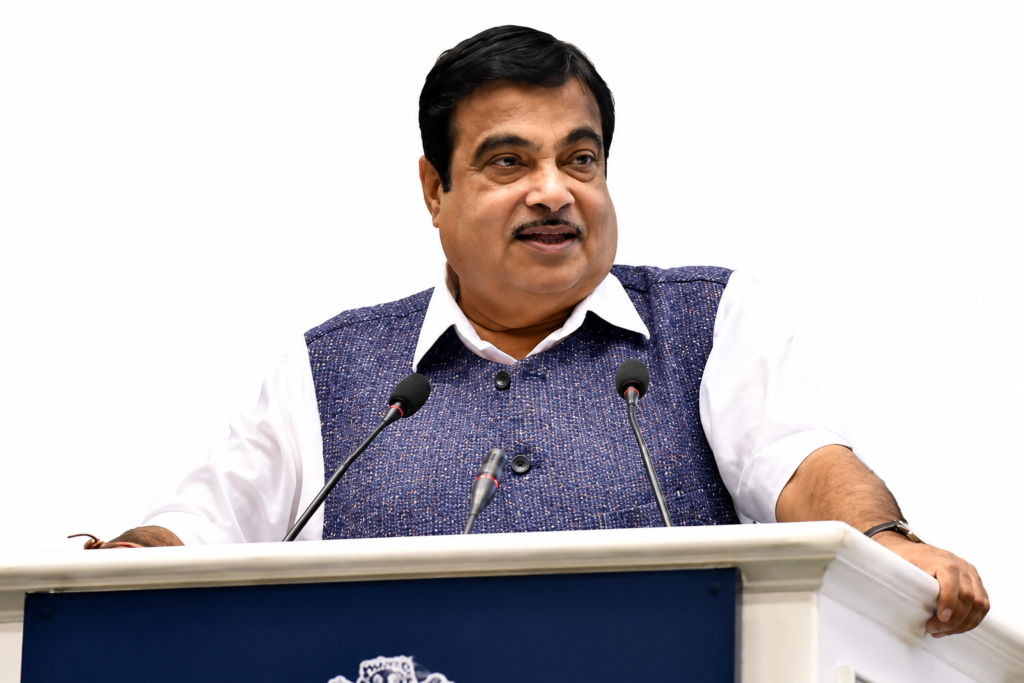
Union Road Transport and Highways Minister Nitin Gadkari has reignited the debate over India’s E20 petrol rollout after questioning how motorists calculate fuel efficiency, saying accurate mileage readings can only be obtained through manufacturer-authorised testing equipment.
His remarks come as complaints over declining mileage after the nationwide adoption of E20 petrol continue to circulate across social media and consumer forums, prompting fresh scrutiny of the government’s flagship ethanol blending programme.
The controversy unfolded during an interview with ABP News, where Gadkari was asked about motorists claiming that their vehicles were delivering significantly lower mileage after switching to E20 petrol.
A journalist cited her own experience, saying the mileage of her E20-compatible car, purchased in 2023, had dropped from around 11 km per litre to nearly 7 km per litre.
Responding to the claim, Gadkari questioned how the figure had been calculated.
“You and I can’t check the mileage. A car’s mileage can only be checked using a company-authorised dealer’s machine,” the minister said, maintaining that authorised diagnostic systems provide the only accurate assessment of a vehicle’s fuel efficiency.
He also argued that motorists often overlook other variables that affect fuel consumption.
“Mileage depends on the vehicle, traffic conditions and the driver’s habits. You cannot blame only the fuel,” Gadkari said, stressing that congestion, driving style, road conditions and vehicle maintenance all influence real-world fuel economy.
His comments have divided opinion because most motorists estimate fuel efficiency using dashboard readings or the full-tank method rather than dealership diagnostic equipment. Automotive experts note that while diagnostic tools are useful for identifying engine faults and electronic issues, everyday fuel economy is influenced by several external factors that cannot be replicated in controlled testing conditions.
Why E20 petrol remains under scrutiny
The debate comes against the backdrop of India’s nationwide transition to E20 petrol, which contains up to 20% ethanol blended with petrol. The rollout, completed ahead of schedule, forms part of the government’s strategy to reduce dependence on imported crude oil, improve energy security and lower transport-related emissions.
The policy, however, has also intensified concerns over fuel efficiency.
The Ministry of Petroleum and Natural Gas has acknowledged that E20 petrol may reduce fuel economy by around 3% to 5% because ethanol contains less energy per litre than conventional petrol.
“It is true that in some vehicles there may be a 3-5% reduction in fuel economy. But mileage is only one parameter,” the ministry said in a recent clarification addressing public concerns over E20 fuel.
The ministry said the programme should be assessed against its broader policy objectives rather than fuel economy alone.
“The larger objective is reducing crude oil imports, lowering emissions and supporting farmers through ethanol production,” it said.
Government officials have consistently argued that higher ethanol blending reduces India’s reliance on imported oil while creating additional demand for domestically produced ethanol derived from sugarcane, maize and surplus food grains.
Despite those assurances, consumer complaints have continued to surface, with some motorists claiming mileage losses well beyond the government’s projected range.
For many vehicle owners, the issue is less about laboratory testing and more about everyday driving experience. Dashboard estimates and full-tank calculations remain the most common methods of measuring fuel economy, even though neither constitutes an official certification process.
Government defends ethanol blending
Gadkari has repeatedly defended the ethanol blending programme, describing it as a long-term strategy to strengthen India’s energy security while reducing emissions from the transport sector.
Earlier this month, he acknowledged that ethanol’s lower calorific value naturally results in a modest decline in mileage compared with conventional petrol. However, he rejected claims that E20 petrol damages vehicle engines.
“Show me a single car that has suffered damage because of E20 fuel,” Gadkari said, dismissing allegations circulating on social media as part of what he described as a false narrative.
The minister also rejected another viral claim suggesting that E20 petrol contains sugarcane juice capable of attracting ants.
“People say E20 petrol contains sugarcane juice and ants will gather around it. Ethanol is alcohol, not sugarcane juice. There is no scientific basis for such claims,” he said.
Gadkari explained that ethanol is an industrial alcohol produced through the processing of agricultural feedstocks such as sugarcane, maize and damaged food grains. Once refined, its chemical properties differ entirely from sugar, making claims that it attracts ants scientifically unfounded.
According to the minister, the nationwide rollout followed extensive testing by automobile manufacturers and research agencies, including the Automotive Research Association of India. He said manufacturers had also addressed compatibility issues in older vehicles by replacing components where necessary.
The government maintains that while motorists may observe a slight reduction in fuel economy, the broader economic and environmental benefits outweigh the trade-off. Besides lowering crude oil imports, officials argue that ethanol blending supports farmers by expanding demand for agricultural feedstocks and contributes to India’s clean-energy transition.
Gadkari has also said the country’s long-term transport strategy extends beyond ethanol, with biofuels, hydrogen and electric mobility forming part of India’s future energy mix.
Political and industry response
The mileage debate has also acquired political overtones.
AAP national convenor Arvind Kejriwal recently wrote to 29 automobile manufacturers seeking clarification on E20 compatibility, engine safety and fuel efficiency, questioning what he described as conflicting public messaging surrounding ethanol-blended petrol.
Automobile manufacturers have meanwhile sought to reassure consumers.
Mercedes-Benz India recently said all its BS VI petrol models are fully compatible with E20 fuel after YouTuber Sourav Joshi claimed that his SUV’s mileage had dropped sharply following the switch to the higher ethanol blend. The company said its vehicles had been engineered and tested to operate with E20 petrol.
The government has continued to cite scientific studies supporting the policy.
A recent study by IIT Kanpur found no evidence that E20 petrol damages vehicle engines, reinforcing the government’s position that the fuel is safe for vehicles designed to operate on the higher ethanol blend.
What the mileage debate means for motorists
The latest controversy has highlighted the difference between laboratory certification, manufacturer diagnostics and real-world driving experience.
While authorised diagnostic equipment can identify technical faults affecting vehicle performance, automotive experts continue to recognise dashboard estimates and carefully conducted full-tank calculations as practical indicators of everyday fuel economy. Actual mileage inevitably varies depending on traffic conditions, driving behaviour, terrain, tyre pressure, vehicle load, weather and maintenance.
The debate has therefore evolved beyond a simple disagreement over fuel efficiency. It reflects a broader challenge facing India’s energy transition: balancing consumer expectations with long-term policy objectives.
For the government, E20 petrol remains a key pillar of its strategy to reduce oil imports, cut emissions and strengthen domestic biofuel production. For many motorists, however, day-to-day fuel economy remains the most visible measure of the policy’s impact.
As the nationwide rollout settles in and more vehicles begin operating exclusively on E20 petrol, questions over mileage, testing methods and consumer experience are likely to remain at the centre of public discussion. Gadkari’s latest remarks have ensured that the conversation is no longer confined to ethanol alone but now extends to how fuel efficiency is measured, communicated and understood in India’s evolving transport landscape.


