

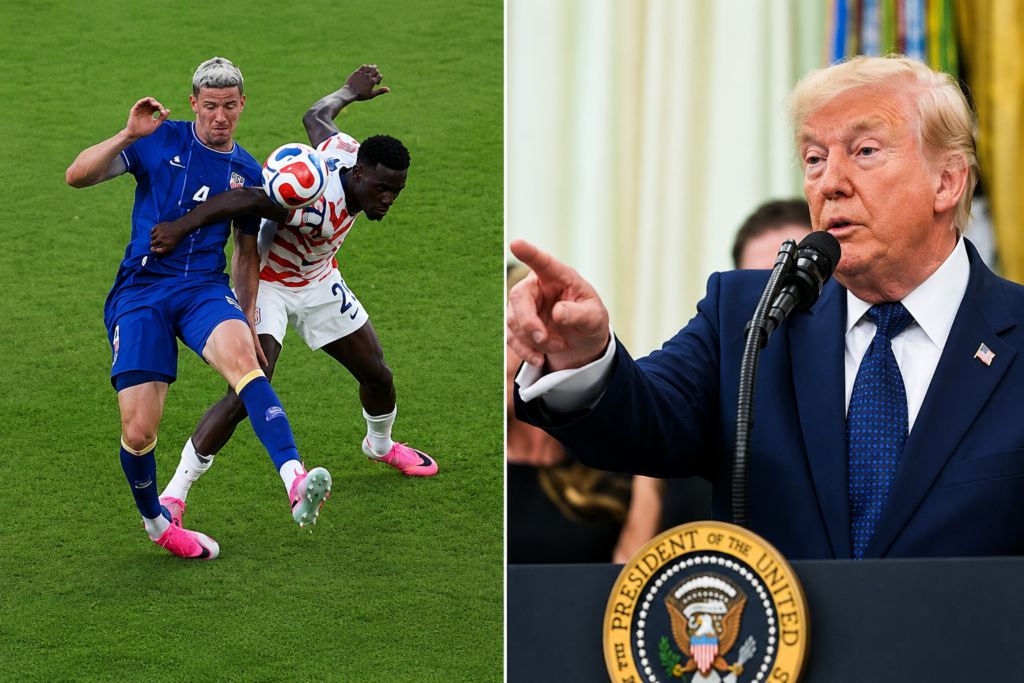
Donald Trump has confirmed that he personally asked FIFA President Gianni Infantino to review the red card shown to United States striker Folarin Balogun, an intervention that has triggered one of the biggest controversies of the 2026 FIFA World Cup.
The U.S. President’s remarks came after FIFA took the unprecedented step of suspending Balogun’s automatic one-match ban, allowing the striker to remain eligible for the United States’ Round of 16 clash against Belgium. While FIFA has insisted its independent judicial bodies made the decision without political influence, the episode has sparked criticism from UEFA, Belgium’s football federation and several leading figures across European football.
The controversy has shifted attention away from events on the pitch and towards broader questions over FIFA’s disciplinary system, governance and the role of political influence in international sport.
Trump Defends Intervention
Speaking to reporters at the White House, Trump acknowledged contacting Infantino after watching the incident that resulted in Balogun’s dismissal against Bosnia and Herzegovina.
“All I did, I asked for a review because I didn’t think it was a foul. I didn’t tell them what to do. I can’t tell them what to do.”
Trump described the challenge as an accidental collision between two players rather than serious foul play.
“That wasn’t a foul. That wasn’t even an infraction. That was two guys running full speed that happened to crash into each other.”
He also criticised Brazilian referee Raphael Claus, calling the decision “horrible” and suggesting the official’s performance should be examined, although he offered no evidence for his remarks.
Trump argued that major World Cup matches should feature each country’s strongest available squad.
“We’ve got to have our best players and they have to have their best. If we win or we lose, it’s fair.”
After FIFA allowed Balogun to play, Trump praised the outcome.
“I think they made a really brilliant decision.”
He also sought to distance Infantino from the ruling.
“I don’t believe he made the decision. I think it was a committee that made the decision.”
FIFA Explains Decision
Balogun was sent off during the United States’ 2-0 victory over Bosnia and Herzegovina after a VAR review concluded that his challenge on Tarik Muharemovic warranted a straight red card.
Under FIFA regulations, such a dismissal normally results in an automatic one-match suspension.
However, FIFA’s Appeal Committee invoked Article 27 of the FIFA Disciplinary Code, allowing implementation of the suspension to be deferred for a probationary period of one year.
The decision did not erase the red card itself. Instead, Balogun remains on probation for the next 12 months. If he commits another offence of a similar nature during that period, the suspended one-match ban will automatically be enforced in addition to any new disciplinary sanction.
The use of Article 27 in this manner is exceptionally rare and immediately became one of the tournament’s defining stories. FIFA has previously relied on the same provision in limited circumstances, but its application during a World Cup knockout stage attracted unprecedented scrutiny.
FIFA Faces Growing Backlash
The decision prompted immediate criticism from football authorities across Europe.
UEFA accused FIFA of undermining confidence in its own disciplinary process.
“We express our disbelief at such an unprecedented, incomprehensible and unjustifiable decision.”
The European governing body added that FIFA had “crossed a red line” and warned that uncertainty over the application of disciplinary rules threatened “the integrity of the game and the credibility of the competition.”
Belgium, scheduled to face the United States in the Round of 16, also challenged Balogun’s eligibility.
The Royal Belgian Football Association described itself as “astonished” by FIFA’s decision and lodged an objection, arguing that automatic suspensions attached to straight red cards should not be suspended in this manner. FIFA later rejected Belgium’s challenge, ruling that the federation did not have standing to appeal the disciplinary decision.
Belgium coach Rudi Garcia criticised the ruling before the match.
“I didn’t know that at the FIFA World Cup the fifth of July is now the first of April and it’s April Fool’s Day.”
He added that Belgium was defending “football with its ethics and integrity.”
Germany’s football federation also called on FIFA to fully explain the circumstances surrounding the decision, warning that any perception of political interference must be addressed quickly to protect the tournament’s credibility. Even former FIFA president Sepp Blatter questioned the optics of the episode, saying disciplinary decisions should be based on rules and evidence rather than political phone calls.
Infantino And Pochettino Respond
As criticism intensified, FIFA President Gianni Infantino confirmed that Trump had contacted him but insisted the process remained independent.
“During our conversation I explained that there was an ongoing legal process involving FIFA’s independent judicial bodies and that the case would be decided in due course by the competent bodies. That is how FIFA’s system works, and it is a principle that I will always uphold.”
Infantino’s statement sought to reinforce FIFA’s position that disciplinary rulings are handled autonomously, regardless of discussions involving political leaders.
United States coach Mauricio Pochettino welcomed the decision, maintaining that Balogun should never have been dismissed in the first place.
“Everyone that really loves the sport and trusts ethics and integrity, I think we celebrate that decision.”
Pochettino argued that the United States had already been punished by playing with 10 men for the remainder of the Bosnia match after what he described as an unfair red card.
American players also expressed relief after learning of Balogun’s availability only hours before training, with the striker regarded as one of the team’s most important attacking players after scoring three goals during the tournament.
Governance Under Spotlight
Beyond Balogun’s availability, the controversy has evolved into a wider debate about FIFA’s governance and the relationship between politics and international football.
Trump’s direct involvement represents one of the most unusual interventions by a sitting head of state in an active World Cup disciplinary matter. Although the U.S. President insisted he merely requested a review rather than attempting to influence the outcome, the timing of FIFA’s decision has fuelled criticism from football organisations and governance experts.
The episode has also drawn attention to Trump’s public relationship with Infantino during the United States’ role as one of the hosts of the expanded 2026 FIFA World Cup, adding another layer of scrutiny to FIFA’s handling of the case.
For FIFA, the challenge now extends beyond one disciplinary decision. The governing body must also reassure players, national associations and supporters that its judicial process remains transparent, independent and consistent regardless of external pressure.
As the United States continues its World Cup campaign with Balogun available for selection, the debate surrounding the striker’s reinstatement is likely to remain one of the defining off-field stories of the tournament, raising lasting questions about sporting integrity, governance and political influence at football’s biggest event.


