

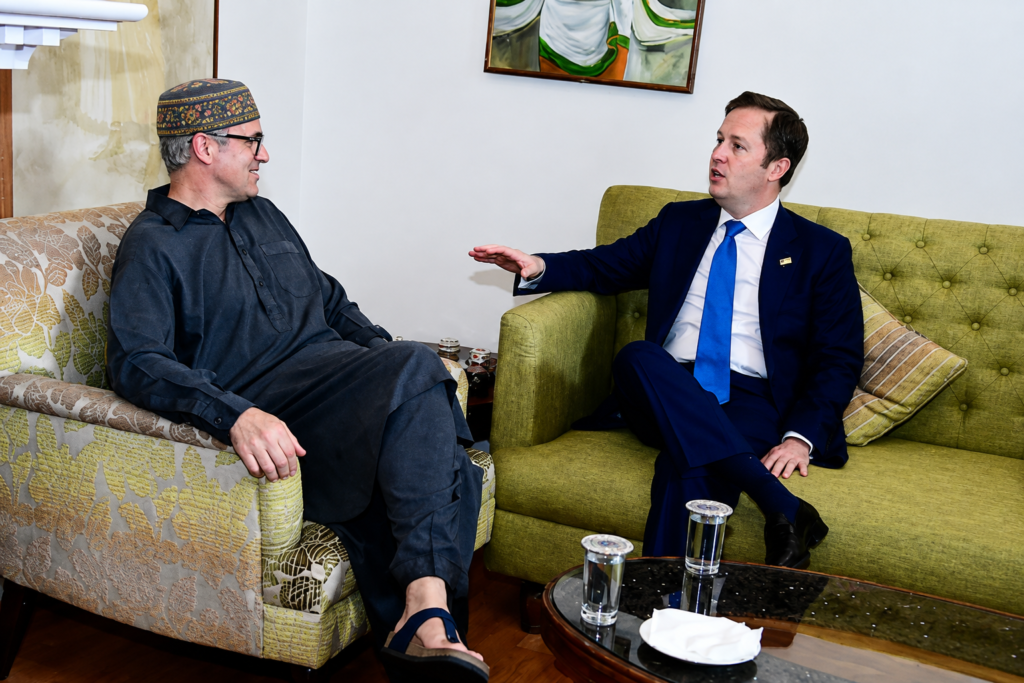
United States Ambassador to India, Sergio Gor, arrived in Srinagar on Wednesday for a two day visit to Jammu and Kashmir and Ladakh, marking the first trip by a sitting American envoy to the Union Territory since the abrogation of Article 370. The visit, closely watched in diplomatic circles, comes at a time when the region is working to rebuild its image after the Pahalgam terror attack of April 2025 and years of heightened security concerns.
Gor, who also serves as President Donald Trump’s Special Envoy for South and Central Asian affairs, met Jammu and Kashmir Chief Minister Omar Abdullah and Lieutenant Governor Manoj Sinha during his stay in the Valley. The meetings covered a range of subjects, from regional security to economic cooperation, and set the tone for what both sides described as a warm and constructive engagement.
A Symbolic First Visit Since Article 370
The significance of Gor’s trip lies as much in its timing as in its content. No American ambassador has visited Jammu and Kashmir since the region’s special status was revoked in August 2019. That the visit finally happened, and so soon after the Pahalgam attack rattled the Valley’s tourism dependent economy, sends a signal that Washington views the situation on the ground as stable enough to engage with directly rather than from a distance.
Speaking after his meeting with the Chief Minister, Gor was unambiguous about where the United States stands on the region’s political status. It’s a pleasure to be here. This is an important part of India. I am here, visiting for the first time. It is an incredibly beautiful place. I am thrilled to be here, thrilled to see this place, he said, effectively echoing New Delhi’s long standing position on the Union Territory.
What Was Discussed Behind Closed Doors
According to Gor, the conversation with Omar Abdullah went beyond pleasantries. We just had a very good meeting. We have some follow-ups, so we hope to take back to Washington, back to Delhi. But a very warm, a very cordial and we look forward to building this relationship forward, the envoy remarked, hinting that concrete outcomes may follow the visit rather than just symbolic goodwill.
On social media, Gor added further detail, noting that the discussions centred on the Chief Minister’s development priorities and on ways to expand economic collaboration between the two countries in a manner that would benefit both sides. The framing suggests that trade, investment and tourism partnerships, rather than politics alone, are likely to dominate the follow up conversations in the coming weeks.
Travel Advisory Review Signals A Shift In Perception
Perhaps the most consequential remark from Gor’s visit concerned the possibility of easing the United States travel advisory for American citizens visiting Jammu and Kashmir. The advisory has long been cited by local tourism operators as a barrier to attracting foreign visitors, particularly from North America.
The United States puts out travel warnings and every so often we re-evaluate those travel warnings. I cannot make any big announcements here today but it is something that we are going to look at, Gor said. He went further, crediting local authorities for their efforts on the security front. New Delhi, the Chief Minister here, the government here, we believe have made some incredible steps to keeping this area safer and making it more safe, he added, before noting that the region’s natural beauty could draw far more American visitors if the advisory were revised.
While the ambassador stopped short of confirming a timeline, the acknowledgment itself carries weight. Travel advisories shape not just individual traveller decisions but also corporate risk assessments, insurance premiums and airline route planning, all of which have a direct bearing on Kashmir’s fragile tourism recovery.
Omar Abdullah’s Measured Response
Ahead of the meeting, Chief Minister Omar Abdullah had already tempered expectations. Speaking to reporters during an early morning inspection of developmental projects in Srinagar, he made clear that he intended to use the meeting to inform, not to complain. Washington won’t solve Kashmir’s problems, he had earlier remarked, underlining his view that internal issues concerning the Union Territory rest squarely with New Delhi rather than any foreign power.
That measured stance did not stop the Chief Minister from engaging substantively once the meeting took place. Officials familiar with the discussions indicated that Abdullah used the opportunity to walk Gor through his administration’s development agenda and to explore avenues for economic partnership, a pragmatic approach that avoided diplomatic overreach while still extracting value from the high profile visit.
A Visit With Ripple Effects Beyond Kashmir
Gor’s itinerary does not end in Srinagar. The envoy is scheduled to travel to Ladakh on Thursday, extending a rare high level American diplomatic presence across two politically sensitive Himalayan regions in a single trip. Observers note that this broader itinerary, covering both Jammu and Kashmir and Ladakh, reflects a deliberate attempt by Washington to normalise engagement with the entire northern frontier of India, an area that has historically drawn cautious diplomatic footing from Western missions.
The visit also arrives against the backdrop of wider India United States engagement, with speculation growing over a possible visit by President Trump to India and a Quadrilateral Security Dialogue summit expected on the horizon. In that context, Gor’s Kashmir trip can be read as more than a standalone gesture. It fits into a larger pattern of Washington recalibrating how it approaches sensitive Indian territories, choosing direct engagement over the cautious distance maintained by previous administrations.
For the residents of Srinagar and the wider Valley, however, the immediate takeaway is simpler. A senior American diplomat walked their streets, praised their region’s security gains, and left open the door to a policy change that could bring more foreign visitors back to a place still healing from tragedy. Whether that promise translates into an actual downgrade of the travel advisory will be the real test of Wednesday’s warm words.


