

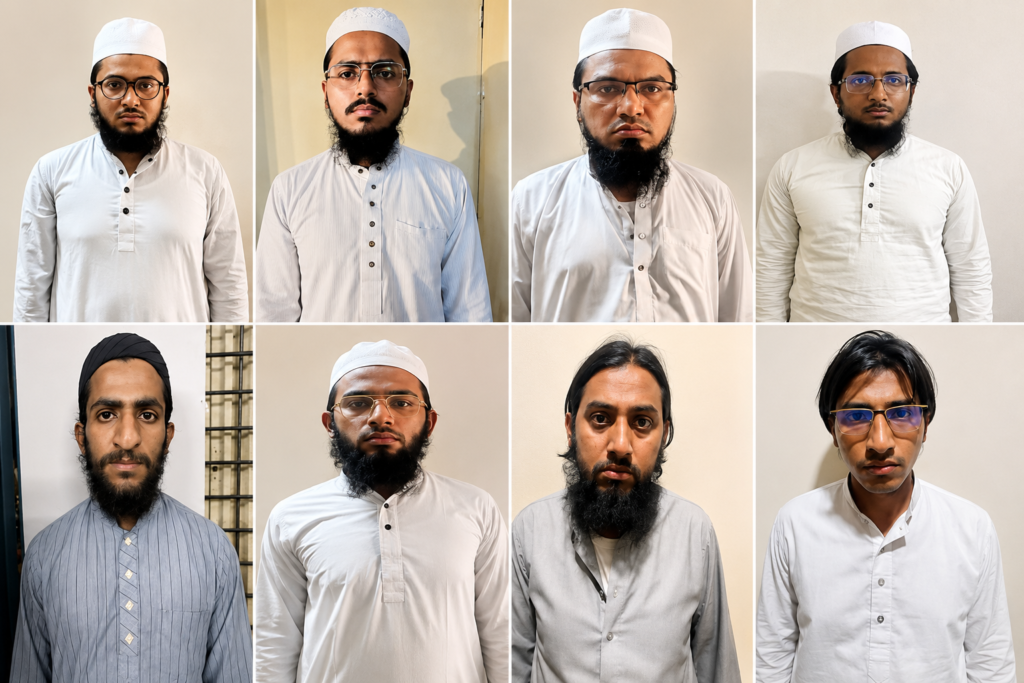
India’s counter-terror apparatus has recorded a major breakthrough after the Gujarat Anti-Terrorism Squad arrested eight alleged operatives linked to the banned terror outfit Jaish-e-Mohammed in a coordinated operation across Gujarat and Madhya Pradesh. Officials say the arrests followed an extensive intelligence-led investigation into extremist activities, including recruitment, ideological radicalisation, terror financing and operational groundwork. The operation, carried out across Ahmedabad, Surat, Bharuch, Narmada and parts of Madhya Pradesh, is being seen as one of the most significant anti-terror actions in western India this year.
The Gujarat ATS said the accused were actively working on behalf of Jaish-e-Mohammed to establish an active network in Gujarat to further the organisation’s terror activities. Investigators believe the group had moved beyond ideological alignment and was in the process of creating a structured support system capable of aiding future attacks. Security agencies say the case underlines growing concerns over dormant extremist cells and their attempts to rebuild operational networks within India.
Multi-State Crackdown
The Gujarat ATS launched simultaneous raids across multiple locations after weeks of surveillance and intelligence gathering. Officials tracked the suspects’ digital communications, movement patterns and alleged meetings before moving in with coordinated arrests.
The eight accused have been identified as Ahmed Abdullah Ghaziwala, Ibrahim Mohammad Hussain Ghagha, Mudassir Abdullah Ghaziwala, Zakaria Durani Mohammad Ammar Ghagha, Mufti Faujaan Ismail Dauwa, Mohammad Amin Shera, Mohammad Abdul Rehman Sawdi and Bilal Mohammad Ammar Ghagha.
According to investigators, the operation was carefully timed to avoid tipping off other possible associates. Officials say the accused were spread across multiple districts, suggesting a wider network than initially suspected.
“This operation was based on sustained intelligence inputs and technical surveillance. The timing was crucial to prevent the module from growing stronger,” a senior Gujarat ATS officer said.
Officials say all eight accused are now in custody and further questioning is expected to reveal more operational details.
Terror Network in Gujarat
Investigators allege the accused were actively building a Jaish-e-Mohammed support ecosystem in Gujarat with the aim of expanding the terror group’s local reach. This included recruitment efforts, ideological influence and logistical preparation.
“The accused were actively working on behalf of Jaish-e-Mohammed to establish an active network in Gujarat to further the organisation’s terror activities,” Gujarat ATS said.
Officials believe the accused were trying to identify and recruit vulnerable youth while creating safe channels for movement, shelter and communication. Security agencies say such support structures are often the foundation of larger operational modules.
The ATS has also found preliminary evidence suggesting some of the accused remained in contact with handlers connected to the banned outfit. Investigators are now working to establish whether those contacts were direct or through intermediaries.
“The pattern indicates this was not random ideological support. It was structured groundwork aimed at building operational capability,” an officer involved in the probe said.
Counter-terror experts say disrupting such networks at an early stage is essential to preventing future attacks.
Radicalisation and Digital Propaganda
One of the most significant aspects of the investigation is the alleged radicalisation campaign linked to the group. Officials say the accused were involved in spreading extremist ideology through private meetings, selective gatherings and encrypted digital platforms.
During the raids, the ATS seized mobile phones, laptops and digital storage devices. Investigators say these contain jihadist literature, propaganda videos and communication logs that are now under forensic examination.
Authorities believe some of the accused attended secret indoctrination meetings where extremist narratives were circulated. These gatherings are now being investigated as possible centres for recruitment and operational planning.
“Radicalisation is often the first layer of terror infrastructure. Once that foundation is built, recruitment and logistics follow,” a former intelligence officer said.
Gujarat Chief Minister Bhupendra Patel has consistently stressed the need for strict vigilance against internal security threats.
“The safety and security of Gujarat remains our highest priority. Our agencies will continue to act decisively against any threat to public peace,” the Chief Minister said during an earlier state security review.
Officials say the digital evidence recovered in the operation may prove critical in understanding the depth of the network.
UAPA Charges and Funding Trail
The Gujarat ATS has registered a case against all eight accused under Sections 13, 17, 18, 38 and 39 of the Unlawful Activities Prevention Act, along with Sections 148 and 61 of the Bharatiya Nyaya Sanhita.
These provisions deal with unlawful activities, terror funding, conspiracy, membership of a banned organisation and support to terrorist activities. Legal experts say the combination of these sections points to serious allegations of organised terror facilitation.
Officials are now tracing possible hawala transactions, cash transfers and financial links that may have supported the alleged network. Investigators believe following the money could expose a wider chain of facilitators.
“Financial channels are often the backbone of terror operations. The funding route can reveal the real size of the network,” a senior security official said.
Central agencies have also been informed and may join the investigation if interstate or foreign links are established.
Wider Security Implications
The arrests have once again highlighted the changing nature of terror networks in India, where recruitment, propaganda, finance and logistics increasingly operate through decentralised and digital channels.
Security analysts say Gujarat remains strategically sensitive because of its long coastline, industrial importance and connectivity, making it a key target for extremist groups seeking operational footholds.
Officials say the current investigation suggests the alleged module may not have been limited to Gujarat alone. Early findings indicate possible plans to support activities in other parts of India, although no specific targets have been disclosed.
Jaish-e-Mohammed has been linked to some of India’s deadliest terror attacks, including the 2019 Pulwama bombing. Any attempt to rebuild local support structures linked to the organisation is treated as a serious national security threat.
“Modern terror operations are layered. One module recruits, another handles money, another manages logistics. Breaking these chains early is the only effective counter-terror strategy,” a former senior intelligence officer said.
The Gujarat ATS says the investigation remains active, with more digital evidence, financial records and communication trails under examination. Officials have not ruled out more arrests as they work to map the full extent of the alleged Jaish-e-Mohammed network.
The case is expected to become a crucial test of India’s preventive counter-terror strategy as agencies continue efforts to disrupt extremist infrastructure before it can become operational.


