

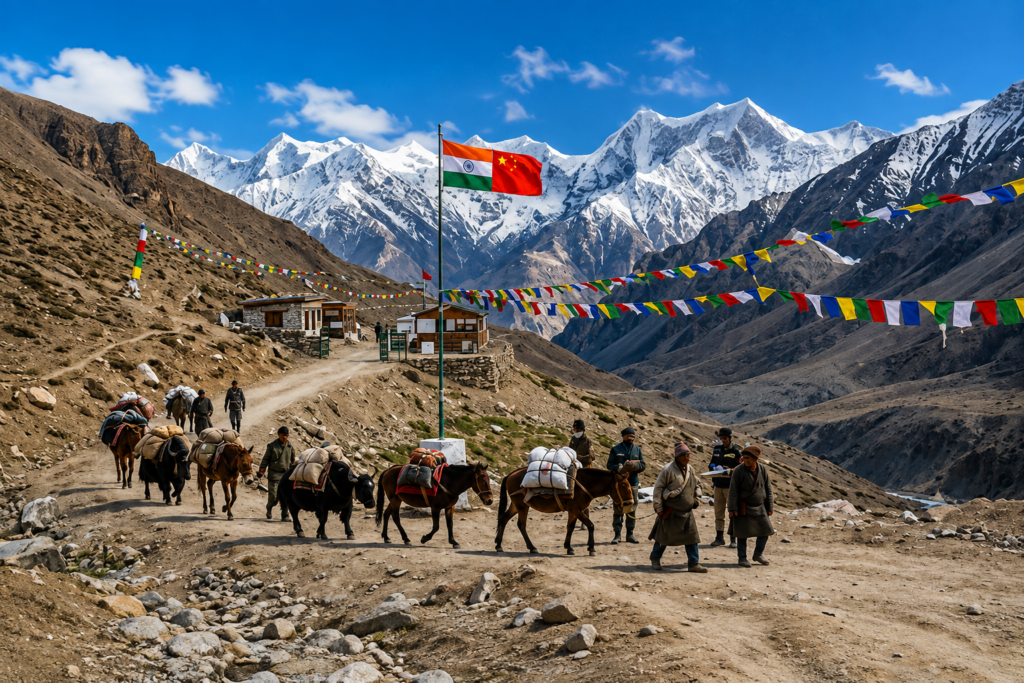
Traditional barter trade between India and China has resumed through the historic Shipki La pass in Himachal Pradesh, marking the end of a six year suspension caused by the Covid-19 pandemic and heightened border tensions. Perched at nearly 3,930 metres in Kinnaur district, the pass has long served as a lifeline for remote Himalayan communities that depend on the short summer trading window to sustain their livelihoods. The route, once part of the ancient Silk Road connecting India with Tibet, will remain open for commercial activity till November 30, when winter snowfall typically forces its closure. Its revival comes at a moment of gradual thaw in India-China relations, following years of strained ties after the 2020 military standoff in eastern Ladakh, and is being read locally as a sign that normalcy is slowly returning to the frontier.
The reopening took place on August 1 in Kinnaur district, with local officials describing the moment as a significant step toward reviving the border economy and strengthening ties with remote Himalayan communities.
A pass shaped by centuries of trade
Shipki La sits at an altitude of nearly 3,930 metres in the Kinnaur district of Himachal Pradesh, marking the watershed boundary between India and the Tibetan plateau. It is one of the highest cross-border trading points in the Trans-Himalaya, and its history as a commercial corridor stretches back long before either modern nation existed in its present form.
Historical records trace organised trade through the pass to the 17th century, when the Ganden Phodrang government of Tibet signed a treaty with the Kingdom of Bushahar in 1679 guaranteeing safe passage for traders. For generations afterward, merchants from Kinnaur, Spiti, Lahaul, Ladakh, and Punjab carried tea, spices, and agricultural tools across the pass, returning with Tibetan wool, salt, and livestock. These exchanges were often sealed not by paperwork but by gamgya, a traditional oath of mutual trust, sometimes symbolised by breaking a twig or stone and each party keeping half as a token of the agreement.
The route gained further prominence in the 19th century as part of the Hindustan-Tibet Road built under Lord Dalhousie, which linked Shimla and the Kinnaur valley to the Indo-Tibetan frontier. Trade was disrupted by the 1962 war between India and China and remained suspended for three decades before being formally revived in 1992. Two years later, a bilateral agreement signed in June 1994 designated Shipki La as an official border trade point, placing it under strict quotas and customs oversight.
From pandemic shutdown to fresh start
The most recent closure began in 2019, when the last group of traders returned from the Tibet Autonomous Region on November 30, just before the Covid-19 outbreak halted cross-border movement worldwide. Unlike earlier disruptions, this one stretched on well beyond the pandemic itself, compounded by the 2020 military standoff in eastern Ladakh, which pushed India-China relations to one of their lowest points in decades.
The route’s revival gathered pace only after diplomatic engagement between the two countries improved. External Affairs Minister S Jaishankar and Chinese Foreign Minister Wang Yi held discussions on restoring several suspended cross-border arrangements, and the two sides agreed in principle to reopen trade through three historic points, Shipki La in Himachal Pradesh, Lipulekh in Uttarakhand, and Nathu La in Sikkim. Himachal Chief Minister Sukhvinder Singh Sukhu had separately written to the Union government pressing for the Shipki La route to be prioritised, a request officials credit with helping accelerate the process.
Ground preparations began well before the formal reopening. Officials in Kinnaur held coordination meetings earlier this year to plan warehouses and trading shops at Namgya, while working to streamline responsibilities between the Indian Army, the Indo-Tibetan Border Police, and customs authorities so that the resumed trade would run without friction along the frontier.
Traders flagged off in traditional style
The formal resumption was marked with ceremony befitting the route’s cultural weight. Himachal Pradesh’s Revenue and Horticulture Minister Jagat Singh Negi flagged off sixteen traders after presenting them with traditional Khataks, ceremonial scarves used to convey respect and goodwill, along with their horses, as the group set out toward Shipki village in Tibet.
Under the arrangement, traders transport their goods by road to the border, after which consignments are carried onward by mules and pack animals to designated trading points inside Tibet. They must complete their transactions and return within 72 hours of crossing. Only traders registered with the local administration and cleared by the Indo-Tibetan Border Police are permitted to take part, and the exchange itself continues to follow the traditional barter system rather than cash transactions, consistent with how commerce has operated along this corridor for generations.
Speaking on the occasion, Negi said the reopening would give fresh momentum to the local economy. “Reopening the Shipki La trade route would provide fresh momentum to the economy of border areas by creating employment and self-employment opportunities for local youth while boosting commercial activity in the region,” he said.
He added that the state government remains focused on the broader development of border regions. “The state government is continuously working towards the holistic development of border areas with special emphasis on making life easier for people in remote regions by strengthening road connectivity, communication networks, and other basic amenities,” Negi said.
What traders will exchange
Trade through Shipki La operates under a tightly regulated list of items, unchanged since 2012 despite repeated requests from local traders for revision. India is permitted to export up to 36 categories of goods, including coffee, tea, barley, rice, wheat, flour, dry fruits, spices, tobacco, canned food, handloom products, copper utensils, processed food, watches, shoes, and medicinal herbs.
In return, imports from Tibet are limited to 20 notified items, among them raw wool, pashmina, yak hair, yak tails, sheep skin, china clay, borax, common salt, blankets, quilts, carpets, and herbal medicines. A ban on livestock trading, imposed in 2012 due to the absence of quarantine facilities on the border, remains in place, cutting off what was once a significant part of the exchange. Traders had previously imported the Chihu goat, valued for its wool and meat, while Chamurthi horses bred in the region were popular exports in the opposite direction.
Local trader associations have used the reopening to renew longstanding demands. Hishey Negi, president of the Kinnaur Indo-China Trade Association, said the item list needed to reflect current market realities. “We have asked them to revise the trade list, which has not been changed since 2012, and also to get the expired Import Export Code revived since it has lapsed as no trade has taken place after 2019,” he said, adding that a quarantine facility at the border was needed to allow livestock trade to resume. He also pointed out that some import items, such as borax and china clay, remain poorly understood by traders in terms of market demand, and called for skill-building workshops to help them make full use of the trade.
New trade mart and tighter compliance
Alongside the flag-off ceremony, Negi inaugurated the Chhuppan Trade Mart, a modern facility built at a cost of approximately ₹1.70 crore in the Shipki La area under Namgya Gram Panchayat. The mart will handle customs clearance and trader registration, replacing the informal arrangements that traders previously relied on and giving the route a permanent institutional base for the first time.
Authorities have paired this new infrastructure with firmer regulatory expectations. Negi urged traders to strictly follow the import-export regulations prescribed by the Union Ministry of Commerce to ensure transparency and compliance through the trading season. The Indo-Tibetan Border Police, which secured the route for the reopening, confirmed that the first convoy was flagged off successfully under tight security in the high altitude terrain, and will continue to oversee movement across the border for the duration of the season.
A modest trade with an outsized local impact
In the context of overall India-China commerce, trade through Shipki La and the other Himalayan passes has always been small. Combined volumes across the routes were valued at roughly ₹49 crore in 2019, the last year before the shutdown, a negligible figure against the two countries’ broader trading relationship. But officials and residents alike say the economic value for border communities far exceeds these headline numbers.
The regulated barter trade sustains at least fourteen villages in upper Kinnaur, including Namgya, Chuppan, Nako, Pooh, and Chango, with registered traders largely drawn from these settlements. For many families, the seasonal trip across Shipki La has historically supplemented income from farming and horticulture, the same sectors Minister Negi oversees in his ministerial role.
The closure had also dimmed the region’s older commercial rhythms. Traders from Kinnaur and neighbouring Lahaul and Spiti have said that the Lavi Fair of Rampur, traditionally a hub for goods bound for or arriving from across the border, had lost some of its shine in the pass’s absence. Meena Devi, a trader from Shaung village in Sangla, said reduced interest in the fair reflected the wider slowdown. “Many people, who visit the fair to specifically buy Chinese goods, are no longer as enthusiastic as earlier. Opening the border will help expand trade and benefit traders on both sides,” she said.
Pilgrimage and tourism add to the momentum
The reopening of trade has arrived alongside another significant development for the region. India and China have agreed to continue and expand the Kailash Mansarovar Yatra, the pilgrimage to Mount Kailash and Lake Mansarovar, from this year onward, with Shipki La added as an additional pilgrimage route alongside the already reopened Lipulekh and Nathu La passes.
A state government spokesperson said the combined resumption of trade and pilgrimage access was expected to open new avenues for tourism, cultural exchange, and development in Himachal Pradesh. For a district as remote as Kinnaur, the prospect of pilgrim traffic passing through alongside trading convoys offers a second economic lever, one that could bring steadier footfall and investment to villages that have long depended on a short and unpredictable trading season.
What comes next
As the season builds toward its November 30 close, the real test will be whether trade volumes recover to pre-2019 levels or surpass them. Much will depend on whether the outstanding demands from trader associations, a revised item list, restored livestock trade, and better facilities at Namgya, receive a hearing from the Union Commerce Ministry in the months ahead.
For now, the sight of horses laden with goods crossing Shipki La again carries significance well beyond the value of what is exchanged. It marks the restoration of a trading relationship that predates both modern nations by centuries, and offers one of India’s most remote border regions a renewed chance to connect with the wider world through commerce, culture, and, increasingly, pilgrimage tourism.


