

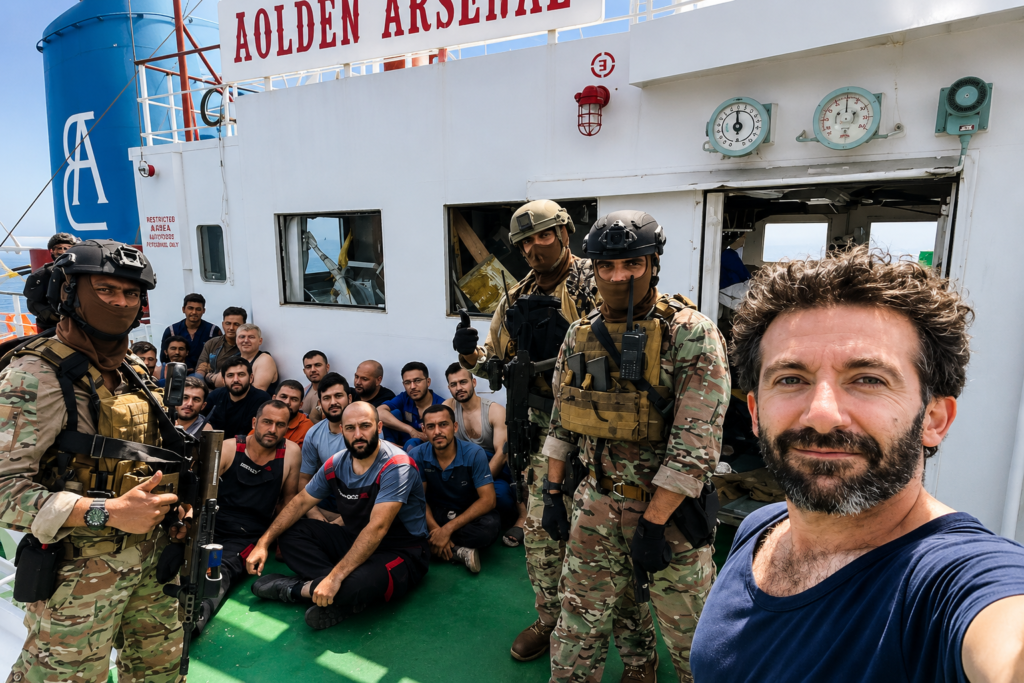
The Indian Navy has carried out another major anti-piracy operation in the Gulf of Aden after INS Trikand intercepted and secured the merchant vessel MV Golden Arsenal following an attempted pirate attack in one of the world’s most volatile shipping corridors. The operation, which unfolded over nearly 24 hours between July 1 and July 2, prevented armed attackers from taking control of the vessel and safeguarded 21 crew members onboard, including one Indian national.
The St. Vincent and the Grenadines-flagged bulk carrier was travelling from Aden towards India with critical commercial cargo when it came under attack nearly 300 nautical miles east-northeast of Djibouti. During the assault, armed pirates damaged the vessel’s bridge superstructure and parts of its adjacent accommodation block, but failed to gain access to the crew after emergency anti-piracy procedures were activated.
The distress call triggered an immediate operational response by the Indian Navy through its Information Fusion Centre Indian Ocean Region, leading to the rapid diversion of INS Trikand, which was already deployed in the region under India’s mission-based anti-piracy framework. The arrival of the warship forced the attackers to abandon the assault before MARCOS commandos boarded and cleared the vessel.
The latest operation is being viewed as another demonstration of India’s growing strategic role in protecting commercial shipping routes across the western Indian Ocean, at a time when piracy threats are showing signs of resurgence after years of decline.
Distress Call and Attack
The attack on MV Golden Arsenal began late on July 1 when armed pirates in fast-moving skiffs approached the merchant vessel as it transited through a known piracy-prone sector of the Gulf of Aden. According to Indian naval officials, the attackers attempted to force entry onto the ship, targeting operational sections of the vessel in what appeared to be an effort to disable command functions.
The crew immediately activated the vessel’s anti-piracy response system and retreated into the citadel, a fortified emergency shelter designed to keep crew members secure during hostile boarding attempts. This tactical response has become standard practice across high-risk commercial routes, particularly near the Horn of Africa.
Officials confirmed that while the attackers caused physical damage to the bridge superstructure and accommodation sections, they were unable to gain control of the ship or access the crew.
“The crew had taken shelter in the vessel’s citadel and remained safe throughout the attack,” Indian government officials said after the operation.
Maritime experts say the ability of crews to execute these emergency drills quickly often determines whether an attack turns into a hostage crisis. In this case, the decision to secure the citadel bought critical time for naval intervention.
The distress alert was relayed through the Information Fusion Centre Indian Ocean Region, India’s central maritime intelligence and coordination hub, which has become a critical node for tracking shipping threats and coordinating responses across regional waters.
INS Trikand’s Response
INS Trikand, a Talwar-class stealth frigate deployed on anti-piracy patrol in the Gulf of Aden, was immediately redirected after the distress signal was received. The vessel is part of India’s long-running mission-based deployment strategy aimed at maintaining naval presence across critical sea lanes.
Indian Navy officials said the warship reached the merchant vessel in a matter of hours, demonstrating the operational readiness maintained in one of the busiest shipping lanes in the world.
The arrival of INS Trikand forced the suspected pirates to flee before they could establish control over the ship. Defence officials say such rapid interventions often prevent hijackings from escalating into prolonged hostage situations.
Following the retreat of the attackers, the Indian Navy deployed its Marine Commandos, known as MARCOS, to board the vessel and carry out a complete sanitisation operation.
The commandos searched every deck, compartment and engineering section to ensure no hostile personnel remained onboard and that no explosives or weapons had been planted.
“Following a thorough search and sanitisation operation, no suspicious personnel or threats were found onboard,” the Indian Navy said.
After the vessel was declared secure, crew members emerged from the citadel and worked alongside Indian naval personnel to assess the damage and restore critical onboard systems.
Security analysts note that these post-attack assessments are often as important as the rescue itself, especially when structural or navigational systems have been compromised.
Air Surveillance and Tactical Coordination
Alongside INS Trikand’s deployment, the Indian Navy also launched a P-8I long-range maritime reconnaissance aircraft to support the mission from the air. The aircraft was tasked with tracking surrounding maritime activity and identifying possible pirate escape routes.
The P-8I has become one of India’s most important maritime surveillance assets, capable of covering vast oceanic stretches and relaying live tactical intelligence back to naval ships.
Officials said the aircraft maintained a broad surveillance perimeter around MV Golden Arsenal while INS Trikand carried out its boarding and sanitisation operations.
This combined sea-air response reflects the increasingly integrated anti-piracy doctrine adopted by India in recent years. Naval strategists say the ability to coordinate surface warships, aerial assets and special forces simultaneously has significantly improved operational speed and threat neutralisation.
Former Indian Navy officers have repeatedly argued that such coordinated responses are now essential because piracy networks have evolved, often using decentralised attack methods and intelligence-sharing among criminal groups.
“Speed, surveillance and coordination are the three pillars of modern anti-piracy operations,” former Vice Admiral Shekhar Sinha said in previous assessments on Indian Ocean security.
The successful deployment of all three elements in this operation underlined India’s expanding maritime capability.
Why the Gulf of Aden Matters
The Gulf of Aden remains one of the world’s most strategically important shipping lanes, connecting the Red Sea to the Arabian Sea and serving as a gateway between Europe and Asia. Every year, thousands of cargo ships carrying oil, industrial goods, food supplies and raw materials pass through this narrow corridor.
For India, the route carries exceptional economic significance. A large portion of India’s imports, including crude oil, fertilisers and industrial materials, move through these waters.
Any disruption in this corridor has immediate implications for freight costs, supply chains and insurance rates.
Officials confirmed that the cargo onboard MV Golden Arsenal was critical for Indian commercial interests, making the protection of the vessel strategically significant.
External Affairs Minister S. Jaishankar has repeatedly stressed the importance of maritime security to India’s economic stability.
“Secure seas are essential for stable global commerce and uninterrupted supply chains,” Jaishankar said during earlier maritime security discussions.
India has steadily expanded its naval footprint across the Indian Ocean Region, often responding to emergencies involving foreign-flagged vessels as part of its broader strategy of being a regional security provider.
The rescue image of one Indian sailor flashing a peace sign beside INS Trikand after the operation has become a symbolic reflection of the confidence merchant crews increasingly place in Indian naval protection.
Rising Global Piracy Threat
The attempted seizure of MV Golden Arsenal comes amid renewed concern over piracy in the western Indian Ocean, with maritime security agencies warning that attacks are becoming more frequent after a relatively quieter period.
The International Maritime Organization has warned that at least three merchant vessels remain under pirate captivity, underlining the persistence of maritime insecurity despite years of international naval patrols.
Security experts say worsening instability in parts of the Horn of Africa, combined with economic hardship and weak coastal enforcement, continues to create conditions for piracy networks to survive and regroup.
This is also the second anti-piracy intervention involving INS Trikand in less than three weeks. On June 17, the same warship responded to another piracy-related emergency in the same broader region, reinforcing concerns about rising threat levels.
Since 2008, the Indian Navy has maintained almost uninterrupted anti-piracy deployments in the Gulf of Aden, escorting thousands of merchant vessels and conducting multiple rescue operations.
Naval officials say this operational continuity has positioned India as one of the most active maritime security actors in the region.
“As a preferred security partner and first responder in the Indian Ocean Region, the Indian Navy remains committed to safeguarding merchant shipping and securing international sea lanes,” naval officials said following the latest operation.
For India, the successful protection of MV Golden Arsenal is not only another tactical victory at sea but also a broader strategic signal. It reinforces New Delhi’s ambition to remain a central stabilising force in the Indian Ocean at a time when maritime security is becoming increasingly linked to economic security, geopolitical competition and global trade resilience.
For the 21 sailors onboard, the immediate outcome was survival. For India, it was another assertion of naval reach in waters where every minute can determine the difference between rescue and captivity.


