

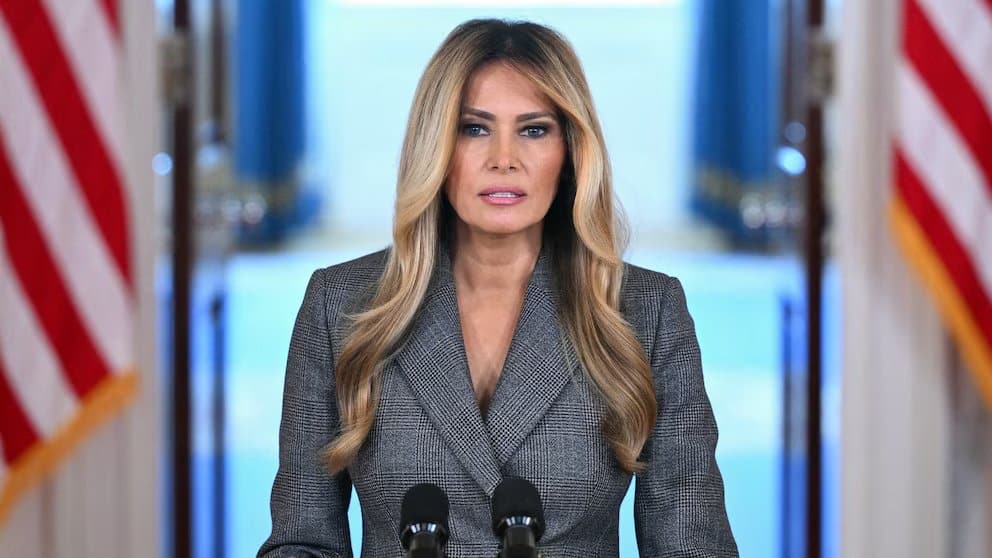
The Melania Trump has brought renewed attention to the Jeffrey Epstein case after issuing a rare public statement in which she denied any personal links and called for victims to testify publicly. Delivered in a White House setting, the remarks come at a time of heightened scrutiny following the release of extensive Epstein-related documents and growing political pressure for further disclosures.
Her statement focused on addressing longstanding allegations, clarifying past interactions and calling for greater transparency in the handling of the case. The intervention has prompted immediate political and legal responses, while also drawing criticism from survivors and advocacy groups. The timing of the statement is significant, as it comes amid renewed debate in the United States over how much information related to Epstein’s network has been made public and whether further institutional action is required.
Clear Denial
Melania Trump issued a direct and unambiguous denial of any association with Epstein, stating, “I never had a relationship with Jeffrey Epstein.” She also pushed back against claims suggesting deeper links, describing such allegations as misleading and inaccurate.
Addressing another long-standing claim, she said Epstein had no role in introducing her to Donald Trump. According to her statement, she met Donald Trump independently in 1998. This clarification directly challenges a narrative that has circulated in public discourse and media reporting over the years.
She acknowledged that she may have encountered Epstein at social events but emphasised that any such contact was brief and did not develop into any form of ongoing relationship. Her remarks consistently separated incidental contact from claims of personal or social association, reinforcing her position that she had no substantive connection to Epstein or his circle.
Email Clarified
Melania Trump also addressed a resurfaced 2002 email involving Ghislaine Maxwell, which has been cited in discussions about her past links to Epstein’s network. She described the email as “trivial”, stating that it did not indicate any meaningful relationship or connection.
By directly responding to documented material, she sought to counter interpretations that have been drawn from archived correspondence. Her clarification reinforced her broader argument that isolated interactions have been overstated and taken out of context.
The reference to the email is significant because it engages with verifiable records rather than general allegations. In doing so, her statement attempts to draw a clear distinction between documented contact and claims of deeper involvement, which have been a persistent feature of public debate surrounding the Epstein case.
Testimony Call
A central element of her remarks was her call for victims connected to the Epstein case to testify publicly. She said victims should come forward and testify “under oath”, arguing that such a process would strengthen transparency and accountability.
Her statement positioned public testimony as a means of establishing a clearer and more comprehensive record of events. While she did not outline a detailed mechanism for how such testimony would be conducted, her remarks align with ongoing political discussions about the need for further examination of the case.
Following her statement, lawmakers indicated that hearings involving Epstein survivors could be organised. This suggests that her call may have accelerated or reinforced existing political momentum towards formal proceedings. The emphasis on sworn testimony reflects a preference for structured legal processes rather than informal disclosures.
Survivor Response
Survivors and advocacy groups responded critically to the proposal for renewed public testimony. Several argued that victims have already provided extensive evidence through legal proceedings and should not be required to repeat their experiences in public forums.
Some survivors warned that additional testimony could result in further trauma, particularly in high-profile settings such as congressional hearings. Others raised concerns that such proceedings could become politicised, shifting the focus away from accountability and towards political narratives.
There were also arguments that responsibility for accountability should lie with institutions rather than victims. Survivors emphasised that the burden of proving wrongdoing should not repeatedly fall on those who have already come forward. The response highlights ongoing tensions between calls for transparency and the need to protect victims from further harm.
Legal Developments
Melania Trump’s remarks come amid continuing legal developments linked to the Epstein case. Authorities in the United States have released millions of documents related to investigations, including material identifying more than a thousand alleged victims. These disclosures have intensified scrutiny and renewed questions about the extent of Epstein’s network.
Legal representatives connected to the case have indicated that further information could emerge, raising the possibility of additional revelations. Reports have also pointed to tensions within the legal and political system, reflecting the ongoing sensitivity of the issue.
The case has remained under scrutiny since Epstein’s arrest in 2019 on federal sex trafficking charges. He died in custody later that year, with his death officially ruled a suicide. However, questions about the circumstances have persisted, contributing to broader concerns about institutional accountability.
Political Response
Melania Trump’s statement prompted an immediate response from political figures, with lawmakers signalling that hearings involving Epstein victims could be held. This reflects growing pressure within the United States to revisit aspects of the case and examine whether further action is required.
The remarks were described as unusual given her historically limited role in political communication. Reports indicated that the intervention came as a surprise in political circles, suggesting it may not have been part of a coordinated messaging strategy.
The renewed focus on the Epstein case comes as public and political interest remains high, particularly following recent document releases. Lawmakers continue to face questions about transparency, accountability and the extent to which all relevant information has been made available.
Ongoing Developments
The situation remains active, with multiple strands of political and legal activity underway. The potential for congressional hearings, combined with the possibility of further disclosures, indicates that the Epstein case continues to evolve.
Melania Trump’s statement has contributed to this renewed momentum by bringing attention back to unresolved questions and ongoing processes. While her remarks were primarily focused on addressing allegations and calling for testimony, their impact has extended into broader discussions about accountability and transparency.
As developments continue, the case remains a subject of sustained scrutiny within both legal and political frameworks, with further actions likely to shape its trajectory in the coming months.


