

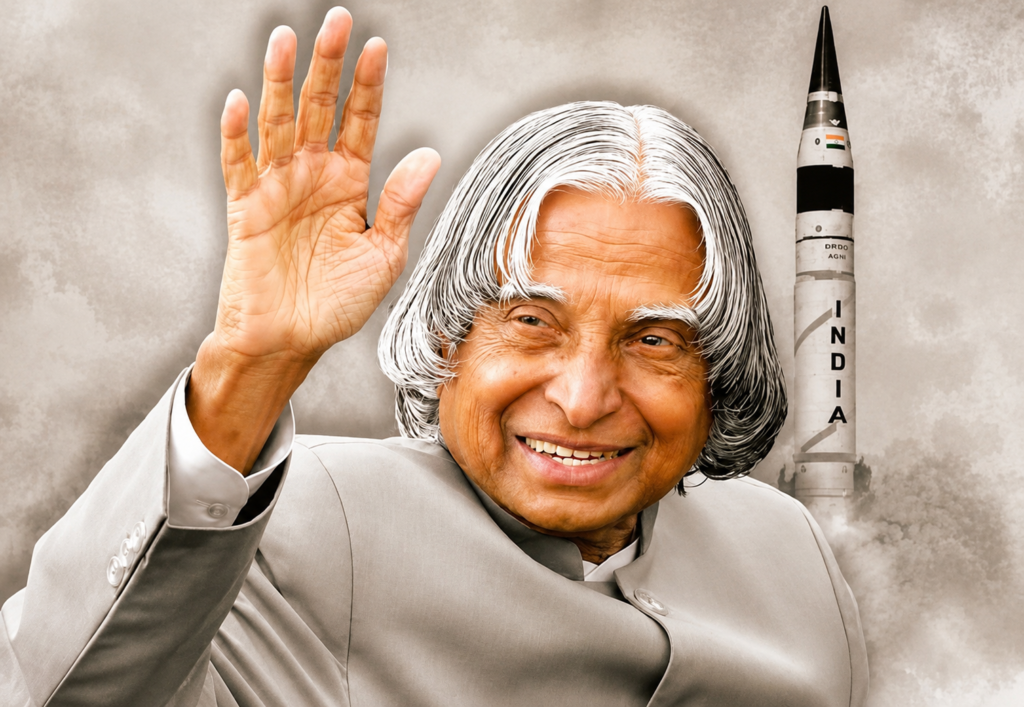
Every year on the 27th of July, something quiet happens across India. No fireworks, no grand parades, just millions of people pausing for a second to remember a man who never wanted to be remembered as a President at all. He wanted to be remembered as a teacher. He was a scientist who built missiles, a President who lived like a monk, and a public figure who somehow never stopped feeling like everyone’s favourite teacher.
Today, on his eleventh death anniversary, tributes are once again arriving from Parliament, from state capitals, from classrooms, and from ordinary citizens who never met him but still feel like they lost someone personal. That wish of his, to be remembered simply as a teacher, is exactly what the nation keeps granting him, year after year, without anyone having to ask.
A lecture he never finished
Dr APJ Abdul Kalam, the eleventh President of India, the Missile Man, the People’s President, died on this day in 2015. But here is the detail that most tributes gloss over. He did not die in a hospital bed or in retirement comfort. He died mid sentence, delivering a lecture titled Creating a Livable Planet Earth to students at IIM Shillong.
He passed away after suffering a cardiac arrest while addressing that room, and true to his lifelong passion for teaching, he spent his final moments interacting with students. If you had to script the perfect ending for a man who lived for young minds, you could not have written it better. Life did it for him.
Leaders pay tribute today
Only a day before this anniversary, Prime Minister Narendra Modi used his Mann Ki Baat broadcast to fondly recall Kalam, saying the former President had inspired children and the youth to dream. That set the tone for a day full of tributes. Union Home Minister Amit Shah called him the architect of India’s space and missile programmes, whose excellence in science lit India’s path to becoming a formidable strategic power. Lok Sabha Speaker Om Birla went a step further and quoted Kalam directly, recalling his line that dreams are not what come while sleeping, but what do not let you sleep.
Uttar Pradesh Chief Minister Yogi Adityanath credited him with giving India a new global identity in defence and space, and with helping make the country a nuclear power. DRDO issued its own tribute calling him one of India’s greatest scientific visionaries, and the Congress party remembered his humility and his faith in the power of youth. In Andhra Pradesh, Governor S. Abdul Nazeer and Chief Minister N. Chandrababu Naidu paid their respects, Deputy Chief Minister Pawan Kalyan highlighted his enduring vision for India’s progress, and former Chief Minister Y.S. Jagan Mohan Reddy called him an inspiration.
The rank that redirected history
But if you scroll past the official statements and the recycled quote cards, there is a far more interesting story hiding underneath. It is the story of a man who failed at the one thing he wanted most, and turned that failure into a template for an entire nation. Kalam’s first dream was not rockets. It was fighter jets. He wanted to fly for the Indian Air Force, and he sat for the selection and cleared the process, only for the gut punch to arrive at the very last stage. He was placed ninth in the qualifiers, and only eight positions were available.
One single rank. That is all that stood between the boy from Rameswaram and a cockpit. Most people would have called that the end of the road. Kalam called it a redirection. He walked into aerospace engineering instead, and by July 1980, as project director, he had helped put the Rohini satellite into orbit aboard India’s first indigenous Satellite Launch Vehicle, making India an exclusive member of the world’s space club. The country whose skies he could not patrol as a pilot came to depend on the rockets and missiles he designed to protect it.
The scientist who worried about sparrows
There is another story that rarely makes it into the tribute columns, and it says more about him than any award ever could. While working at the Defence Research and Development Organisation, he rejected a proposal to place broken glass pieces on the compound walls to prevent break ins, because he feared the glass might hurt birds that perched there. Here was a man building missile systems capable of striking targets hundreds of kilometres away, and in the same breath, he was worried about sparrows landing on a wall. That contradiction, ferocious about national defence and tender about the smallest living thing, is probably the truest summary of who he was.
The same restraint showed up in how he handled money. Dr Kalam donated his entire salary as President to PURA, Providing Urban Amenities to Rural Areas, a trust he had founded himself, reasoning that the government would take care of him until his last breath, so there was no harm in giving away every rupee he earned. He also carried a musical instrument called the veena wherever his schedule allowed, wrote Tamil poetry in his spare hours, and remained a strict vegetarian and a bachelor his entire life. He took office as the eleventh President of India on 25 July 2002, and honorary doctorates poured in from around thirty universities, yet he insisted that a title he valued more than any of them was simply teacher.
The answer he gave a journalist
Perhaps the most telling anecdote of all is the one about a journalist’s question. Asked whether he wanted to be remembered as a scientist, a President, or a teacher, Kalam did not hesitate. He wanted to be remembered as a teacher first, and after that, like any other person. Not the Missile Man. Not Rashtrapati. Just a teacher, and then just a person. In a country obsessed with titles and legacies, that answer alone deserves more attention than it usually gets.
As tributes flow in through the day, from Parliament corridors to state secretariats to classrooms holding essay competitions in his memory, the real tribute is not the wreath laid or the quote shared online. It is the reminder Kalam offers every single year without fail, that failing your first dream can still lead somewhere bigger, that holding power does not have to mean holding on to everything, and that eleven years after IIM Shillong, the lecture he never finished is, in some strange way, still being delivered to anyone willing to attend class.


