

Keir Starmer has resigned as British prime minister, ending a government that came to power less than two years ago with one of Labour’s biggest election victories in modern history. His exit makes him the sixth UK prime minister to leave office before completing a full term in just ten years, extending a period of political instability that has defined Britain since Brexit.
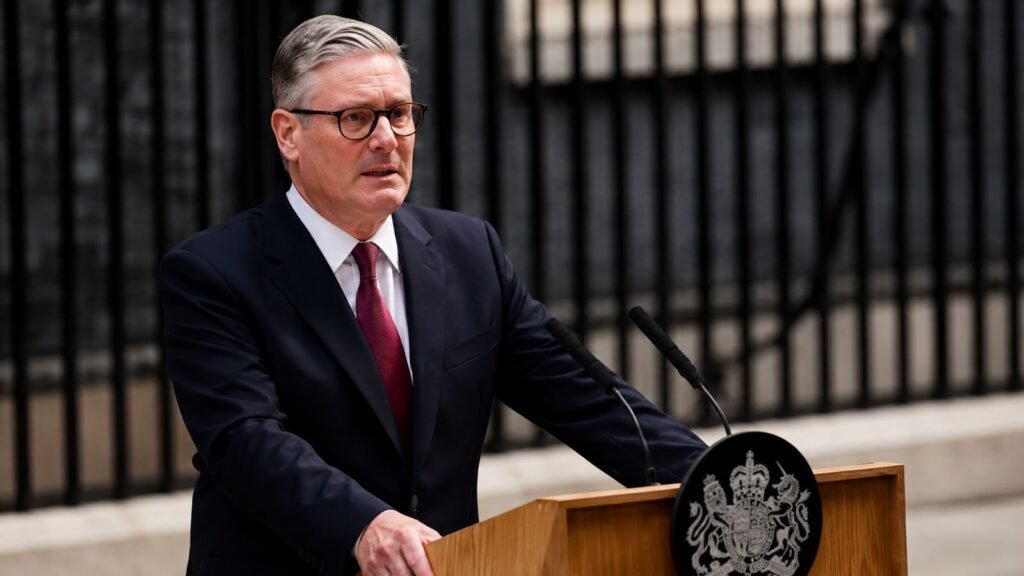
Standing outside 10 Downing Street on Monday, Starmer confirmed his departure after mounting pressure from Labour MPs. Before formally stepping down, he defended his record, pointing to rising wages, improving economic growth, infrastructure spending and reduced NHS waiting lists. But the key line of his speech revealed the deeper political reality.
“The question my party is asking now is whether I am best placed to lead us into the next general election.”
It was a striking acknowledgment from a leader known for discipline and caution. Starmer said he had “served with everything I had” and that every decision had been made “with the national interest at heart.” He added that he would leave office “with good grace.”
His resignation closes one chapter for Labour and opens another for Britain.
The promise
When Starmer won the July 2024 election by a landslide, he was seen as the man who could restore order after years of Conservative chaos. Britain had gone through Brexit turmoil, Boris Johnson’s scandals, Liz Truss’s economic collapse and Rishi Sunak’s defeat. Voters wanted stability and Starmer offered exactly that.
His background as a former chief prosecutor helped build trust. He projected seriousness, control and competence. Labour’s message was simple. Stability, order and repair.
That strategy worked because voters were exhausted by crisis. But once in office, Starmer quickly discovered that political calm does not automatically solve economic pain. Inflation slowed, but living costs remained high. Public services were still under strain. Economic growth remained fragile. Migration continued to dominate headlines.
The government looked stable, but the country still felt unsettled.
The decline
By early 2026, Labour’s polling numbers had begun to fall sharply. Many voters felt the government was moving too slowly on the economy and healthcare. NHS waiting lists remained politically toxic, while illegal Channel crossings became a daily symbol of government weakness.
At the same time, Reform UK under Nigel Farage was gaining momentum by tapping into voter frustration. Farage positioned himself as the anti-establishment challenger, targeting Labour’s traditional working-class support.
That shift became obvious in the May local elections.
Labour lost heavily across England and suffered major setbacks in Wales and Scotland. The results triggered alarm inside the party because many of those lost votes were not going back to the Conservatives. They were moving to Reform UK.
For Labour MPs, the question was no longer whether Starmer was unpopular. It was whether he could still win.
The revolt
The biggest threat to Starmer came from inside his own party.
For months, Labour MPs had grown frustrated with what they saw as a lack of political direction. Starmer’s cautious style, once considered an advantage, was increasingly seen as a weakness. Policy reversals and unclear messaging damaged his authority.
The pressure intensified after two senior defence resignations over military spending disagreements earlier this month. Those departures exposed cabinet divisions and raised fresh questions about Starmer’s leadership.
At the same time, donors and trade unions reportedly began privately questioning whether Labour needed a new face before the next election.
By the weekend, senior ministers had warned Starmer that support inside Parliament was collapsing.
That left him with little room to survive.
Burnham returns
The decisive moment came when Andy Burnham returned to Parliament through a by-election victory in Makerfield.
Burnham’s return instantly changed Labour’s internal politics. As former Mayor of Greater Manchester, he had built a reputation as a stronger communicator with deeper connections to working-class voters. Unlike Starmer, Burnham had remained politically popular outside Westminster.
His return gave Labour MPs a realistic alternative.
Within days, reports suggested nearly 200 MPs were ready to support him in a leadership race. That made Starmer’s position impossible.
Rather than face a damaging internal contest, he stepped aside.
It was not a dramatic coup. It was a calculated transfer of power.
The transition
Starmer’s resignation has been tightly controlled.
He announced that the Labour leadership contest will begin on July 9 and that he will remain as caretaker prime minister until a successor is chosen. Party officials expect the process to be completed before Parliament returns in September.
There had been speculation that Foreign Secretary David Lammy might temporarily step in, but Starmer chose to stay and oversee the transition himself.
That decision reflects his political style. Even in resignation, he prioritized order over chaos.
It also gives Labour time to steady itself before the next phase.
What comes next
Andy Burnham is now the overwhelming favourite to replace Starmer. His position became even stronger after Wes Streeting withdrew from the race and endorsed him. That has led many inside Labour to believe Burnham could win without a serious challenge.
If that happens, Britain could have a new prime minister within weeks.
Opposition parties are already calling for a general election. Nigel Farage has argued that voters should choose the next prime minister directly. But under Britain’s parliamentary system, Labour can replace its leader without going back to the public.
That means Burnham could inherit office immediately.
His leadership would likely shift Labour toward a sharper and more populist political style.
The legacy
Keir Starmer leaves office with a mixed but significant legacy. He rebuilt Labour after its crushing 2019 defeat and returned it to power when many believed it would take years. He restored party discipline, repaired international alliances and became one of Europe’s strongest backers of Ukraine.
But at home, his politics struggled to inspire.
He was trusted, but often not loved. He was competent, but rarely seen as transformative. In a political era shaped by anger and urgency, that became his greatest weakness.
His resignation now places him alongside David Cameron, Theresa May, Boris Johnson, Liz Truss and Rishi Sunak in Britain’s growing list of unfinished premierships.
Britain is now preparing for its seventh prime minister in ten years.
And the question remains whether any leader in modern British politics can still last.


