

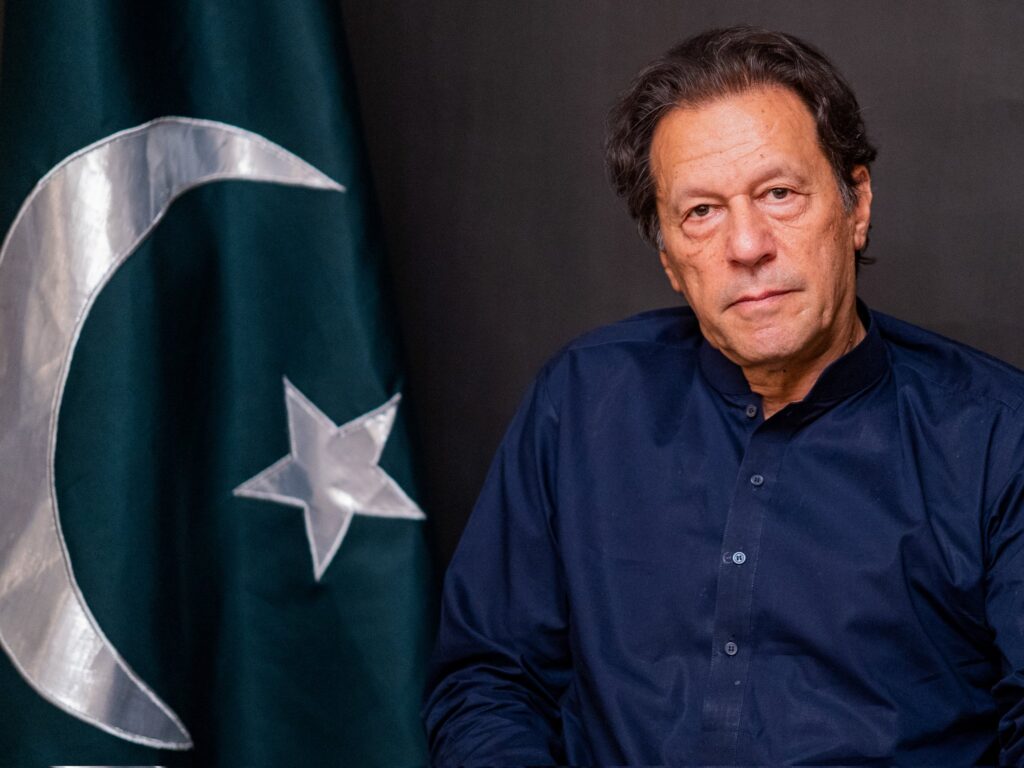
Imran Khan has become the focus of Pakistan’s most volatile political and human-rights debate in years, as his family, supporters and political observers demand verified proof of his condition inside Adiala Jail. The former prime minister, detained for over two years on a range of politically charged cases, has reportedly been held in extended solitary confinement, with no contact granted to family members or lawyers for several weeks.
The situation escalated dramatically when his son, Kasim Khan, issued a direct and urgent statement that has since gone viral across Pakistan and global political circles. His words transformed what had been a simmering concern into a national question: Where is Imran Khan, and what is his condition?
Kasim said his father has been kept in a “death cell” under a total blackout, describing the environment as deliberately opaque and designed to prevent the family from confirming he is alive. His appeal has since become the emotional and political center of an already polarized national atmosphere.
Kasim Khan’s Explosive Statement
Kasim’s statement has been one of the most forceful and alarming public declarations ever made by a close family member of the former prime minister. Speaking on social media, he said:
“My father has been under arrest for 845 days. For the past six weeks, he has been kept in solitary confinement in a death cell with zero transparency. There have been no phone calls, no visits and no proof of life. This is not security protocol. It is a deliberate attempt to hide his condition.”
Kasim added that all court-ordered visits have been blocked, including scheduled access for Imran Khan’s sisters. He said the family has not had any contact whatsoever since early November, and that there is still no confirmation that the former prime minister has been examined by an independent doctor.
His warning was blunt and uncompromising:
“Let it be clear: the Pakistani government and its handlers will be held fully accountable legally, morally and internationally.”
The statement’s tone and urgency ignited a fire across Pakistan’s political ecosystem. It coincided with widespread rumors online about Imran Khan’s health, physical condition and potential mistreatment — rumors that have multiplied due to the complete absence of recent verified images, medical reports, or appearance before court.
Visitation Blocked Despite Court Orders
The crisis escalated after multiple reports confirmed that Imran Khan’s sisters, lawyers and doctors were denied access even when the Islamabad High Court had allowed scheduled visits.
His sister Aleema Khan filed a contempt petition asserting that the prison administration has “wilfully violated” the court’s order and is obstructing all contact with the family.
Key allegations include:
- No family visit permitted for over six weeks
- Legal team denied entry, preventing consultations
- Medical staff blocked, leaving his health unverified
- No documentation released, including medical updates or photos
These violations have fueled claims that the authorities are hiding his condition, a sentiment echoed by PTI leaders who argue that the blackout is politically motivated and designed to silence Imran Khan entirely.
Protests, Government Statements and Conflicting Claims
As the family’s warnings spread across the country, PTI supporters, civil society groups and concerned citizens intensified demonstrations outside Adiala Jail, demanding clear proof of the former prime minister’s well-being. Protests erupted in Rawalpindi, Lahore and parts of Khyber Pakhtunkhwa, with crowds chanting for “proof of life” and accusing authorities of deliberately withholding access. The tension escalated further when reports circulated that Imran Khan’s sisters and legal team had once again been denied entry, despite previous court orders. Several videos from the protest sites showed police pushing back demonstrators as they attempted to approach the jail’s restricted perimeter.
In response to the growing unrest, Adiala Jail authorities issued an official statement insisting that Imran Khan remains inside the prison, is “safe and healthy,” and continues to receive regular care. Officials also stressed that he has not been transferred and is not facing any medical emergency. Government ministers echoed these assurances, publicly declaring that Imran Khan is “absolutely fine” and dismissing all rumours of deteriorating health as unfounded.
However, authorities have not provided any recent verified photo or video, any updated medical report, or any documented confirmation of the last time Imran Khan spoke to family, lawyers or medical personnel. Officials have also offered no explanation for the abrupt halt in court-mandated visits, a silence that continues to deepen public suspicion. This ongoing lack of physical or documentary evidence is the central factor sustaining nationwide concern and keeping the issue firmly at the forefront of Pakistan’s political debate.
How the Crisis Reached This Point
Imran Khan’s current predicament cannot be viewed in isolation. It is the result of a multi-year political, legal and institutional confrontation.
April 2022
He was removed from office through a parliamentary vote. His relationship with Pakistan’s military and establishment deteriorated rapidly afterward.
May 2023
Imran Khan was arrested in the Al-Qadir Trust case, resulting in widespread protests. The Supreme Court later termed the arrest unlawful in its manner of execution.
August 2023 onwards
He faced a series of high-profile cases including the Toshakhana gifts case, the cypher case, and multiple corruption charges. Some convictions were suspended or overturned, while others remain under appeal.
2024–2025
Several sentences were issued against him in different cases, keeping him in long-term custody. All this resulted in his prolonged detention at Adiala Jail, where he has remained for over a year.
Throughout this period, human-rights organisations repeatedly flagged fair-trial concerns, pointing to rapid indictments, limited legal access and the unusually high number of cases initiated against a single political figure.
Pakistan Awaits Answers
As court hearings resume and public pressure intensifies, the question dominating Pakistan today is no longer political it is existential. The country, the region, and observers abroad are all waiting for clear, independently verified proof of Imran Khan’s condition.
Until such proof emerges, the crisis is expected to deepen, with political, legal and international dimensions now intertwined. What began as a routine visitation dispute has transformed into the most high-stakes transparency demand Pakistan has faced in years.
For now, one question reverberates across the nation:“Where is Imran Khan?”


