

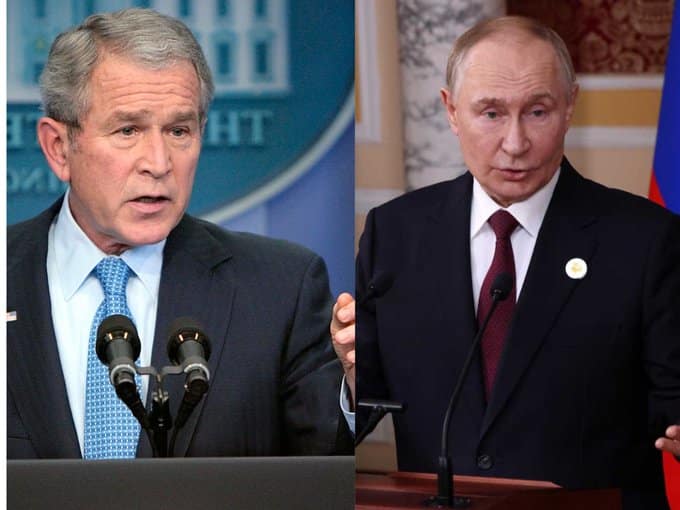
Newly declassified transcripts released by the United States National Security Archive have revealed that Russian President Vladimir Putin privately warned US President George W. Bush that Pakistan was a “junta with nuclear weapons”, raising alarm over the country’s military-led governance, weak democratic oversight, and serious nuclear proliferation risks.
The documents, drawn from private meetings between 2001 and 2008, show that despite Pakistan’s public status as a key US ally, both Washington and Moscow were deeply uneasy about Islamabad’s control over its nuclear arsenal. In one striking exchange, Bush admitted, “It makes us nervous, too,” as Putin urged him to consider how nuclear leaks could directly threaten Russian security.
The revelations offer rare insight into how global powers privately viewed Pakistan at a time when public diplomacy painted a far more restrained picture.
Why Did Putin Call Pakistan a Junta?
Putin’s language was unusually blunt for a private diplomatic exchange.
“It is just a junta with nuclear weapons. It is no democracy, yet the West does not criticise it.”
The use of the word junta was deliberate. It reflected Moscow’s belief that Pakistan’s political system lacked democratic legitimacy and civilian oversight, conditions that significantly increased nuclear risk.
Putin contrasted Pakistan’s treatment with that of Iran and North Korea, arguing that Western governments applied double standards by tolerating Pakistan’s nuclear status while aggressively pressuring others.
How Did Bush Respond to the Junta Remark?
Bush did not challenge Putin’s assessment. Instead, the declassified records show that he acknowledged Pakistan remained a serious non-proliferation concern, even as Washington relied heavily on Islamabad for strategic cooperation in South Asia.
The exchange highlights a key contradiction in US policy at the time. Publicly, Pakistan was a critical partner. Privately, its nuclear stewardship was viewed with suspicion at the highest levels of government.
How Did Nuclear Fears Resurface in 2005?
Concerns about Pakistan’s nuclear programme resurfaced repeatedly in later meetings.
During a September 29, 2005 conversation in the Oval Office, Putin raised a highly sensitive intelligence issue. He told Bush that uranium found in Iranian centrifuges was of Pakistani origin.
Bush immediately acknowledged the gravity of the finding.
“Yes, the stuff the Iranians forgot to tell the IAEA about. That’s a violation,” Bush said.
Putin responded that the Pakistani origin of the uranium made him nervous. Bush replied, “It makes us nervous, too.”
Putin then added a pointed remark: “Think about us.”
The exchange underscored Russia’s fear that nuclear material leaking from a military-led system like Pakistan could pose a direct threat to its own security.
What Did This Reveal About Proliferation Risks?
The dialogue confirmed that Pakistan’s nuclear programme was not seen as a contained national issue.
Instead, it was viewed as a global proliferation threat, particularly due to evidence linking Pakistan to Iran’s nuclear enrichment activities.
The transcripts reinforced intelligence assessments that sensitive nuclear material and technology had moved beyond Pakistan’s borders, raising fears of further illicit transfers.
How Did Bush Raise the Issue With Musharraf?
Bush told Putin that he had personally confronted Pervez Musharraf after the exposure of Abdul Qadeer Khan’s nuclear smuggling network.
Khan, widely regarded as the architect of Pakistan’s nuclear bomb, was found to have supplied nuclear technology to Iran, North Korea, and Libya.
Bush said Musharraf had placed Khan and several associates under house arrest or in jail. However, he admitted that Washington still lacked full clarity on what had been transferred and to whom.
“We want to know what they said,” Bush remarked, reflecting frustration over incomplete disclosures from Pakistani authorities.
Putin added that Russian experts believed interactions related to Iran’s enrichment programme may have continued. Bush said US intelligence assessments shared that concern.
Why the AQ Khan Network Deepened Fears
The AQ Khan network fundamentally altered how Pakistan’s nuclear programme was viewed internationally.
It demonstrated that proliferation could occur from within a state-run nuclear system, not just through rogue actors. For leaders like Putin and Bush, this reinforced fears that a military-dominated structure lacked sufficient internal safeguards.
The existence of such a network made Pakistan’s status as a nuclear-armed junta even more alarming.
Pakistan Outside the Nuclear Treaty System
Pakistan developed its nuclear weapons outside the Nuclear Non-Proliferation Treaty framework, unlike many other nuclear states.
This meant its programme was not subject to the same level of international oversight or transparency, further heightening concern among global powers.
The declassified transcripts show that this lack of formal accountability was a recurring theme in private discussions between Washington and Moscow.
Public Alliance and Private Anxiety
At the time these conversations took place, Pakistan was a frontline ally in the US-led War on Terror.
Publicly, US officials praised Islamabad’s cooperation. Privately, however, they remained uneasy about who ultimately controlled Pakistan’s nuclear assets and how secure those systems were.
Putin’s remarks reveal that Russia shared those anxieties and believed the risks were being underestimated by the international community.
Why These Revelations Matter Today
More than two decades later, Pakistan remains one of the world’s fastest-growing nuclear powers.
The declassified Putin-Bush transcripts confirm that concerns over a nuclear-armed junta are longstanding, bipartisan, and shared across geopolitical rivals.
They also show that nuclear risk is shaped not only by weapons technology but by governance, transparency, and political stability.
Unresolved Concerns
The phrase “a junta with nuclear weapons” was not a casual remark. It was a stark warning about the dangers of nuclear arms in the hands of a military-dominated system with limited democratic oversight.
The newly released transcripts expose how deeply both the United States and Russia worried about Pakistan’s nuclear programme, even while maintaining strategic partnerships.
As global attention once again turns to nuclear security, these documents serve as a reminder that some of today’s most serious risks were identified years ago and remain unresolved.


