

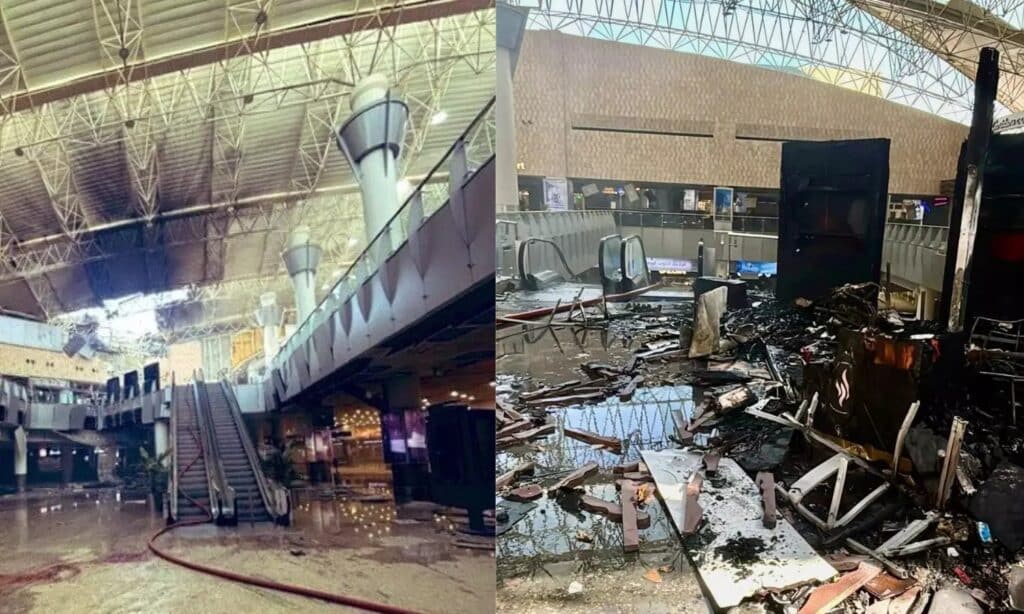
A reported Iranian drone and missile attack on Kuwait International Airport has intensified fears of a wider regional conflict, as military tensions involving Iran, Israel, Hezbollah and the United States continue to spread across multiple fronts in West Asia. The strike, which damaged infrastructure at Kuwait’s main aviation hub, disrupted flight operations and prompted emergency security measures, comes amid a broader escalation that has stretched from the Gulf to Lebanon and raised concerns about regional stability, global energy supplies and international transportation networks.
The airport attack unfolded against a backdrop of increasing military activity across the Middle East. Recent days have seen U.S. strikes against Iranian-linked targets, renewed Hezbollah rocket attacks on northern Israel, Israeli military operations in Lebanon and growing concerns over security in the Strait of Hormuz. Together, these developments have transformed what were once separate flashpoints into an interconnected regional crisis with significant geopolitical and economic implications.
Airport Strike
Kuwait International Airport became the latest target in the escalating confrontation after drones and missiles struck areas associated with airport operations. Kuwaiti authorities activated emergency response procedures as security forces and emergency teams moved to assess the damage and secure affected facilities.
According to official reports, at least one person was killed and dozens were injured in the attack. Authorities said Terminal 1 sustained significant damage, forcing temporary disruptions to airport operations. Several flights were diverted while safety inspections were carried out, and aviation authorities implemented emergency measures to protect passengers and staff.
Operations later resumed on a limited basis through Terminal 4 following security assessments, but the incident highlighted the vulnerability of critical civilian infrastructure in a region facing increasing security threats.
The attack also sent shockwaves through the aviation sector. Kuwait International Airport serves as a major transit hub connecting Asia, Europe and the Middle East, and any disruption to its operations has immediate implications for regional and international travel.
India confirmed that one of its nationals was killed in the attack, making it one of the most significant international casualties reported so far. The Ministry of External Affairs condemned the strike and said the Indian Embassy in Kuwait was coordinating with local authorities while providing assistance to affected citizens. New Delhi reiterated its call for the protection of civilians and civilian infrastructure and expressed concern over the deteriorating security situation across West Asia, home to millions of Indian expatriates.
Kuwaiti authorities said the attacks also affected civilian facilities and diplomatic missions, though officials did not immediately identify the diplomatic compounds involved. The government condemned the strike as a violation of Kuwait’s sovereignty and international law, while security agencies launched investigations into the incident and expanded protective measures around critical infrastructure.
Conflict Expands
The airport strike occurred amid a broader escalation involving Iran, the United States and regional allies. U.S. officials have accused Tehran of supporting attacks against American interests and partner nations, while Iran has maintained that its actions are linked to what it describes as efforts to counter military pressure and foreign intervention.
The confrontation widened further after reports of Iranian missile activity linked to Bahrain, where regional defence systems were activated and incoming threats were reportedly intercepted. The developments underscored concerns that the conflict is no longer confined to a single theatre but is increasingly affecting multiple countries across the Gulf.
The United States responded with military action targeting facilities on Iran’s Qeshm Island, describing the operation as a defensive measure aimed at degrading capabilities linked to drone and missile attacks. The exchange marked another significant escalation in a crisis that has steadily intensified over recent weeks.
U.S. President Donald Trump has repeatedly emphasized that Washington would defend its interests and allies in the region. “Iran must never have a nuclear weapon,” Trump said in recent remarks, while reiterating support for regional security partnerships and warning against attacks targeting American personnel or allies.
Iranian officials, meanwhile, have accused Washington of contributing to regional instability and have defended Tehran’s actions as necessary to protect its strategic interests. The competing positions illustrate the growing divide between the two sides as diplomatic efforts struggle to keep pace with military developments.
Despite the latest military exchanges, U.S. officials maintained that the ceasefire framework between Washington and Tehran technically remains in place. The position highlighted the complex diplomatic environment surrounding the conflict, with military operations continuing even as efforts to prevent a broader regional confrontation remain active.
Israel and Lebanon
At the same time, fighting along the Israel-Lebanon border has intensified, creating a second major front in the regional crisis.
Hezbollah launched fresh rocket attacks toward northern Israel, prompting Israeli military responses against targets in southern Lebanon and areas near Beirut. Israeli officials said the operations were aimed at preventing further attacks and degrading Hezbollah’s military infrastructure.
Israeli Prime Minister Benjamin Netanyahu defended the operations, stating that Israel would continue to act against threats to its security. “Israel will take whatever action is necessary to defend its citizens,” Netanyahu said, warning that continued attacks from Lebanon would draw further responses.
The latest exchanges have increased international concern over the possibility of a wider conflict involving Lebanon. Lebanese authorities have reported casualties from Israeli strikes, while health officials say thousands of people have been killed since the conflict intensified.
The situation has also created diplomatic challenges for the United States, which has sought to support Israel’s security while simultaneously working to prevent a broader regional war. Reports indicate that Trump urged restraint regarding major military operations in Beirut, highlighting concerns within Washington about the risk of further escalation.
Diplomacy Under Pressure
Despite the growing violence, diplomatic efforts continue behind the scenes.
U.S. Secretary of State Marco Rubio has been involved in discussions aimed at reducing tensions and establishing a longer-term security arrangement in Lebanon. American officials have emphasized the importance of preventing Hezbollah from re-establishing military influence in areas close to Israel’s northern border.
At the same time, wider negotiations involving Iran remain complicated by disagreements over sanctions, regional security issues and broader geopolitical disputes. Iranian officials have linked progress in diplomacy to economic and political conditions that remain contentious among Western governments.
Iranian officials have also linked broader diplomatic progress to developments in Lebanon and the continuation of Israeli military operations there. The position has emerged as another obstacle to efforts aimed at reducing tensions and reviving wider negotiations involving regional security and economic issues.
The latest attacks have placed additional strain on these negotiations. Every new military exchange increases pressure on diplomats attempting to prevent the conflict from expanding further.
Regional governments, including Gulf states, have also intensified efforts to coordinate security measures and protect critical infrastructure from potential future attacks.
Global Impact
Beyond the immediate military consequences, the crisis is drawing attention because of its potential impact on global trade and energy markets.
The Strait of Hormuz remains one of the world’s most strategically important waterways, handling a significant share of international oil exports. Heightened military activity in and around the Gulf has increased concerns about shipping security and the possibility of disruptions to commercial traffic.
Concerns over the security of shipping routes and energy infrastructure were reflected in global markets, with oil prices rising as investors assessed the potential impact of the escalating crisis. Analysts said uncertainty surrounding the Strait of Hormuz and wider Gulf security conditions remained a key factor influencing market sentiment.
Energy markets have closely monitored developments, while shipping companies have implemented additional security precautions amid fears of further escalation. Any prolonged instability affecting the Strait could have consequences extending well beyond the Middle East, influencing global energy prices and international trade flows.
The attack on Kuwait International Airport also demonstrated how civilian infrastructure has become increasingly exposed to the effects of regional conflicts. Airports, ports and commercial facilities now face risks that were once largely confined to military installations.
As military operations continue across multiple fronts and diplomatic efforts struggle to gain momentum, the Kuwait airport strike stands as one of the clearest signs yet that the West Asia crisis has entered a more dangerous and unpredictable phase.
The coming days will be closely watched by governments, markets and security officials worldwide as they assess whether diplomatic engagement can contain the conflict or whether the region is heading toward a broader confrontation with far-reaching consequences.


