

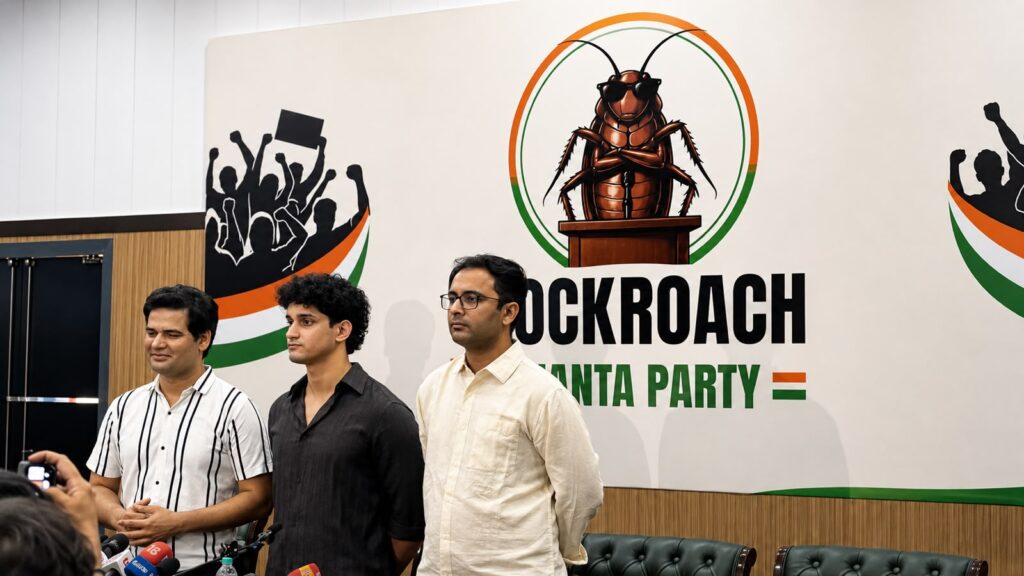
The Cockroach Janta Party (CJP), the youth-led movement that gained prominence through social media campaigns on education and employment issues, took a significant step toward formal organisation on Tuesday by appointing three official spokespersons and outlining its roadmap ahead of the June 6 protest in Delhi.
At its first formal press conference in the national capital, the movement introduced Saurav Das, Vijeta Dahiya and Ashutosh Ranka as its spokespersons, describing the appointments as part of an effort to build a structured organisation and develop a new generation of public leadership.
The announcement comes just days before CJP founder Abhijeet Dipke is scheduled to return to India and lead a protest at Jantar Mantar, which organisers say will focus on examination accountability, education reform and demands for greater institutional responsibility.
The press conference marks one of the clearest signs yet that the movement is attempting to evolve beyond its origins as a social media phenomenon and establish itself as a sustained public platform focused on student and youth issues.
First Press Conference
The June 3 press conference was the first official media interaction held by the Cockroach Janta Party since the movement began attracting national attention.
During the event, the newly appointed spokespersons outlined the organisation’s objectives and reiterated support for the June 6 mobilisation in Delhi.
The appointments were presented as a move toward institutionalising the movement’s activities and creating a framework that allows it to communicate more effectively with the public, policymakers and the media.
CJP representatives said the organisation was entering a new phase in which leadership responsibilities would be distributed among multiple public faces rather than being centred solely around founder Abhijeet Dipke.
The move is being viewed as an attempt to create a more durable organisational structure ahead of what is expected to be the group’s largest public demonstration so far.
The spokespersons also reaffirmed the movement’s position on examination-related controversies and repeated calls for accountability within the education system.
June 6 Protest
The press conference was largely focused on preparations for the June 6 protest at Jantar Mantar.
Organisers said the demonstration would proceed as planned and would remain peaceful.
The gathering is expected to coincide with Dipke’s return to India after spending time in the United States. In recent public statements, Dipke has said he intends to participate in the protest despite the possibility of facing legal action or detention.
Supporters have been urged to assemble in Delhi and participate through peaceful and democratic means.
The movement has repeatedly stressed that the protest is not intended to promote partisan politics but to highlight concerns surrounding examination systems and public accountability.
Organisers say participants from multiple states are expected to attend.
The June 6 mobilisation is widely seen as a test of whether the movement’s substantial online support can be converted into meaningful participation on the ground.
Education Demands
At the centre of the campaign are concerns related to examination governance and accountability.
CJP representatives have argued that recurring controversies involving major examinations have damaged public confidence in educational institutions and created uncertainty for students and families.
The movement has repeatedly referenced concerns linked to national examinations, including NEET, CUET and CBSE assessments, while calling for stronger oversight mechanisms and greater transparency.
A key demand associated with the June 6 protest is the resignation of Union Education Minister Dharmendra Pradhan.
Movement representatives have maintained that accountability must extend to senior decision-makers when examination systems face repeated criticism and controversy.
The issue has emerged as a major talking point in recent months, with students, educators and policy observers continuing to debate reforms aimed at improving transparency and safeguarding the integrity of high-stakes examinations.
The government has previously stated that measures have been undertaken to strengthen examination systems and address concerns arising from recent controversies.
From Online To Organisation
The Cockroach Janta Party first gained attention through social media, where its content resonated with young Indians discussing education, employment and governance-related issues.
Its unconventional branding and direct communication style helped it rapidly build an audience among students frustrated by examination-related controversies and broader concerns about opportunities for young people.
What began as an online movement has gradually expanded into petitions, volunteer networks, public campaigns and organised events.
The appointment of spokespersons represents the most visible attempt so far to formalise the organisation’s structure.
By creating designated public representatives, CJP appears to be positioning itself for sustained engagement beyond social media platforms.
The move also signals an effort to ensure continuity as the movement grows and attracts greater public attention.
Political observers have noted that youth-driven digital campaigns often struggle to maintain momentum once they move offline. The June 6 protest is therefore expected to serve as an important test of the group’s organisational capacity and long-term ambitions.
Wangchuk’s Support
While the press conference remained the central development of the day, the movement also received a significant boost this week from education reform advocate Sonam Wangchuk.
Wangchuk publicly backed the June 6 protest and said he would join demonstrators if no meaningful action is taken before June 5.
The activist has linked the campaign to broader concerns surrounding education governance and examination accountability.
In messages shared ahead of the protest, he called on participants to remain peaceful and urged supporters to conduct themselves through democratic means.
Wangchuk has also referred to concerns involving NEET, CUET and CBSE examinations while arguing that educational quality and institutional credibility are critical to India’s long-term development goals.
His support has brought additional national attention to the June 6 mobilisation and expanded public discussion around the movement’s demands.
For the Cockroach Janta Party, however, Tuesday’s press conference may prove equally significant. By appointing spokespersons, presenting a more formal leadership structure and reaffirming its protest plans, the organisation has signalled that it intends to move beyond viral social media campaigns and establish a sustained presence in India’s public debate on education and accountability.
As preparations continue for June 6, attention is now focused on whether that transition from online activism to organised public mobilisation can be successfully achieved in the national capital.


