

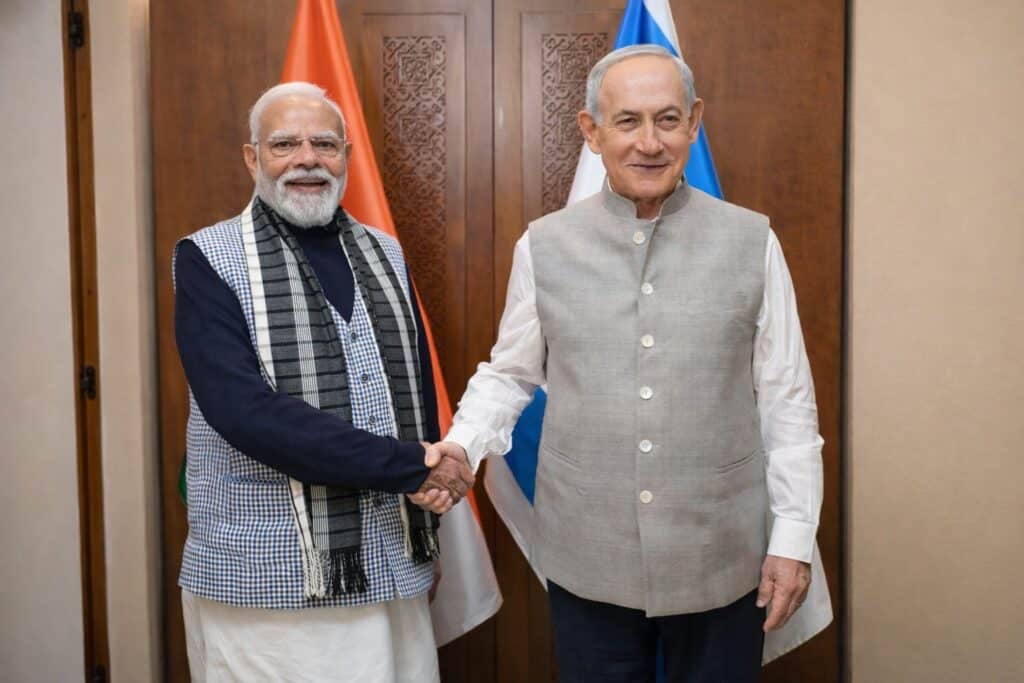
India and Israel elevated their bilateral relationship to a Special Strategic Partnership during Prime Minister Narendra Modi’s February 2026 visit to Israel, institutionalising cooperation across defence, trade, finance, critical technologies, and geopolitics. Officials on both sides described the upgrade as a long-term, future-oriented alignment built on decades of political trust.
The move comes as negotiations on a long-pending Free Trade Agreement (FTA) near conclusion, and both countries expand collaboration in sectors including artificial intelligence, cybersecurity, space, and advanced weapons systems. Analysts say the partnership signals a shift from sector-specific cooperation to structural integration, placing Israel among India’s most comprehensive bilateral frameworks.
Strategic Upgrade
India and Israel established full diplomatic ties in 1992, elevated to a Strategic Partnership in 2017. The 2026 decision to designate ties as a Special Strategic Partnership institutionalises high-level cooperation across defence, trade, digital finance, critical technologies, and civil sectors.
Addressing the Knesset, Modi said, “Our ties have stood the test of time. This elevation reflects shared democratic values and a shared vision for innovation-led growth.” Israeli leaders described India as a central strategic partner in Asia, emphasising long-term institutional cooperation in defence and emerging technologies.
The speech marked the first time an Indian prime minister addressed Israel’s parliament, underlining the political depth of engagement. Modi also reaffirmed India’s stance on West Asia peace, stating, “Peace, security, and stability in the region are in the interest of humanity.” This dual messaging reflects New Delhi’s calibrated foreign policy balancing Israel, Arab states, and Iran.
Defence Co-Development
Defence remains the backbone of India–Israel ties. Israel ranks among India’s top defence suppliers, providing missile systems, unmanned aerial vehicles, radar platforms, and electronic warfare technologies.
During the latest talks, officials emphasised joint development and co-manufacturing, signalling a move away from a traditional buyer-seller model. Israeli defence authorities noted, “Both nations are now focusing on co-development, co-production, and co-innovation in advanced defence platforms.”
Discussions reportedly covered next-generation air defence systems, laser-based technologies, and battlefield innovation. Analysts say the collaboration aligns with India’s self-reliance drive in defence manufacturing, strengthening domestic industrial capacity and reducing dependency on imports.
Security cooperation also extends to counterterrorism, intelligence sharing, and border management, reinforcing convergence on regional threat perceptions.
Free Trade Agreement Nearing Completion
Economic integration is the second pillar of the upgraded partnership. Bilateral trade has expanded from approximately $200 million in 1992 to multi-billion-dollar levels, encompassing diamonds, chemicals, pharmaceuticals, electronics, and defence equipment.
Officials indicated the India–Israel Free Trade Agreement is in advanced stages. Modi stated, “The proposed agreement will unlock new avenues of growth and investment, reflecting the true potential of our relationship.” Israeli officials described the talks as “productive and forward-looking,” with expectations that the FTA will reduce tariffs, facilitate services trade, and promote technology exchange.
The FTA is expected to boost sectors such as information technology, biotechnology, medical devices, clean energy, and advanced manufacturing. Economists note it provides Indian exporters access to Israel’s innovation-driven economy while offering Israeli firms a gateway into India’s large consumer market.
Critical Technologies Partnership
A defining feature of the Special Strategic Partnership is collaboration in critical and emerging technologies. Multiple memorandums of understanding were signed covering artificial intelligence, cybersecurity, quantum research, digital infrastructure, and innovation ecosystems.
Modi highlighted, “We will shape the technologies of tomorrow together,” positioning innovation at the core of bilateral ties. Initiatives include joint research, start-up collaboration, talent mobility frameworks, and commercialisation of high-end technologies.
Cybersecurity cooperation is set to expand through institutional mechanisms and knowledge-sharing platforms, reflecting growing concerns over global cyber threats. Both nations view digital resilience as central to national security and economic growth.
UPI Integration Expands Digital Footprint
In a major fintech development, India’s Unified Payments Interface (UPI) will be integrated with Israeli digital systems to enable seamless cross-border transactions.
Officials described the linkage as a step toward financial interoperability and digital public infrastructure cooperation. The integration is expected to facilitate tourism, commerce, and business operations, extending India’s global digital governance footprint.
Civil Cooperation: Agriculture, Space, and Energy
India and Israel will expand collaboration in civil sectors. The longstanding agricultural partnership will now include innovation-driven farming centres, advanced irrigation technologies, and water efficiency programmes supporting Indian states with arid-zone challenges.
Space cooperation is set to deepen, focusing on satellite applications, geospatial technologies, and joint research. Energy partnerships target clean technologies and civil nuclear applications, subject to regulatory frameworks.
Financial regulators from both countries signed agreements to strengthen cooperation in capital markets and financial services, reinforcing the economic infrastructure underpinning the strategic upgrade.
Geopolitical Significance
The deepening ties occur amid West Asia volatility. Analysts say the Special Strategic Partnership positions India to balance regional security interests while advancing economic and technological cooperation.
Modi’s Knesset address underscored India’s dual approach: “India stands with Israel firmly, while supporting dialogue and a two-state solution.” This calibrated messaging ensures India maintains relations with Israel, Arab states, and Iran while projecting itself as a stabilising actor.
The partnership also aligns with minilateral frameworks linking technology, infrastructure, and economic connectivity across the region.
Long-Term Outlook
The Special Strategic Partnership marks a transition from transactional engagement to structural alignment. Defence co-development, a near-finalised FTA, critical technologies collaboration, and digital integration signal a durable, multi-dimensional relationship.
Officials describe the partnership as a long-term strategic bet on innovation, security, and economic interdependence. Analysts suggest it could reshape West Asia power equations and influence Indo-Pacific strategic dynamics.
As both nations implement agreements, the India–Israel partnership is expected to evolve from symbolic cooperation to substantive, high-impact collaboration, cementing its position among India’s most consequential international relationships.


