

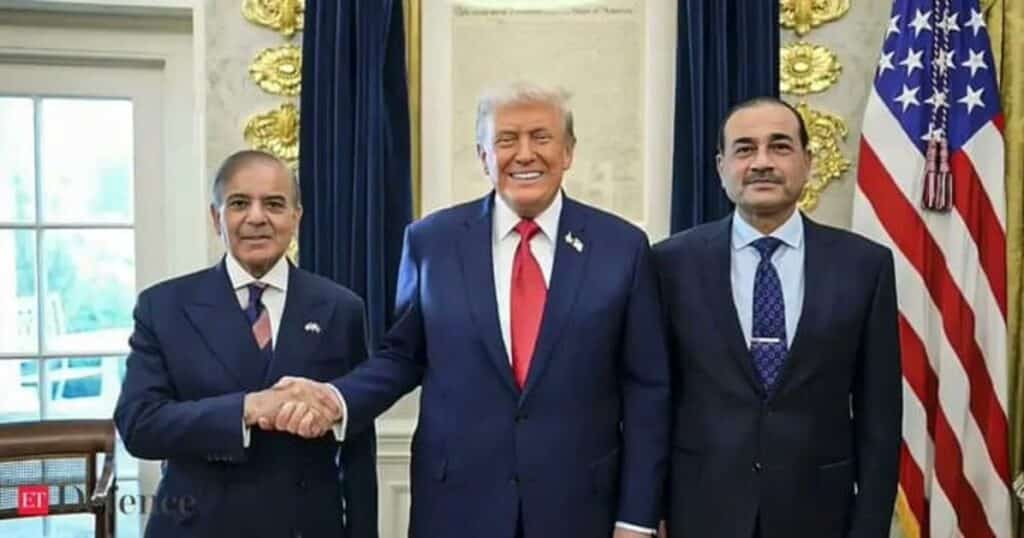
A social media amplification by Donald Trump has placed Pakistan at the centre of a rapidly evolving diplomatic situation involving the United States, Iran and Israel.
The development follows a public offer by Shehbaz Sharif to facilitate dialogue between Washington and Tehran. Trump’s decision to reshare the message has elevated it into a geopolitical signal, suggesting that Islamabad could emerge as a potential intermediary even as official confirmation of talks remains absent.
In a post on X, Sharif stated: “Pakistan is ready and honoured to facilitate meaningful and conclusive talks between the United States and Iran, provided both sides agree.”
The carefully worded statement reflects a conditional offer, positioning Pakistan as a neutral facilitator without assuming formal authority over the process. It also signals Islamabad’s intent to play a constructive diplomatic role at a time when tensions in West Asia are threatening to widen into a broader regional confrontation.
Trump Signal, US Caution
Trump’s amplification has been widely interpreted as a sign of openness toward alternative diplomatic channels. While it does not confirm negotiations, it brings Pakistan’s proposal into the centre of global diplomatic discourse and raises expectations that backchannel efforts may be gaining traction.
At the same time, official US responses have remained measured and cautious. “This is a sensitive situation and we would not want to get ahead of any formal announcements,” a senior official said, underscoring that any engagement, if underway, is still at a preliminary stage.
This contrast between Trump’s public signaling and the administration’s institutional restraint reflects a familiar pattern in high-stakes diplomacy. Political leaders often use messaging to test the waters, while official channels move more cautiously to avoid premature commitments. The gap between perception and policy is particularly significant in this case, where even small signals can influence markets, alliances and regional stability.
Iran Denies Talks
Tehran has issued a firm and unambiguous response through its envoy in Pakistan, directly countering speculation about ongoing negotiations.
“There have been no negotiations between the two countries, directly or indirectly,” the Iranian envoy stated, rejecting claims of active diplomatic engagement with Washington.
The envoy also addressed reports circulating in international media, adding: “We have heard such details through the media… but there have been no negotiations.”
Despite this categorical denial, the statement included a softer note that leaves room for diplomatic movement. “We hope these efforts can help in ending the war,” the envoy said, referring to mediation initiatives by countries such as Pakistan.
This dual messaging highlights Iran’s cautious approach. Publicly, it seeks to maintain a firm stance against US pressure and avoid appearing to concede. Privately, the acknowledgment of mediation efforts suggests that Tehran is monitoring developments closely and may be open to engagement under the right conditions. This balance between denial and openness is a hallmark of complex diplomatic situations where trust deficits remain high.
Backchannels Active
Even in the absence of formal talks, there is growing evidence that indirect communication channels are active. Pakistan is believed to be among several countries facilitating exchanges between Washington and Tehran, acting as a conduit for proposals and messages.
Islamabad has reportedly conveyed a US proposal to Iran, indicating that substantive communication may already be taking place behind the scenes. While the details of the proposal remain undisclosed, its transmission suggests a level of engagement that goes beyond symbolic diplomacy.
Sharif has reiterated Pakistan’s readiness to expand its role if required. “Pakistan stands ready and honoured to be the host to facilitate meaningful and conclusive talks… aimed at achieving a peaceful resolution and ensuring regional stability,” he said.
Iran has also acknowledged receiving proposals through intermediaries. “We have received proposals through friendly countries, but there are no direct talks with the United States,” a senior Iranian official stated.
This pattern reflects the importance of backchannel diplomacy in managing sensitive conflicts. Such channels allow both sides to explore options, clarify positions and reduce misunderstandings without the political risks associated with public negotiations. They also enable mediators like Pakistan to build trust gradually and shape the framework for potential formal talks.
Saudi Role Emerges
Pakistan’s diplomatic initiative is being pursued in coordination with key regional stakeholders, particularly Mohammed bin Salman of Saudi Arabia.
Saudi Arabia’s involvement adds a significant layer of complexity and credibility to the process. As a major regional power with close ties to the United States and a long-standing rivalry with Iran, Riyadh’s position carries considerable weight.
Saudi officials have emphasized the need to maintain stability while safeguarding national security. “The Kingdom condemns violations of sovereignty and will take all necessary measures to protect its security and stability,” they have stated.
This dual emphasis on deterrence and diplomacy reflects the broader regional environment, where countries are seeking to avoid escalation while preparing for potential threats. Pakistan’s engagement with Saudi leadership suggests that its mediation effort is aligned with these broader strategic considerations, rather than being an isolated initiative.
Conflict Drives Diplomacy
The renewed diplomatic activity is unfolding against the backdrop of an intensifying conflict involving the United States and Israel in relation to Iran. Military actions, strategic warnings and disruptions to key energy routes have heightened concerns about a wider regional escalation.
Israeli leadership has maintained a firm position on national security. “Israel will continue to defend itself by all necessary means and reserves the right to act against threats,” officials have said.
These developments have increased the urgency of diplomatic efforts. For many countries in the region, including Pakistan, the risks of prolonged conflict are not theoretical. They include potential disruptions to energy supplies, economic instability and broader security challenges.
Sharif has consistently emphasized the need for dialogue as a means of de-escalation. “Dialogue and diplomacy remain the only viable path forward to resolve tensions and avoid further escalation,” he has said.
Pakistan’s involvement reflects both strategic calculation and necessity. Its geographic location, diplomatic relationships and economic interests make stability in West Asia a priority. By positioning itself as a mediator, Islamabad is seeking to contribute to de-escalation while also reinforcing its role in regional diplomacy.
The situation is also being closely monitored by India, where developments in West Asia have direct implications for energy security and strategic planning.
Outlook Unclear
The current situation represents an early and uncertain stage of diplomatic engagement. Public statements, indirect communication and regional coordination suggest that groundwork is being laid for possible negotiations, but significant obstacles remain.
Iran’s firm denial of talks highlights the depth of mistrust, while the absence of formal confirmation from Washington underscores the tentative nature of the process. At the same time, the existence of backchannel exchanges and mediation efforts indicates that dialogue, in some form, is already underway.
Pakistan’s role, while still evolving, has become more visible and potentially significant. Its ability to maintain neutrality, manage regional expectations and facilitate communication will be critical in determining whether this diplomatic opening leads to meaningful progress.
For now, the situation remains fluid, defined by cautious signals rather than concrete agreements, with multiple actors navigating a complex and high-stakes geopolitical landscape.


