

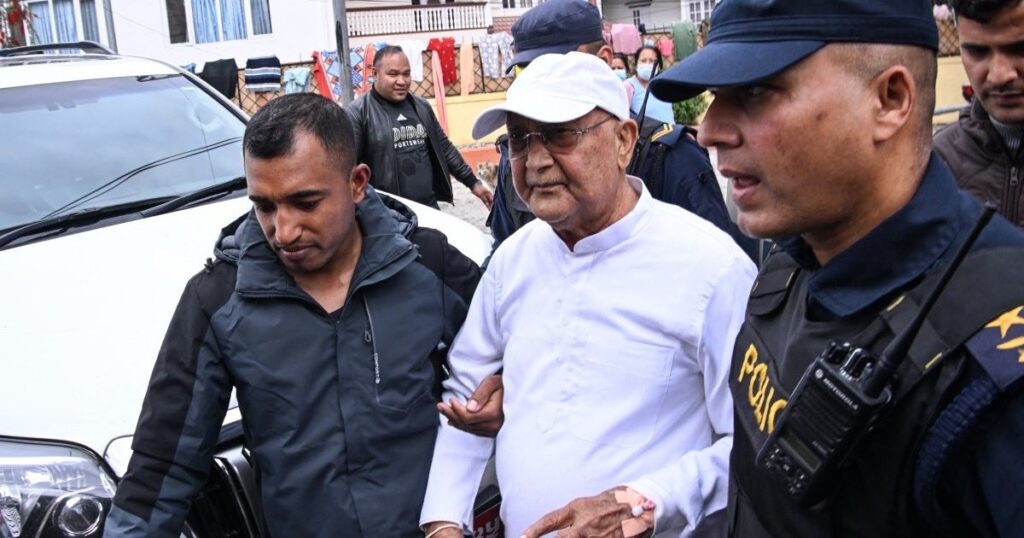
Former prime minister K. P. Sharma Oli and ex-home minister Ramesh Lekhak were detained on Saturday over their alleged role in the deadly 2025 Gen Z protest crackdown, in which at least 77 people were killed nationwide, including 19 on the first day of violence.
The arrests, carried out in the Kathmandu Valley hours after Balendra Shah was sworn in as prime minister, mark a dramatic escalation in Nepal’s political transition and are widely seen as the new government’s first major step toward delivering on promises of accountability after the youth-led uprising that forced Oli from power.
Arrests and Charges
Police confirmed that Oli was arrested from his residence in Bhaktapur, while Lekhak was detained in Suryabinayak during an early morning operation. Both were produced before a Kathmandu court, which granted remand for further investigation.
Authorities have filed charges including culpable homicide and criminal negligence, based on findings of a government-appointed commission that investigated the 2025 unrest. The panel concluded that the leadership failed to act during critical hours when security forces escalated the use of force against protesters.
The report stated that timely intervention from senior leadership could have prevented the scale of casualties. It recommended prosecution of those responsible, with potential prison sentences of up to 10 years if convicted.
Government officials have emphasised that the arrests are grounded in evidence. A senior official said the action reflects “accountability under law, not political retaliation,” underscoring the administration’s attempt to frame the move as institutional rather than political.
Deadly Protests and Timeline
The arrests stem from the September 2025 Gen Z protests, a nationwide movement led largely by young Nepalis frustrated with corruption, unemployment and governance failures. The protests were initially triggered by a controversial social media ban but quickly expanded into a broader anti-establishment uprising.
By 8 and 9 September, demonstrations had intensified across Kathmandu and other cities. Protesters breached security perimeters and gathered around key government institutions, including parliament premises. Security forces responded with curfews and, in several instances, live ammunition.
At least 77 people were killed and more than 2,000 injured during the unrest. Medical reports indicated that many victims suffered gunshot wounds, raising serious concerns about the proportionality of force used. Public infrastructure was heavily damaged, with government buildings, political offices and vehicles set on fire during peak violence.
On 9 September 2025, Oli resigned as prime minister amid mounting public pressure. The crisis led to an interim political arrangement and eventually national elections in early 2026.
Shah’s Mandate and Crackdown
The rise of Balendra Shah reflects a broader generational shift in Nepal’s political landscape. A former mayor of Kathmandu and an anti-establishment figure, Shah secured a decisive electoral victory driven largely by youth support and widespread dissatisfaction with traditional political elites.
His campaign focused on governance reform, transparency and accountability for past actions. The arrests of Oli and Lekhak are widely seen as an early signal that the new administration intends to act on those promises.
Following the detentions, authorities initiated coordinated raids and investigations linked to former officials. Government representatives said the actions were based on evidence gathered by the investigative commission and aimed at restoring public trust in state institutions.
In an official statement, the prime minister’s office said, “No individual, regardless of position, is above the law,” reinforcing the government’s position on accountability.
Political Fallout and Public Reaction
The arrests have triggered immediate political backlash. Supporters of K. P. Sharma Oli have staged protests in parts of Kathmandu, alleging that the move is politically motivated. Clashes between demonstrators and police have been reported, raising concerns about renewed instability.
Oli’s legal team has challenged the detention, arguing that there was no risk of flight and that due process has not been fully observed. A senior lawyer representing him said, “This is a case driven by political pressure rather than legal merit,” signalling a prolonged legal battle ahead.
At the same time, families of victims and civil society groups have welcomed the arrests as a long-awaited step toward justice. Human rights organisations have called for a transparent and independent judicial process, stressing that accountability must be established through credible legal proceedings.
The situation remains sensitive, with authorities balancing law enforcement with the risk of escalating tensions on the streets.
A Defining Test for Nepal
The arrest of a former prime minister marks a significant moment in Nepal’s democratic evolution, widely seen as an attempt to end decades of political impunity. For many observers, the move signals a break from a system in which senior leaders often avoided legal consequences despite major controversies.
However, the outcome of the case will be critical. Nepal’s judiciary now faces one of its most high-profile tests, with intense public and political scrutiny surrounding the proceedings. Ensuring due process, transparency and impartiality will be essential to maintaining credibility.
The developments also reflect a broader youth-driven political shift following the uprising that brought down Oli’s government. While the arrests may strengthen public confidence in accountability, they also risk deepening political divisions if perceived as selective enforcement.
Nepal now stands at a crossroads. The coming weeks will determine whether this moment becomes a foundation for stronger democratic institutions or another chapter in the country’s long history of political instability.


