

The United States is considering a move that could fundamentally alter how modern wars are financed. Under Donald Trump, the White House has confirmed that Washington is exploring whether Arab nations should help fund the ongoing war against Iran.
What appears to be a financial discussion is, in reality, a deeper strategic shift. As war costs escalate, oil markets destabilise and political resistance grows in Washington, the administration is attempting to redefine alliances not just in military terms, but in economic ones.
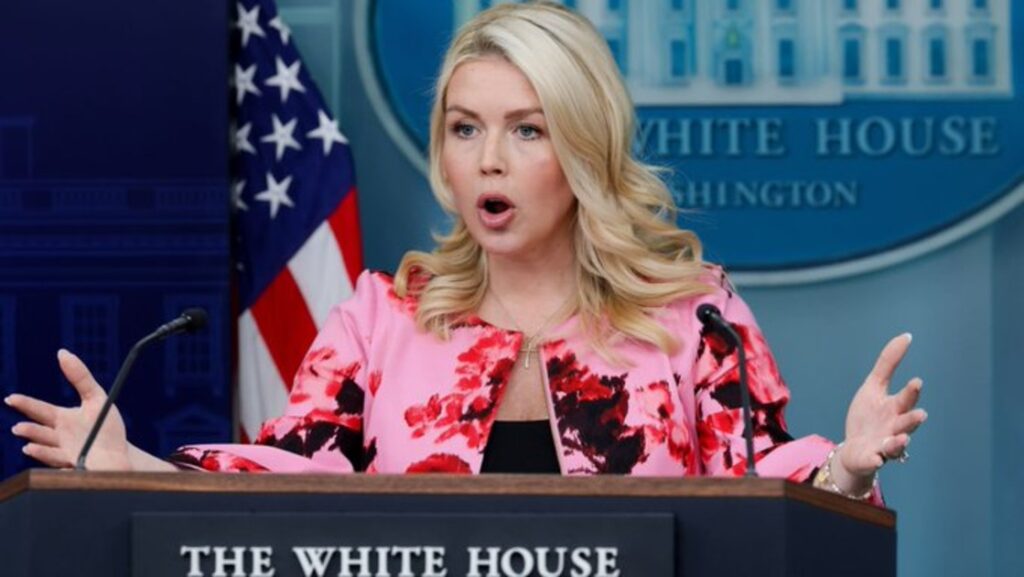
Press Secretary Karoline Leavitt made the position clear when asked directly about the idea. “It’s an idea that I know that he has,” she said, adding that it is “something that I think you’ll hear more from him on.”
The proposal comes at a moment when the war is no longer just about battlefield outcomes, but about sustainability, leverage and control.
Funding Pressure
The push to involve Arab states is being driven as much by domestic constraints as by international strategy.
The Pentagon has sought roughly $200 billion in additional funding to sustain the war effort, a figure that has intensified debate within Washington. Congress remains divided, with growing concern over both the scale of spending and the absence of a clearly defined endgame.
Within this context, the administration’s thinking has evolved. Asking allies to contribute is no longer framed as optional burden-sharing, but increasingly as a necessary adjustment to maintain long-term operations.
Karoline Leavitt confirmed that the idea is actively being considered at the highest level, stating that Trump “would be quite interested in calling on” Arab countries to help cover the costs.
Donald Trump has consistently argued that allies benefiting from US protection should contribute more financially. His broader doctrine has been clear: partnerships must be reciprocal, particularly in times of conflict.
The funding question, therefore, is not isolated. It sits at the intersection of fiscal pressure, political resistance and a wider effort to redefine how wars are sustained.
Regional Stakes
The focus on Arab states is rooted in the direct impact of the conflict on the region.
Countries such as Saudi Arabia, United Arab Emirates and Qatar are deeply exposed to the consequences of escalation with Iran. Energy infrastructure, shipping routes and national security are all closely tied to developments in the conflict.
The Strait of Hormuz remains a critical flashpoint. Any disruption to the flow of oil through this narrow passage has immediate global economic implications.
Trump has linked these risks directly to the argument for burden-sharing. In recent comments, he suggested that countries relying on these routes should take a more active role in securing them, reinforcing the idea that financial contributions are part of that responsibility.
The administration’s position is that the war is not only an American concern. It is a regional crisis with global consequences, and those most affected should be part of the solution.
Strategy and Signals
The proposal is part of a broader strategy that blends military escalation with economic and diplomatic pressure.
Donald Trump has adopted an increasingly hard line in his public messaging. He has threatened to target Iran’s energy infrastructure if Tehran does not comply with US demands, signalling a willingness to escalate beyond conventional military engagements.
At the same time, the administration continues to maintain that diplomatic channels remain open. Karoline Leavitt stated that what Iran says publicly often differs from its private communications with US officials, suggesting that some level of engagement is ongoing behind the scenes.
Trump has reinforced this dual-track approach, claiming that Iran has been seeking negotiations. “They are begging to reach a deal,” he said, even as Tehran has publicly denied such talks.
This contradiction is central to the current strategy. Military pressure is being used to strengthen negotiating leverage, while financial burden-sharing is intended to expand that pressure regionally.
The result is a complex balancing act, where war, diplomacy and economic strategy are operating simultaneously.
Reluctant Allies
Despite the logic presented by Washington, Gulf states face a difficult calculation.
On one hand, they have described Iranian actions as a direct threat to regional security, with repeated attacks on infrastructure and civilian areas reinforcing those concerns. On the other hand, deeper involvement in the conflict carries significant risks.
Escalation could expose them to further retaliation, disrupt oil exports and undermine economic stability at a time when diversification efforts are underway. The financial burden itself also raises political questions, particularly in countries where public support for a prolonged conflict is uncertain.
This creates a clear contradiction. Gulf states are among those most affected by the conflict, yet they remain cautious about being seen as active financial backers of a US-led war.
Karoline Leavitt acknowledged that discussions with partners would continue, but stopped short of indicating any commitments, underscoring the sensitivity of the issue.
Legitimacy and Future Model
Beyond immediate strategy, the proposal raises broader questions about the future of warfare and global alliances.
Within the United States, the war itself remains contested. Lawmakers continue to debate the extent of presidential authority, with some pushing for limits under the War Powers framework and others supporting continued military engagement.
At the same time, the rationale for the war has evolved, with objectives ranging from deterrence to the weakening of Iran’s military capabilities and even the possibility of regime change. Donald Trump has suggested that Iran’s leadership has already been significantly weakened, describing the situation as a form of transformation in the country’s power structure.
Introducing external funding into this environment complicates accountability. If multiple nations finance a conflict, responsibility becomes more diffuse, raising legal and ethical questions about ownership of decisions and consequences.
Yet for the administration, the logic remains consistent. Karoline Leavitt framed the approach as one rooted in shared responsibility, while Trump’s broader position reflects a shift towards alliances defined not only by strategic alignment, but by tangible contributions.
What Comes Next
For now, the proposal remains under discussion, with no formal commitments from Arab partners. Much will depend on how regional governments respond in the coming weeks, as well as the evolving situation on the ground.
In Washington, the debate over funding and authorisation is expected to intensify, particularly as costs continue to rise. At the same time, diplomatic signals between the United States and Iran remain uncertain, adding another layer of complexity.
Whether the idea translates into policy or remains a negotiating tactic, it has already exposed a shifting reality: the financial burden of war is becoming as contested as the conflict itself.


