

A US-Iran ceasefire aimed at reducing tensions across the Middle East has come under immediate strain, as Israeli military operations in Lebanon continued despite the agreement. The deal, described as a temporary pause to prevent a broader regional war, was expected to ease hostilities involving Iranian-backed groups.
However, conflicting interpretations have quickly emerged. US officials indicated that the ceasefire was limited to direct US-Iran confrontation and did not restrict Israel’s operations against Hezbollah. A senior US official said the agreement was “not intended to limit Israel’s right to defend itself,” reinforcing Washington’s position.
In contrast, Iranian officials signalled that the ceasefire should apply across all fronts, including Lebanon, arguing that continued Israeli strikes undermine the spirit of the agreement.
This disagreement has exposed a critical weakness in the ceasefire framework, raising concerns that the deal lacks clarity and enforcement, and may already be at risk of collapse.
Strikes Intensify Rapidly
Israeli forces launched a wave of intense airstrikes across Lebanon, including in Beirut, Tyre and the Bekaa Valley, in what has been described as one of the most concentrated phases of the conflict. Reports indicate that more than 100 strikes were carried out within minutes, targeting what Israel said were Hezbollah command centres, weapons depots and logistical infrastructure.
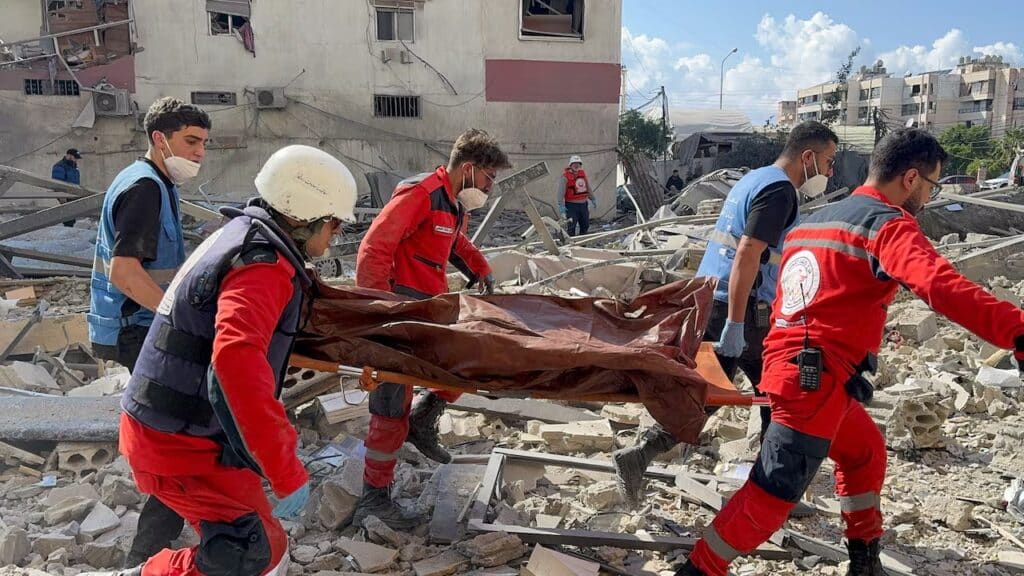
According to Lebanon’s health ministry, at least 203 people were killed and more than 1,000 wounded on Wednesday, making it one of the deadliest days in recent months. Entire neighbourhoods were hit, with buildings destroyed and key transport routes damaged, leaving emergency services overwhelmed.
Israeli Prime Minister Benjamin Netanyahu defended the operations, stating that Israel would act “wherever necessary” to counter threats posed by Hezbollah. Military officials also confirmed the targeting of senior operatives and strategic assets, including a Hezbollah-linked aide, indicating a focus on weakening the group’s leadership network.
The intensity and speed of the strikes suggest a significant escalation, despite ongoing diplomatic efforts to stabilise the situation.
Civilian Crisis Worsens
The humanitarian impact has been severe, with hospitals across Lebanon struggling to cope with the influx of casualties. Medical facilities, particularly in southern regions, have reported critical shortages of supplies and staff, while rescue teams continue to search for survivors in heavily damaged areas.
More than one million people are estimated to have been displaced, with families fleeing their homes amid continued airstrikes. In Beirut, rescue teams were seen working through the rubble as the full extent of the destruction became visible a day after the strikes.
The United Nations “unequivocally condemned” the scale of the attacks, describing the situation as “horrific” and calling for immediate restraint.
Lebanese authorities declared a national day of mourning, announcing a public holiday as the country grappled with the scale of the casualties.
President Joseph Aoun condemned the attacks, calling them “a massacre”, as officials appealed for urgent international intervention.
Aid organisations have warned that the crisis could escalate further if hostilities continue, particularly given Lebanon’s already fragile economic conditions.
Hezbollah Responds
Hezbollah’s reaction has underscored the fragile nature of the ceasefire and the growing risk of escalation. Following the announcement of the ceasefire, the group initially paused its attacks, signalling a willingness to align with Iranian commitments.
However, after Israeli strikes intensified inside Lebanon, Hezbollah resumed rocket fire towards Israeli territory, framing its response as a direct reaction to ongoing military operations. A Hezbollah-linked official stated that “any continued aggression will be met with a response,” indicating that the group does not consider itself bound by a ceasefire it believes has already been violated.
The targeting of senior Hezbollah-linked figures has further heightened tensions, increasing pressure on the group to retaliate and reducing the likelihood of immediate de-escalation.
The sequence of events highlights the absence of a unified interpretation of the ceasefire, with both sides acting under different assumptions about its scope and validity.
Global Tensions Rise
International concern has intensified, with world leaders warning of the risk of a broader regional conflict. Diplomatic efforts are now focused on clarifying the ceasefire and preventing further escalation.
Iran condemned the continued strikes as a “grave violation” of the US-Iran ceasefire agreement, warning that such actions could further destabilise the region.
Former US President Donald Trump warned that the ceasefire “must hold” to avoid a wider war, while European leaders cautioned that the escalation could have serious economic and security consequences.
The United Nations has reiterated calls for restraint, urging all sides to prioritise civilian protection.
Beyond the immediate conflict, the situation carries wider strategic implications. Iran has signalled potential disruption in the Strait of Hormuz, raising fears over global energy supplies and shipping security. Oil markets have shown volatility amid concerns that continued conflict could impact global supply chains.
As diplomatic efforts continue, the coming days will be critical in determining whether the ceasefire can stabilise the region or whether the conflict will expand into a wider and more dangerous confrontation.


