

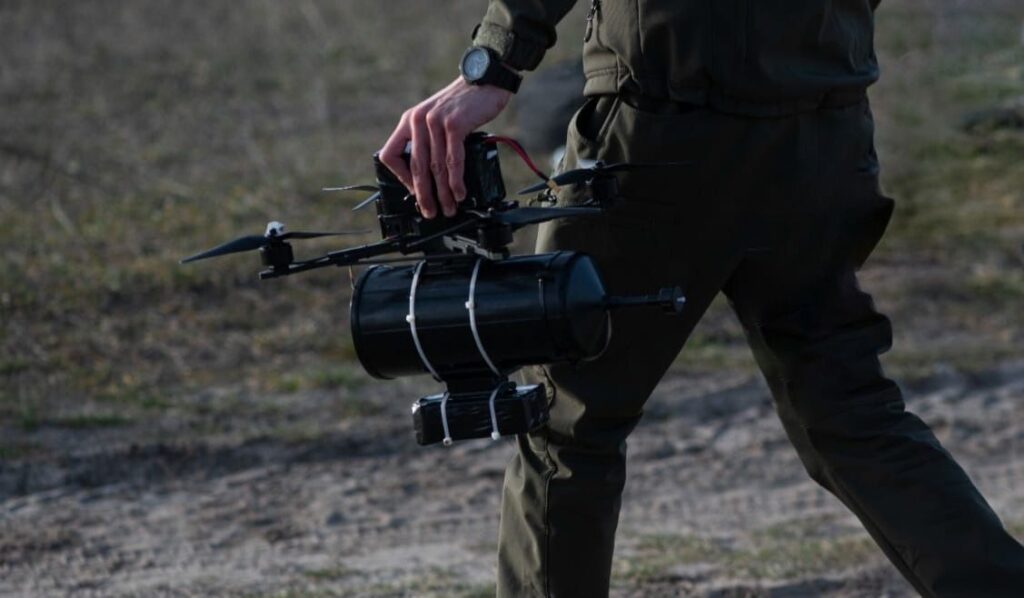
The confrontation between Israel and Hezbollah has entered a new and more complex phase, one shaped not by long-range rockets or conventional missile exchanges, but by the growing use of small, highly precise drones that are difficult to detect and expensive to defeat. Security analysts say Hezbollah’s latest battlefield innovation, described in several reports as an “invisible killer”, reflects a wider transformation in modern warfare where low-cost technology can create serious strategic pressure on a far stronger military power.
At the centre of concern are fibre-optic guided first-person-view drones. Unlike traditional unmanned systems that rely on radio signals or satellite navigation, these drones are controlled through a physical cable linked to the operator. That makes them harder to jam, harder to trace electronically and more reliable in contested battle zones. Their emergence has triggered fresh debate inside Israel over whether traditional defence systems designed for missiles and rockets are fully prepared for a new era of drone warfare on the northern front.
A New Weapon Changing the Battlefield
Military experts say the importance of these drones lies not in their size, but in their tactical usefulness. They can be launched quickly, flown at low altitude and directed with precision toward military vehicles, troop concentrations, observation posts or temporary bases.
Unlike larger drones used for surveillance, FPV drones are often designed as attack systems carrying explosive payloads. Their operators receive live video and steer them directly into a target. This allows even a relatively small charge to cause significant damage if it hits a weak point such as a vehicle hatch, bunker entrance or troop shelter.
Israeli analysts quoted in regional media have warned that such systems reduce reaction time for soldiers on the ground. “You may hear them before you see them,” one security source was reported as saying.
For Hezbollah, the weapon offers a major advantage. It does not need air superiority, advanced fighter aircraft or expensive missile stocks to create pressure. A small drone team with technical training can threaten far more costly military assets.
Why Israel’s Defences Face a New Test
Israel operates one of the world’s most advanced layered defence networks, developed over years to counter rockets, missiles and larger aerial threats. Systems such as Iron Dome and advanced radar networks have repeatedly proven effective against conventional attacks.
However, military planners acknowledge that small low-flying drones present a different challenge. They move close to terrain, can appear with limited warning and may not generate the same signatures as larger aircraft.
The fibre-optic guidance system is especially significant. Because commands pass through a cable rather than radio frequency signals, conventional jamming becomes less effective. That removes one of the most trusted tools in modern counter-drone warfare.
Israeli defence researcher Yehoshua Kalisky was quoted in international coverage saying these drones are dangerous because “they are immune to jamming and difficult to track back to their launch point.”
This creates a tactical problem for Israel. Expensive interception systems may be required to stop devices that cost only a fraction of the price to build.
Deadly Precision and Psychological Pressure
Recent battlefield reports indicate these drones are being used not only for direct strikes, but also for layered attacks designed to increase confusion.
One reported incident near the Lebanese border said 19-year-old Israeli soldier Sergeant Idan Fooks was killed in a drone strike. Additional drones were reportedly launched when rescue teams and a helicopter moved in, highlighting a tactic aimed at striking both the original target and those responding afterward.
Military experts say such attacks can have an effect beyond casualties. Soldiers may delay movement, avoid open areas, change rescue procedures and remain under constant pressure.
Former commanders have often argued that morale and tempo are as important as hardware in war. In this context, a silent drone overhead can slow operations even when it does not strike.
A retired regional security official said in commentary carried by international media, “The value of these systems is not only destruction. It is fear, hesitation and disruption.”
That psychological dimension is particularly important in border conflicts where troops operate in exposed positions for extended periods.
Cheap Technology, Global Lessons
The wider significance of Hezbollah’s drone tactics is that they reflect a global military trend first seen at scale during the Russia-Ukraine war. There, commercially available drones modified with explosives changed battlefield tactics, damaged tanks and forced armies to rethink movement near front lines.
Hezbollah appears to have adapted similar ideas to the terrain of southern Lebanon. Hills, villages and narrow border zones create short engagement distances where small drones can be launched from concealed positions and reach targets quickly.
Israeli officials have also raised concerns about supply chains. Reports suggest some components may come from abroad, including commercial markets in Asia or support networks linked to Iran, before being modified locally.
This reflects a broader security challenge for many nations. Civilian technology is increasingly dual-use, meaning cameras, batteries, navigation tools and lightweight airframes can be repurposed for military use.
As one Western defence analyst noted, “The barrier to entry for precision strike capability has fallen dramatically.”
That means non-state actors can now field capabilities once limited to advanced militaries.
What Comes Next for Israel and Hezbollah
Israel is unlikely to leave this threat unanswered. Defence experts expect faster investment in laser interception systems, acoustic sensors, AI-assisted tracking, automatic short-range weapons and stronger battlefield fortifications for frontline troops.
Operational tactics are also likely to change. Forces may disperse more widely, use camouflage more aggressively and alter rescue procedures when drone threats are present.
For Hezbollah, the strategic message is already clear. It has shown that low-cost systems can force a technologically superior opponent to adapt, spend more and reconsider battlefield assumptions.
The broader lesson reaches beyond the Israel-Lebanon border. Future conflicts may not be defined only by missiles, tanks or aircraft, but by small, precise and inexpensive machines that exploit gaps in expensive defence systems.
As military planners around the world study these developments, one conclusion is becoming harder to ignore: in modern war, the most dangerous weapon is not always the largest one.


