

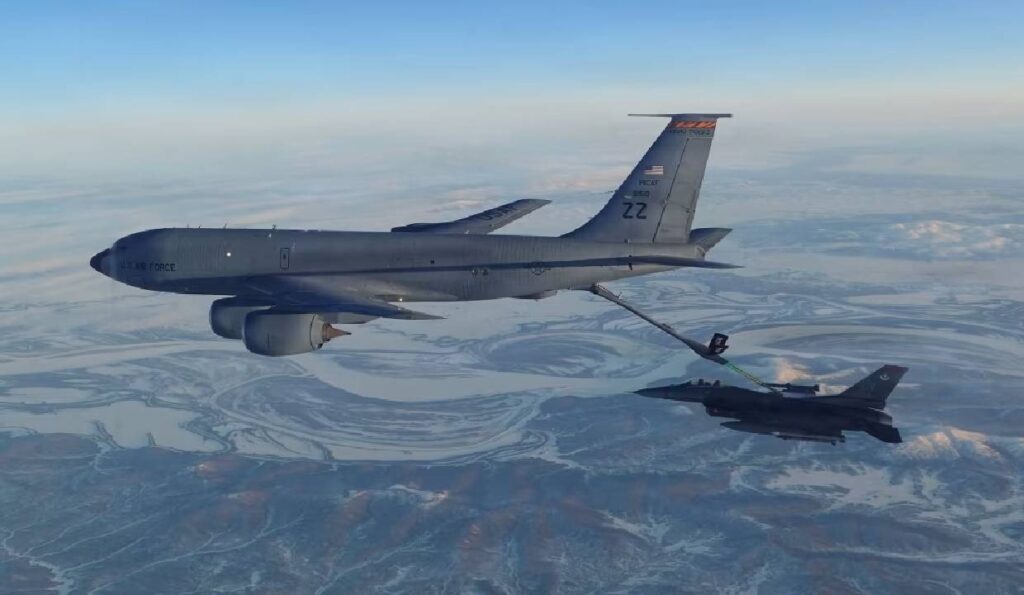
A United States Air Force aerial refuelling aircraft, often described as a “flying gas station”, triggered an emergency alert over the Gulf before disappearing from public flight-tracking systems near Qatar, prompting intense global attention at a time of heightened tension across the Middle East. The aircraft, identified in multiple reports as a Boeing KC-135R Stratotanker, is one of the most important support platforms in the US military fleet. Data available through open-source trackers indicated the tanker transmitted the international emergency squawk code 7700, circled in the region, began a descent and then vanished from publicly visible radar feeds.
No official US statement has suggested a crash, hostile strike or loss of the aircraft. However, the incident quickly became a major story because tanker aircraft are critical to sustaining combat missions, intelligence operations and long-range air patrols. With Qatar hosting one of Washington’s largest regional air bases and the Gulf remaining a highly sensitive security zone, even a brief unexplained emergency involving such an aircraft was always likely to attract scrutiny.
Emergency Signal Raises Questions
According to publicly available flight data, the KC-135R declared code 7700 while operating over Gulf airspace. In international aviation, the code is used by pilots to signal a general emergency and request priority support from air traffic control.
A 7700 alert can be triggered for several reasons, including engine trouble, hydraulic faults, navigation issues, communication failures, onboard medical emergencies or fuel management concerns. It does not automatically indicate a crash scenario, but it does signal that the crew considered the situation serious enough to require immediate assistance.
The aircraft was then reported to have flown holding patterns before beginning a descent. That sequence has led many aviation analysts to believe the crew may have been managing a technical issue while preparing for diversion or landing.
Former military pilots often note that emergency procedures are designed to remain calm and methodical even under pressure. As one common principle in military aviation states, “Aviate, navigate, communicate.” In practice, that means controlling the aircraft first, choosing a safe route second, and communicating with controllers third.
The absence of dramatic official warnings has also led many observers to conclude that the situation was likely contained professionally by the crew rather than escalating into a major accident.
Why the KC-135 Is So Important
The Boeing KC-135R Stratotanker is not a frontline fighter or bomber, yet it remains one of the most strategically valuable aircraft in the American arsenal. Its primary role is aerial refuelling, allowing combat jets, reconnaissance aircraft and surveillance platforms to remain airborne for longer and operate farther from base.
Without tanker support, even advanced fighter aircraft face major limits on endurance and range. In any sustained air campaign, refuelling aircraft effectively act as airborne logistics hubs.
The KC-135 first entered service in the late 1950s and has undergone multiple upgrades, including the more capable KC-135R variant. It can carry vast quantities of fuel and refuel multiple aircraft in a single sortie. Despite the arrival of newer tankers such as the KC-46 Pegasus, the KC-135 still forms a major part of US global air operations.
US Air Force officials have repeatedly described aerial refuelling as essential to modern power projection. In previous statements on tanker operations, service leaders have emphasised that “global reach depends on global refuelling.”
That is why any emergency involving a tanker aircraft receives serious attention. A fighter jet is highly visible, but a tanker often makes the wider mission possible.
Why Qatar Matters Strategically
The location of the incident is central to understanding why the story spread so rapidly.
Qatar hosts Al Udeid Air Base, one of the most important US military facilities outside the United States. The base has long served as a command, logistics and air operations hub for missions across the Gulf, Iraq, Syria and the wider Middle East.
Its geographic position places it near Iran, the Persian Gulf and the Strait of Hormuz, one of the world’s most sensitive maritime chokepoints. Any unusual military aviation event in this corridor is immediately viewed through a geopolitical lens.
Regional tensions in recent years have included missile threats, drone attacks, maritime incidents and repeated warnings over airspace security. Against that backdrop, even a routine technical emergency can trigger international speculation.
Officials in Gulf states have frequently stressed the need for stability and safe navigation in the region. The broader strategic message has often been clear: “Freedom of movement and regional security remain essential for global markets and energy flows.”
For the US military, bases in Qatar provide rapid response capability, intelligence coordination and strategic depth. That makes the country a crucial node in regional defence planning.
Missing Aircraft or Missing Data?
Much of the drama surrounding the incident came from the phrase “went missing”. In reality, disappearing from public flight-tracking websites is not the same as being lost operationally.
Military aircraft frequently limit visible transponder data for security reasons. Public radar feeds can also lose coverage when aircraft descend, switch systems, land at secure facilities or move into areas with incomplete civilian tracking networks.
This means an aircraft can vanish from websites while remaining fully known to military controllers.
Defence analysts have increasingly warned against drawing instant conclusions from open-source aviation data. As one commonly cited caution in security circles puts it, “Absence of public data is not evidence of disaster.”
That distinction is especially important in conflict-sensitive regions, where operational secrecy is routine and incomplete information spreads rapidly online.
No verified evidence has emerged to indicate the KC-135 was shot down, destroyed or permanently lost. The stronger reading of available information is that an emergency occurred, procedures were followed, and public visibility ended before official clarification was issued.
What This Incident Means
The KC-135 episode became global news because it combined three powerful elements: military secrecy, strategic geography and real-time digital speculation.
For defence planners, the incident underlines how valuable support aircraft remain in any modern air operation. Fighters may dominate headlines, but tankers enable endurance, reach and sustained presence.
For the public, it is also a reminder that open-source tracking platforms do not always tell the full story. In sensitive regions such as the Gulf, partial data can create dramatic narratives long before facts are confirmed.
Until US authorities provide fuller details, the most credible conclusion is measured rather than sensational: a high-value tanker aircraft declared an emergency near Qatar, likely managed the situation under established procedures, and then disappeared from public tracking feeds.
Whether the cause was technical, precautionary or operational, the event demonstrated that in modern warfare, the aircraft supporting the mission can suddenly become the centre of the story.


