

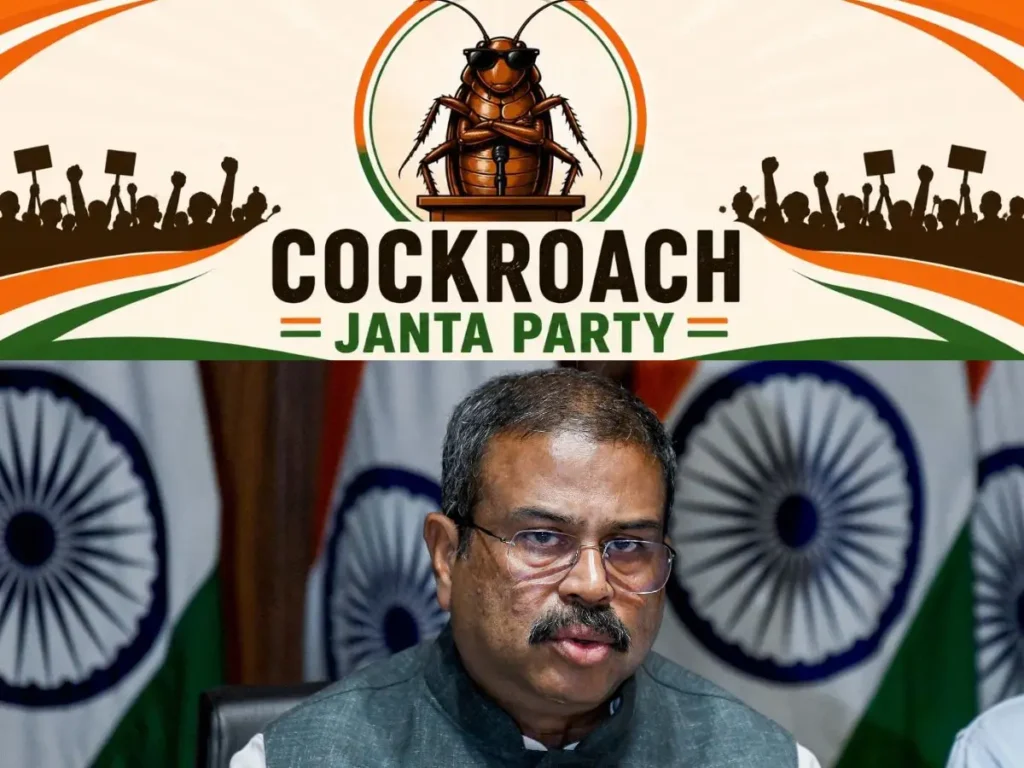
India’s rapidly expanding Cockroach Janata Party, popularly known as CJP, has moved from internet satire to direct political confrontation after demanding the resignation of Union Education Minister Dharmendra Pradhan over the NEET controversy. What began as a meme-driven online movement has now evolved into one of the country’s most closely watched youth-led digital campaigns, combining political satire with growing anger over examination irregularities, unemployment and institutional accountability.
The movement, led by digital strategist Abhijeet Dipke, intensified its campaign after allegations surrounding NEET examination irregularities and paper leak concerns triggered outrage among students and parents across India. Through viral reels, online petitions, satire videos and highly shareable social media campaigns, the organisation has rapidly transformed from an internet trend into a wider political talking point.
Its rise has sparked debate across political and media circles about the growing influence of meme-driven activism in India. While critics dismiss the movement as performative internet politics, supporters argue it reflects genuine frustration among students and unemployed youth who feel increasingly disconnected from traditional political institutions.
How the Cockroach Janata Party Emerged
The Cockroach Janata Party did not emerge through conventional political structures. Instead, it grew out of social media satire after controversial remarks allegedly compared unemployed or frustrated youth to “cockroaches.” Rather than rejecting the label, users across social media embraced it and turned it into a symbol of survival, resilience and political frustration.
Within days, parody graphics, memes and satire videos flooded Instagram and X, with supporters using cockroach imagery to criticise unemployment, examination controversies and institutional failures. For many young users, the symbolism reflected feelings of invisibility within an increasingly competitive education and employment system.
The movement gained momentum by mixing humour with political messaging. Viral posts mocked bureaucratic responses, while digital campaigns targeted issues such as paper leaks, delayed recruitments and economic uncertainty. Unlike traditional political organisations built around rallies and speeches, CJP relied almost entirely on internet culture to expand its influence.
Its support base grew rapidly among students preparing for competitive examinations and young Indians frustrated by repeated recruitment controversies. Analysts say the movement succeeded because it translated complex public anger into accessible, emotionally charged online content designed for Gen Z audiences.
Dipke’s Viral Statements Fuel Campaign
Founder Abhijeet Dipke has emerged as the public face of the movement and its most recognisable voice. Reports describe Dipke as a political communications strategist with experience in digital campaigning and online mobilisation.
As criticism around the NEET controversy intensified, Dipke framed the campaign as a response to systemic failures affecting millions of students.
“This is not just a meme page anymore. Students are angry, unemployed youth are angry, and people are exhausted by a system that repeatedly fails them,” he said while responding to questions about the movement’s growing political role.
In another widely shared statement, Dipke said the organisation had decided to move beyond satire and directly challenge institutional accountability.
“Everyone is saying you are doing great on the internet, but I think now it is time to do some real work,” he said while announcing the campaign seeking the Education Minister’s resignation.
Dipke also claimed that the examination controversy had deeply affected students across the country.
“It was the fault of the system that over 22 lakh students’ future was impacted,” he said.
Referring to the emotional pressure surrounding competitive examinations, he further stated:
“It was the fault of the system that NEET students committed suicide.”
The comments significantly amplified the campaign online, with supporters portraying the movement as a voice for students frustrated with repeated examination controversies and institutional uncertainty.
Why the NEET Row Became a Flashpoint
The NEET controversy became the first major national issue around which the Cockroach Janata Party organised sustained political mobilisation. Allegations involving examination irregularities and paper leak concerns sparked widespread anxiety among students and parents over the credibility of India’s competitive examination system.
CJP directly targeted Education Minister Dharmendra Pradhan and launched an online petition campaign demanding his resignation. The campaign included digital signature drives, viral social media posts and coordinated online messaging calling for accountability within the education system.
Dipke argued that responsibility for the controversy could not remain limited to lower administrative levels.
“More than two million students prepare for years with immense pressure and financial sacrifice. If the credibility of the examination system itself is questioned, accountability cannot stop at lower levels,” he said during the campaign.
The movement connected the NEET issue with broader frustrations surrounding cancelled examinations, recruitment delays and growing competition for educational and employment opportunities. Through memes, satire clips and online mobilisation, the campaign rapidly expanded beyond student circles and entered mainstream political discourse.
Political observers say the NEET issue marked a turning point for the organisation. Until then, CJP had largely been viewed as a satire-driven internet movement. Its direct demand for the resignation of a Union minister transformed it into a more assertive political campaign.
Account Restrictions and Threat Claims
As the Cockroach Janata Party’s visibility increased, questions emerged over its rapid rise and political influence. Critics alleged coordinated amplification and attempted to link the movement to opposition political ecosystems, although no formal evidence has publicly established organisational ties to any political party.
Dipke strongly rejected those accusations and insisted the movement reflected widespread public frustration.
“People are trying to dismiss the movement by calling it fake or politically controlled because they are uncomfortable with the scale of public anger,” he said.
The debate intensified after social media accounts associated with the movement reportedly faced restrictions and temporary withholding actions online. Supporters described the measures as attempts to suppress dissenting voices, while critics argued that rapidly expanding digital movements should face greater scrutiny regarding transparency and accountability.
Following the account restrictions, supporters began circulating the slogan:
“Cockroaches Never Die.”
The phrase quickly became one of the campaign’s most recognisable online messages and was widely shared across social media platforms.
Dipke also publicly claimed he had received threats during the controversy.
“Receiving death threats now,” he wrote in a social media post while discussing the backlash surrounding the campaign.
The claims could not be independently verified, but they further intensified online attention surrounding the movement.
What CJP Signals for Indian Politics
The rise of the Cockroach Janata Party highlights a significant shift in India’s political communication landscape, where internet culture, memes and digital activism increasingly shape national conversations alongside traditional political campaigns.
At the centre of the movement are recurring concerns over unemployment, examination systems, economic uncertainty and institutional trust. Many supporters view the organisation less as a formal political party and more as a public expression of frustration from a generation struggling with competition, insecurity and repeated institutional controversies.
Dipke has repeatedly argued that the humour surrounding the movement should not distract from the seriousness of the issues being raised.
“People laugh at the memes because humour makes the anger easier to express. But behind every joke there is frustration, disappointment and exhaustion,” he said.
Whether the Cockroach Janata Party evolves into a long-term political force remains uncertain. However, its rapid emergence has already demonstrated the growing influence of digitally driven youth movements in shaping political narratives in India, particularly around emotionally charged issues such as education, unemployment and accountability.


