

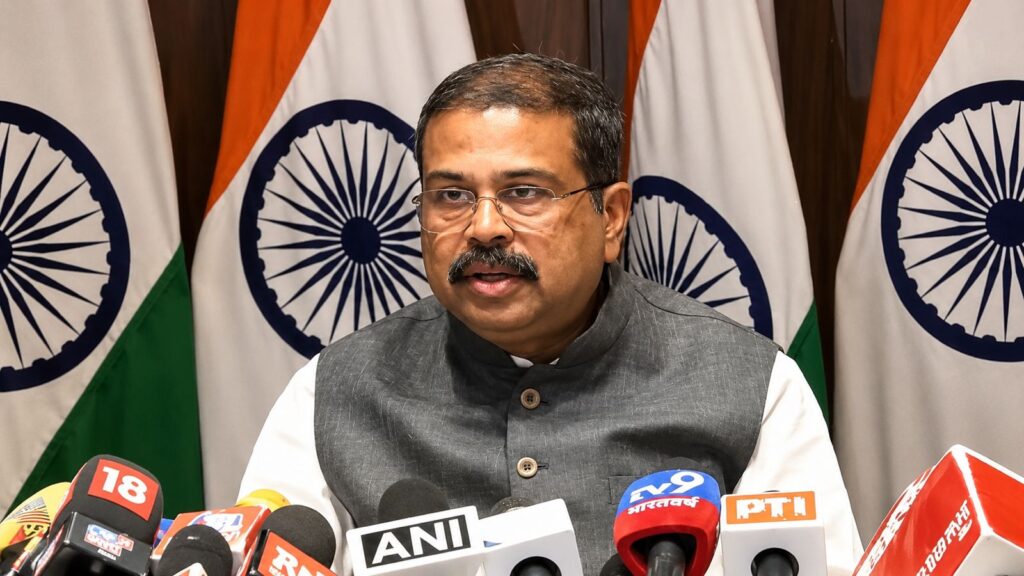
India’s largest medical entrance examination is heading towards one of the most significant reforms in its history after the Centre acknowledged serious irregularities in the conduct of NEET-UG 2026. In a major policy announcement made amid mounting public outrage over the alleged paper leak controversy, Union Education Minister Dharmendra Pradhan confirmed that the cancelled NEET-UG examination will now be reconducted on June 21, while the government has also decided to transition the examination to a computer-based format from the next cycle onward.
The announcement follows weeks of protests, political criticism and growing anger among students and parents after allegations surfaced that portions of the examination paper had circulated before the May 3 test. The controversy rapidly escalated into one of the most serious education crises faced by the National Testing Agency (NTA) in recent years, raising concerns about the integrity of India’s competitive examination system.
Speaking during a high-stakes press conference in New Delhi, Pradhan admitted that authorities had received multiple complaints regarding similarities between so-called “guess papers” and the actual examination. The Centre subsequently initiated an inquiry before referring the matter to the Central Bureau of Investigation (CBI).
The minister further stated that the government would not allow deserving students to suffer because of organised cheating networks.
“We did not want any deserving student to be deprived of their rights because of the conspiracy of education mafias or because an undeserving candidate benefited through unfair means,” he said.
The Centre’s decision to cancel and reconduct one of the country’s most important entrance examinations has now triggered wider debate over examination security, accountability within the NTA and the future of large-scale competitive testing in India.
CBI Probe Deepens
The Education Ministry’s acknowledgement that questions may have circulated before the examination has intensified scrutiny on the functioning of the NTA and renewed concerns regarding systemic vulnerabilities in India’s examination framework.
According to officials, objections first began arriving through the NTA grievance portal shortly after the May 3 examination concluded. Students and coaching centres alleged that several questions appearing in viral “guess papers” matched those in the actual NEET-UG examination.
Following preliminary verification, the Centre referred the matter to the Central Bureau of Investigation for a detailed probe into the source of the leak and the individuals allegedly involved.
During the press briefing, Dharmendra Pradhan admitted there had been a serious administrative lapse despite earlier reforms introduced after previous controversies.
“There has been a breach in the command chain somewhere. We accept that there have been shortcomings,” the minister said.
The statement marked one of the strongest public acknowledgements by the government since the controversy erupted.
Officials said investigators are now examining whether organised cheating syndicates, commonly described by authorities as “education mafias”, played a role in circulating examination material before the test.
Investigators have also identified Pune-based chemistry lecturer P.V. Kulkarni as one of the alleged masterminds behind the leak. According to the CBI, the accused allegedly gained insider access to confidential examination material before the test and played a central role in circulating the paper through a wider network.
The CBI is additionally probing the possibility of insider involvement within the examination ecosystem, including whether officials or individuals connected to the examination process facilitated access to confidential material.
Several arrests and raids have already been reported across multiple states as agencies attempt to identify the exact point at which the security chain was compromised.
The controversy has also intensified political attacks on the government, with opposition parties accusing authorities of failing to safeguard the integrity of one of India’s most competitive examinations. Student organisations across several cities held demonstrations demanding accountability, while many candidates expressed frustration over the uncertainty surrounding their academic future.
The Centre, however, has maintained that cancelling the examination was necessary to preserve fairness.
“Honest students should not suffer because of the actions of a few criminals,” Pradhan said while reiterating the government’s “zero tolerance” policy towards paper leaks and examination fraud.
NEET Goes Online
In what could become the biggest structural reform in the history of NEET, the government has announced that the examination will transition from the traditional OMR-based pen-and-paper system to a computer-based format from the next examination cycle.
The decision effectively ends decades of large-scale offline testing for undergraduate medical admissions and represents a major shift in how competitive examinations may be conducted in India going forward.
Pradhan said the existing OMR-based structure had become increasingly vulnerable to leaks, manipulation and organised malpractice.
“The root cause was the OMR system. From next year, the NEET exam will be computer-based,” he announced.
Officials believe the shift to a Computer-Based Test (CBT) format will significantly improve examination security through encrypted digital question delivery, randomisation of question sequences and tighter monitoring systems.
The Centre also believes the online model could reduce the risks associated with the printing, transportation and storage of physical question papers, which have repeatedly emerged as weak points in previous examination controversies.
However, the transition is also expected to create major logistical and infrastructural challenges. NEET is among the world’s largest entrance examinations, with nearly 23 lakh candidates appearing annually from urban centres as well as remote rural regions.
Education experts say the success of the online transition will depend heavily on the availability of reliable testing infrastructure, stable internet connectivity and equal digital access for students from economically weaker and geographically isolated backgrounds.
Many students welcomed the announcement on social media and online discussion forums, describing the move as a long-overdue reform. Others, however, raised concerns regarding technical failures, unfamiliarity with computer-based testing and the possibility of digital inequality affecting performance.
The debate has also revived wider discussions about whether other large-scale competitive examinations in India could eventually move fully online in the coming years.
Re-Exam On June 21
The cancelled NEET-UG 2026 examination will now be reconducted nationwide on June 21 under revised administrative and security arrangements.
According to officials, fresh admit cards will be issued before the examination, while candidates will also receive another opportunity to select their preferred examination city through a revised correction window.
Authorities said the additional city preference option was introduced because many students may have travelled back to their hometowns or shifted locations after the earlier examination was cancelled.
Officials also clarified that candidates would not be required to submit fresh applications, as existing registrations would remain valid for the re-examination.
The examination schedule has also been modified. Unlike the earlier three-hour duration, the revised examination will now be conducted from 2 pm to 5:15 pm, providing candidates with an additional 15 minutes.
According to the Education Ministry, the additional time is primarily intended to prevent disruption caused by attendance marking, biometric verification and security procedures, which reportedly consumed examination time during the earlier test.
Authorities are also expected to introduce stricter frisking procedures, enhanced monitoring systems and tighter coordination between examination centres and local administration.
The Centre has additionally indicated that it may coordinate with state governments to provide logistical support and contingency measures in case adverse weather conditions affect travel during the re-examination period.
The June 21 re-test is now being viewed as a critical exercise not only for students but also for the credibility of the examination system itself. Any further irregularity could significantly deepen the ongoing crisis surrounding the NTA.
Students Get Refunds
In another major announcement aimed at easing student concerns, the government confirmed that candidates would not be required to pay examination fees again for the re-test.
Pradhan stated that the fees already collected for the cancelled May 3 examination would be refunded, while the June 21 examination would effectively be conducted free of cost for all candidates.
The announcement came after widespread criticism from students and parents who argued that many families had already spent significant amounts on travel, accommodation and examination-related expenses during the original test.
For candidates from economically weaker backgrounds, the cancellation had created additional financial stress, particularly for those who had travelled long distances to examination centres.
The government’s decision to waive fees for the re-examination is being viewed as an attempt to reduce some of the burden created by the controversy, although several student groups continue to demand broader accountability and compensation for logistical disruptions.
The issue has also drawn reactions from political leaders, education experts and student organisations across the country, many of whom criticised repeated examination irregularities affecting students.
Several education activists argued that recurring controversies surrounding entrance examinations were steadily damaging public trust in merit-based admissions and national testing institutions.
The controversy has also entered the legal domain, with notices reportedly being served to the National Testing Agency, the National Medical Commission and the Education Ministry over the cancellation and handling of the examination process.
Meanwhile, investigators claim the leaked material was allegedly circulated across multiple states in the form of so-called “guess papers”, with reports suggesting that copies were sold for amounts ranging between ₹10 lakh and ₹25 lakh.
The financial scale of the alleged racket has intensified concerns regarding the involvement of organised cheating syndicates operating within India’s competitive examination ecosystem.
A Turning Point For NEET
The NEET-UG controversy is now being viewed by many education experts as a turning point for India’s competitive examination structure.
For years, concerns had been raised about the vulnerability of large-scale offline examinations that depend heavily on printed question papers and manual OMR processing. The controversy has revived broader concerns about the vulnerability of India’s high-stakes competitive examinations, many of which continue to rely heavily on physical paper distribution and manual examination systems.
The 2026 controversy appears to have accelerated reforms that had long remained under discussion within policy circles.
The Centre’s decision to move towards computer-based testing is expected to reshape not only NEET but potentially the broader ecosystem of national entrance examinations in the future.
Experts argue that stronger cybersecurity systems, improved internal accountability, stricter oversight of examination logistics and faster investigation mechanisms will all be necessary if authorities hope to prevent similar controversies in the future.
The National Testing Agency itself now faces perhaps the most serious credibility challenge since its establishment. Repeated allegations involving examination irregularities, technical failures and paper leaks in multiple national-level tests have increasingly placed the agency under public and political pressure.
Pradhan acknowledged that major reforms would be necessary within the examination ecosystem.
“We will ensure zero errors in NTA functioning,” he said.
For millions of students preparing for highly competitive entrance examinations every year, the controversy has become a reminder of how deeply educational futures can be affected by administrative failures.
As June 21 approaches, attention will now shift to whether the government and the NTA can conduct the re-examination smoothly and restore confidence in one of India’s most important academic institutions.
The outcome may ultimately determine not only the future credibility of NEET but also the direction of competitive examination reforms across the country.


