

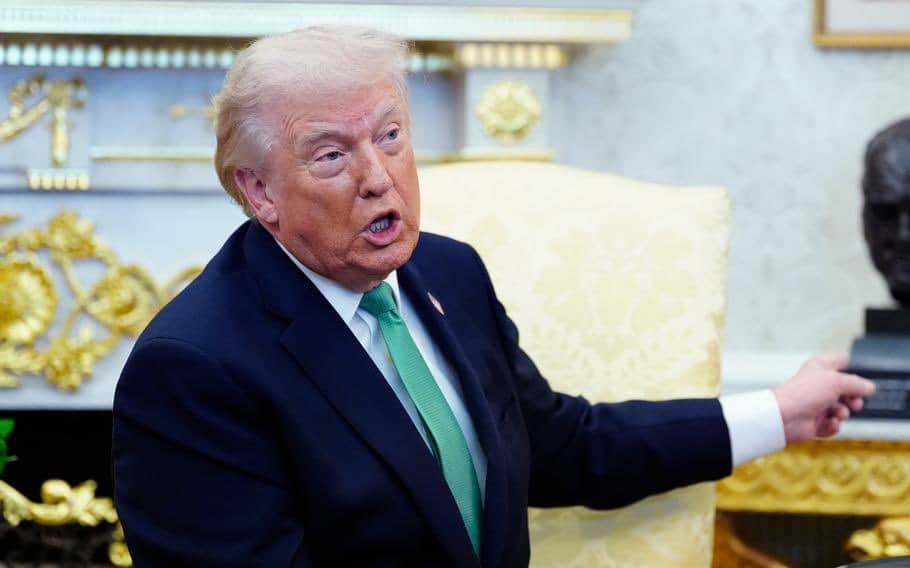
The United States and Iran are facing renewed tensions after President Donald Trump claimed that Iranian forces shot down a US Army AH-64 Apache attack helicopter over the Strait of Hormuz. The incident, which occurred near the coast of Oman during the early hours of Monday, has raised concerns about regional security and the future of ongoing diplomatic efforts between Washington and Tehran. While Trump has publicly blamed Iran and warned that the United States is “obligated to respond”, military officials continue to investigate the exact cause of the crash.
The episode comes at a sensitive moment, with tensions already high across the Middle East following recent developments involving Iran, Israel, and Hezbollah. Given the strategic importance of the Strait of Hormuz to global energy supplies, the outcome of the investigation could have consequences far beyond the Gulf region.
Trump Accuses Iran
President Donald Trump directly accused Iran of bringing down a US military helicopter, transforming what initially appeared to be an aviation incident into a major geopolitical development.
Speaking to reporters before boarding Air Force One at New York’s John F. Kennedy International Airport, Trump first reassured the public about the condition of the crew.
“The pilots are fine. Nobody injured. We are going to issue a report tomorrow.”
Hours later, after receiving military briefings, the president publicly blamed Iran.
“We have just been informed by our great military that last night the Iranians shot down one of our highly advanced Apache-type helicopters that was patrolling over the Strait of Hormuz. There were two pilots on board, both are safe and unharmed. Nevertheless, the United States is obligated to respond to this attack.”
The Apache involved was reportedly one of only four such helicopters operating in the Gulf theatre. If confirmed, the incident would represent one of the most direct confrontations between the United States and Iran in recent years.
However, despite Trump’s assertion, US military officials have not yet publicly released evidence proving that hostile fire caused the crash.
Apache Downed Over Hormuz
According to US Central Command (CENTCOM), the helicopter went down near the coast of Oman at approximately 3:00 to 3:30 a.m. local time while conducting operations in the vicinity of the Strait of Hormuz.
The rescue operation that followed quickly became one of the most significant aspects of the incident.
Both pilots survived and were located in the water shortly after the crash. US military officials confirmed that an autonomous US Navy surface vessel known as Corsair, operating under Task Force 59, played a key role in the recovery mission.
The unmanned vessel reportedly reached the pilots and transported them to safety before additional military assets completed the extraction process. Officials described the operation as the first known successful rescue of US military personnel by an autonomous sea drone during an active mission.
The recovery was completed within roughly two hours, preventing what could have become a far more serious military crisis. Defence analysts have described the rescue as an important milestone in the Pentagon’s efforts to integrate autonomous technologies into operational missions.
Investigation Continues
The most important unanswered question remains whether the helicopter was actually shot down by Iranian forces.
Soon after reports emerged that the Apache had gone down, Iranian media outlets and several pro-government platforms claimed that the Islamic Revolutionary Guard Corps (IRGC) had successfully targeted the aircraft over the Strait of Hormuz.
Those reports spread rapidly across regional media networks and social media platforms, fuelling speculation about a possible escalation between Tehran and Washington.
However, Iranian authorities have not formally acknowledged responsibility for the incident. Tehran has not released evidence supporting the claims made by affiliated media outlets, nor has it issued an official military statement confirming that Iranian forces engaged the aircraft.
That distinction remains critical.
While Trump’s statement leaves little doubt about the White House position, military officials continue to describe the cause of the crash as under investigation. Investigators are reportedly examining multiple possibilities, including hostile action, mechanical failure, operational error, or another technical cause.
The findings of the investigation could determine Washington’s next steps. If evidence confirms that Iranian forces deliberately targeted the helicopter, pressure for a US response is likely to grow significantly.
Why Hormuz Matters
The location of the incident makes it especially significant.
The Strait of Hormuz is one of the world’s most important maritime chokepoints, linking the Persian Gulf with international waters. A substantial share of global oil exports passes through the narrow waterway every day, making it critical to international trade and energy security.
Even limited military incidents in the area can affect oil prices, shipping costs, and investor confidence. Markets closely monitored developments following reports of the crash, with analysts warning that any escalation involving the Strait could disrupt global energy flows.
For decades, the United States has maintained a strong military presence in the region to safeguard commercial shipping and freedom of navigation. Iran, meanwhile, has repeatedly criticised foreign military activity near its waters and warned against actions it considers provocative.
The strategic importance of the Strait means that incidents involving military aircraft or naval forces immediately attract international attention and carry implications far beyond the Middle East.
US Response and Diplomacy
The Apache incident comes at a particularly delicate moment in regional diplomacy.
In recent weeks, tensions involving Iran and Israel have remained high despite efforts to prevent a broader conflict. Israeli military operations against Hezbollah-linked targets in southern Lebanon and Iranian warnings over regional security have added to uncertainty across the region.
Iranian parliamentary speaker Mohammad Bagher Qalibaf recently stressed that commitments made under ongoing diplomatic understandings must be respected, highlighting the fragile nature of current negotiations.
At the same time, Trump has repeatedly suggested that talks with Iran may be approaching a breakthrough.
“We’re very close. I think we’re in the final throes of a deal.”
The president has also expressed confidence that an agreement could be reached within days, raising hopes that diplomacy may still offer a path towards de-escalation.
Yet those comments now sit alongside his warning that the United States is obligated to respond if Iran was responsible for bringing down the Apache helicopter.
The situation leaves Washington balancing diplomacy with deterrence. Potential responses could range from additional sanctions and cyber operations to increased military deployments or targeted strikes against Iranian-linked assets. No decision has been announced, and officials are expected to wait for the outcome of the investigation before determining the next course of action.
For now, the confirmed facts remain limited: a US Army Apache helicopter crashed near the Strait of Hormuz, both crew members survived, a historic autonomous rescue operation brought them to safety, and President Donald Trump has publicly accused Iran of shooting the aircraft down.
Whether the incident becomes a short-lived diplomatic dispute or the beginning of a broader confrontation may depend on the evidence uncovered by investigators and the decisions taken in Washington and Tehran in the coming days.


