

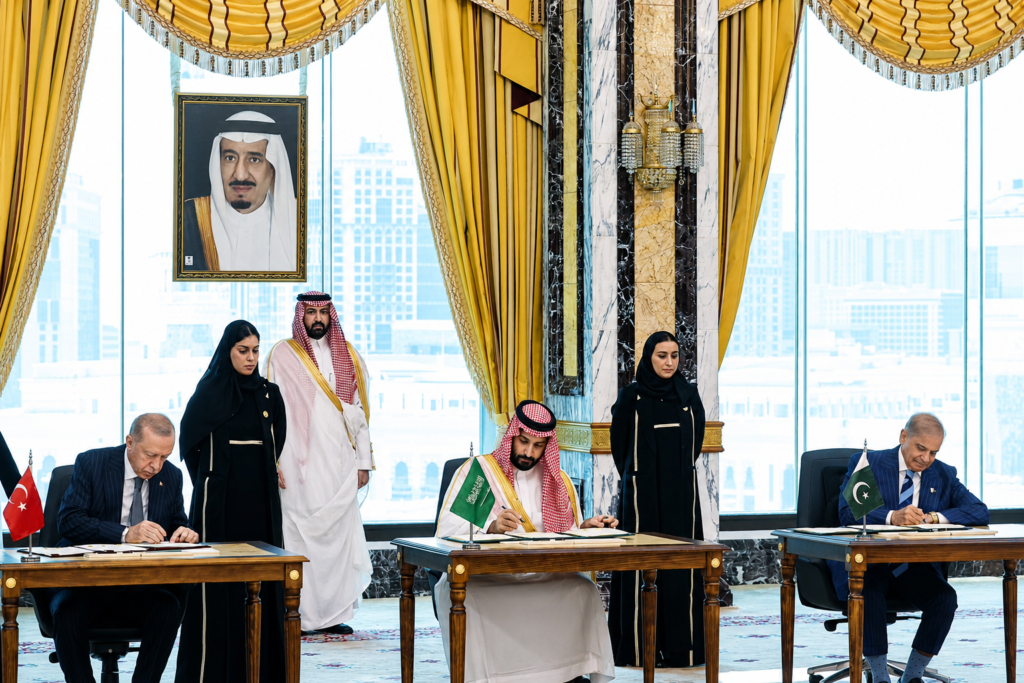
Saudi Arabia, Turkiye and Pakistan have signed a mutual defence agreement that binds three of the Muslim world’s most consequential military and economic powers into a single security framework, at a moment when the wider Middle East is enduring some of its most sustained turmoil in decades.
The pact, signed in Mecca on Friday, commits each country to treat an armed attack on any one of the three as an attack on all. It was formalised during a meeting in Saudi Arabia between Crown Prince Mohammed bin Salman, Turkish President Recep Tayyip Erdogan and Pakistani Prime Minister Shehbaz Sharif, with Pakistan’s army chief, Field Marshal Asim Munir, also present.
Known formally as the Mecca Joint Defence Agreement, the pact follows nearly a year of negotiation and comes after months in which Saudi Arabia has repeatedly come under fire from Iran and its regional allies, following the escalation triggered by American and Israeli strikes on Iran on February 28. For a region already reordering itself along new fault lines, the agreement signals a deliberate hedge against the erosion of old security guarantees.
How the agreement took shape
Talks between the three governments have been under way since at least January, when Reuters reported that Ankara was pushing for a broader regional security platform. Turkish Foreign Minister Hakan Fidan said at the time that his government favoured such a structure to encourage cooperation and stability across the Middle East and South Asia.
What changed in the months since, according to officials familiar with the discussions, was the speed at which events forced the issue. One source close to the Saudi government said the idea had been under discussion for some time, but that recent developments in the region had expedited it. A second source independently confirmed the timing of the signing.
The choreography around the signing was carefully arranged. Mr Sharif and Field Marshal Munir travelled to Jeddah on Thursday and performed the Umrah pilgrimage in Mecca the following morning, before President Erdogan arrived from Ankara. All three delegations then convened with the Crown Prince to finalise the agreement.
The terms of the pact
According to a joint statement issued after the signing, the agreement is intended to strengthen collective deterrence against any act of aggression and stipulates that any armed attack against any one of the three states shall be regarded as an attack against them all. The statement said the pact would also broaden cooperation across all aspects of defence between the three countries.
Beyond that, the text made public offers little detail. It does not specify troop commitments, command arrangements or the circumstances that would trigger a collective response, leaving considerable room for interpretation about how the pact would function in practice.
A Turkish official briefed on the agreement characterised it as defensive in nature, insisting it was not aimed at any particular country, remained open to other states in the region that wished to join, and did not supersede any existing bilateral or multilateral commitments held by the three signatories. That last assurance is significant. Turkiye remains a NATO member with its own collective defence obligations, and Saudi Arabia continues to lean heavily on its long-standing security relationship with Washington. Framing the new pact as complementary, rather than as a substitute, appears intended to reassure both Western partners and sceptical neighbours.
A region under strain
The agreement lands against the backdrop of nearly three years of upheaval that trace back to the Hamas attack on Israel of October 7, 2023. In the years since, Israel has fought a prolonged war in Gaza, moved into southern Lebanon, taken territory inside Syria and launched two rounds of air strikes against Iran. Iran has responded by striking American bases and civilian infrastructure across Saudi Arabia, Kuwait, Bahrain, Qatar, the United Arab Emirates, Oman, Jordan and Israel.
Saudi Arabia has absorbed the heaviest cost among the Gulf states. The kingdom’s oil exports and its ambitious economic diversification plans, central to Crown Prince Mohammed bin Salman’s Vision 2030 agenda, have both come under pressure, while shipping through the Strait of Hormuz, once responsible for roughly a fifth of the world’s oil and liquefied natural gas trade, has been badly disrupted.
A senior Saudi official said on Thursday that the kingdom was braced for coordinated attacks from Iraqi militias and Houthi forces operating under Iranian direction, a warning that helps explain the urgency behind Riyadh’s push to widen its network of security partnerships. Turkiye and Pakistan have so far avoided being drawn into direct confrontation, but officials in both capitals are understood to fear that a wider conflagration would threaten their own economic and security interests. Islamabad, for its part, has tried to position itself as a potential mediator between Riyadh and Tehran rather than as a party to the conflict.
Symbolism in the setting
The decision to sign the agreement in Mecca, Islam’s holiest city, was widely read as a deliberate choice intended to lend the pact religious as well as strategic weight, reinforced by the timing around the Pakistani delegation’s pilgrimage.
Mr Fidan had previewed the direction of this cooperation in January, saying that Ankara favoured a broader regional security platform to promote cooperation and stability.
The trilateral pact does not emerge from nothing. Pakistan has trained and advised Saudi armed forces for decades, while Turkiye and Pakistan have exchanged warships and training aircraft in recent years. In 2023, Saudi Arabia agreed to buy Turkish drones in what Ankara described as its largest defence export contract to date. Pakistan’s presence inside the kingdom has grown further still. Reuters reported in May that Islamabad had deployed around 8,000 troops, along with fighter jets, drones and an air defence system, in support of Saudi Arabia, and that Pakistan had separately opened talks with Kuwait in July over an expanded security arrangement tied to energy cooperation and investment.
Built on an earlier bilateral pact
Friday’s agreement extends a framework Saudi Arabia and Pakistan established between themselves in September 2025, when the two countries signed a Strategic Mutual Defence Agreement in Riyadh committing each to treat external aggression against the other as aggression against both. A Saudi official described that earlier pact as covering all military means available to the two states.
That bilateral agreement drew considerable international attention at the time, not least because Pakistan is the only nuclear-armed country in the Muslim world. Iran’s president, Masoud Pezeshkian, went so far as to welcome the Saudi-Pakistan pact in an address to the United Nations General Assembly last September, suggesting it might mark the start of a broader regional security architecture. Whether Tehran views Friday’s expanded, trilateral version of that framework in the same terms remains to be seen.
A prospective Islamic security axis
Some analysts have begun describing the emerging grouping, informally, as an Islamic NATO, one that would combine Turkiye’s standing as NATO’s second largest military, Saudi Arabia’s position as one of the world’s foremost oil exporters and custodian of Islam’s holiest sites, and Pakistan’s status as the Muslim world’s sole nuclear power.
Mansoor Ahmed, a researcher at the Australian National University’s Strategic and Defence Studies Centre, said Pakistan and Turkiye bring established defence industries to the arrangement, while Saudi Arabia is better positioned to contribute financing and technological investment. He cautioned, however, that the pact was unlikely to extend into nuclear territory, noting that Pakistan’s atomic arsenal remains oriented toward what Islamabad regards as the threat from India rather than any deterrent guarantee it might offer to new partners.
According to people familiar with the negotiations, the treaty is intended to go beyond a simple mutual defence clause, laying the groundwork for institutionalised intelligence sharing, defence industrial cooperation and joint technology development. Should that ambition be realised, it would represent one of the more significant realignments of Muslim-majority military powers in recent decades.
How the region is reacting
The implications have registered well beyond the three capitals involved. India has said it will study the agreement’s consequences for its own national security, a response shaped by New Delhi’s long-running rivalry with Islamabad and its otherwise improving relationship with Riyadh.
Within the Gulf, the pact raises unresolved questions about how the United Arab Emirates, Qatar and Egypt might respond, and whether any of them could eventually join, given the Turkish official’s insistence that the arrangement remains open to other regional states.
What comes next
The public statement leaves substantial ambiguity around implementation. It is not yet clear how quickly the three governments intend to build out coordination structures, how Turkiye’s NATO commitments will sit alongside its new obligations, or how the pact will interact with Saudi Arabia’s existing security relationship with Washington.
Neither the Saudi government nor Pakistan’s military establishment has offered further comment beyond Friday’s joint statement. Officials in Riyadh, Islamabad and Ankara are expected to hold follow-up talks in the coming weeks aimed at converting the political commitment into a working framework, potentially covering joint exercises, shared intelligence arrangements and coordinated defence procurement.
For now, the Mecca Joint Defence Agreement stands as a marker of how three of the Muslim world’s most influential states are choosing to navigate an increasingly unstable regional order, one in which long-standing reliance on Western security guarantees is being supplemented, and in places tested, by new alliances built on shared faith, economic interdependence and a common exposure to a widening Middle East conflict.


