

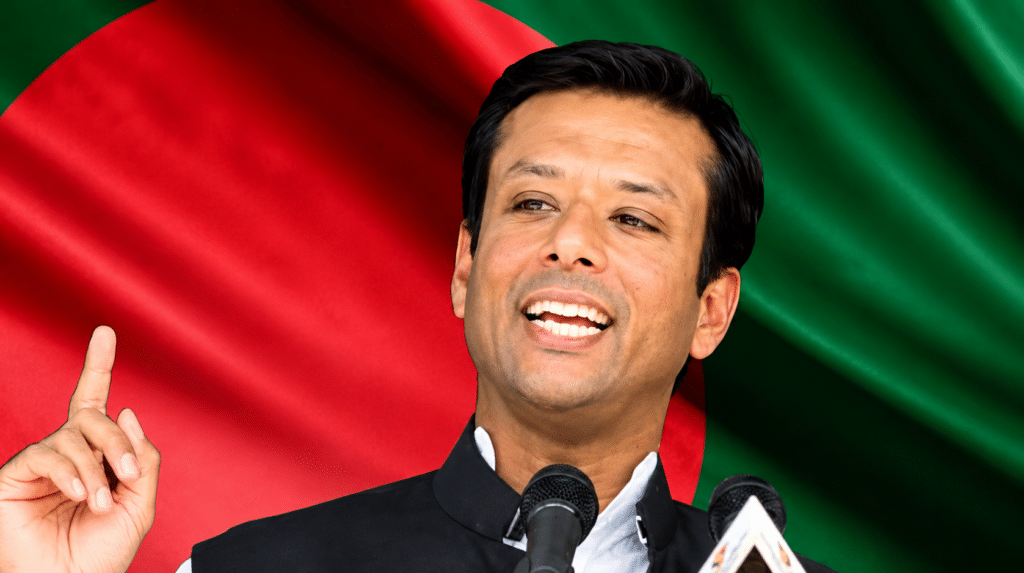
Former Bangladesh Prime Minister Sheikh Hasina broke her silence this week, delivering her first public address since she was removed from power in August 2024. The remarks, made from exile in New Delhi, were accompanied by a sharp warning from her son and political adviser, Sajeeb Wazed Joy, who said Bangladesh has effectively turned into another Pakistan and that India needs to take note of the rising extremism across its eastern border.
The comments have reignited tensions between Dhaka and New Delhi at a time when the two neighbours are already navigating a difficult diplomatic relationship, shaped by Hasina’s continued presence on Indian soil, an extradition request from Bangladesh, and an upcoming general election in the country.
Hasina Breaks Her Silence
Sheikh Hasina, 78, has lived in exile in India since a student led uprising toppled her fifteen year rule in August 2024. She was later sentenced to death in absentia by a special tribunal in Dhaka over her government’s crackdown on the uprising, in which more than 1,400 people were reported killed. She has dismissed the verdict as legally void.
Her address was delivered via audio link at an event hosted by the Foreign Correspondents’ Club of South Asia in New Delhi, alongside her son and several former Awami League leaders, including ex Education Minister Mohibul Hasan Chowdhury Nowfel. It marked her first sustained public appearance since fleeing Dhaka.
In her speech, Hasina directed her sharpest criticism at Muhammad Yunus, the Nobel laureate who now heads Bangladesh’s interim government. She described the current administration in stark terms, calling it responsible for widespread lawlessness and repression.
“The murderous fascist Yunus, a money launderer, a plunderer, a corrupt power hungry traitor, has bled our nation dry with his all consuming perditions, staining the soul of our motherland,” Hasina said, according to reports from the event.
She went further, describing the state of her country in equally dramatic terms.
“Bangladesh stands today at the edge of an abyss, a nation battered and bleeding. The entire country has become a vast prison, an execution ground, a valley of death,” she said.
Joy’s Warning To India
While Hasina focused her fire on the Yunus government, it was her son Sajeeb Wazed Joy who framed the crisis as a direct regional security concern for India. Speaking separately in a virtual interaction with journalists from Delhi, Joy argued that Bangladesh’s drift toward extremism should alarm policymakers in New Delhi far more than they currently appear to acknowledge.
He went on to allege that foreign intelligence networks, including Pakistan’s ISI, are now operating with greater freedom inside Bangladesh, and that hardline groups have gained a public platform that would have been unthinkable during his mother’s tenure.
“Al Qaeda operatives are speaking at public rallies. This is what is happening in Bangladesh, and this does not portend well for India or the world at large,” he added.
Joy has also previously credited India directly for protecting his mother’s life. In an earlier interview, he expressed gratitude toward the Indian government for granting her refuge, claiming that militant groups had been plotting to assassinate her had she remained in Bangladesh.
Yunus Government Hits Back
Dhaka reacted swiftly and angrily to the New Delhi address, accusing India of enabling a fugitive former leader to spread what it called hate speech from Indian soil. Bangladesh’s Ministry of Foreign Affairs issued a statement expressing its displeasure in unusually blunt language.
“Allowing the event to take place in the Indian capital and letting mass murderer Hasina openly deliver her hate speech constitute a clear affront to the people and the Government of Bangladesh,” the ministry said.
The statement further accused Hasina of using the platform to call for the removal of the interim government and of issuing what it described as blatant incitements to her supporters to carry out acts of unrest ahead of the country’s upcoming national election.
India, for its part, has maintained that it played no role in organising the event, describing it as a private engagement that it had no hand in facilitating.
Escalating Diplomatic Tension
The latest exchange adds to a string of frictions that have built up between the two countries since Hasina’s ouster. Dhaka has repeatedly protested her political activity while residing in India, and both sides have summoned each other’s high commissioners in recent months over separate disputes, including a controversy linked to cricket.
Bangladesh has formally sought Hasina’s extradition, a request India has so far resisted, allowing her to remain in the country despite mounting pressure from the interim government. The friction over her presence has become one of the most sensitive issues in the bilateral relationship, feeding into broader anxieties in Dhaka about New Delhi’s intentions toward Bangladesh’s internal politics.
For India, the situation presents a delicate balancing act. Maintaining its long standing ties with Hasina’s Awami League while managing a working relationship with the current administration in Dhaka has proven increasingly difficult as rhetoric on both sides has hardened.
What Lies Ahead For Bangladesh
Bangladesh is preparing to hold its first general election since Hasina’s removal, scheduled for February 12. Her Awami League party has already been barred from contesting after the country’s Election Commission suspended its registration earlier this year, leaving her political camp without a formal route back into mainstream politics for now.
Against this backdrop, the renewed accusations from Hasina and her son are likely to sharpen an already polarised national conversation ahead of the vote. Her remarks about extremism and the comparison to Pakistan are expected to resonate strongly with segments of the Bangladeshi diaspora and Awami League loyalists, even as the interim government dismisses them as an attempt to derail the democratic transition currently underway.
With regional stability, bilateral trust between India and Bangladesh, and the credibility of the upcoming election all in the balance, the coming weeks are likely to see continued sparring between Dhaka and the exiled former leadership in New Delhi.


