

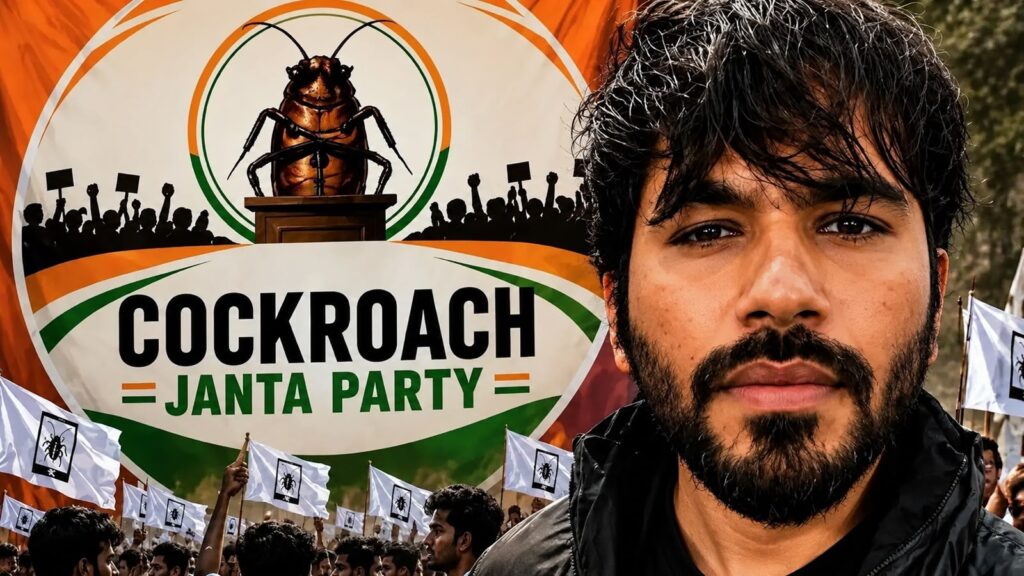
A political movement that began as an online joke is preparing for its most significant test yet.
On June 6, Cockroach Janta Party (CJP) founder Abhijeet Dipke is expected to return to India and lead a protest in Delhi centred on the NEET-UG 2026 paper leak controversy and wider concerns surrounding examination governance. The planned demonstration comes after weeks of extraordinary growth for a movement that started as satire but has since developed into one of the country’s most closely watched youth-led campaigns. With more than 23 million Instagram followers, over one million reported sign-ups and a petition demanding the resignation of Union Education Minister Dharmendra Pradhan attracting nearly 800,000 signatures, CJP has evolved from an internet phenomenon into a movement that has entered the national political conversation.
Its rise comes at a moment of growing frustration among students and job aspirants. The cancellation of NEET-UG 2026 following allegations of a paper leak, concerns over recruitment examinations, delays in hiring processes, administrative lapses and wider anxieties surrounding employment opportunities have fuelled a sense of discontent among many young Indians. CJP has sought to channel that frustration into a campaign focused on accountability, transparency and institutional reform. The June 6 protest will now provide the clearest indication of whether one of India’s fastest-growing online movements can convert digital influence into public mobilisation.
The Spark
The origins of the movement can be traced to a remark that quickly became a national talking point.
During a Supreme Court hearing related to alleged fake educational qualifications, Justice Surya Kant used the term “cockroaches” while referring to individuals accused of obtaining fraudulent credentials. The comment spread rapidly across social media, where many young Indians interpreted it as symbolic of a broader disconnect between institutions and ordinary citizens.
Among those who responded was Abhijeet Dipke, a political communications professional based in the United States. Rather than rejecting the label, Dipke embraced it and transformed it into the foundation of a new movement.
The Cockroach Janta Party was launched as a satirical platform that used humour, memes and internet culture to highlight concerns affecting students, unemployed graduates and young professionals. The cockroach was reimagined as a symbol of resilience, survival and persistence. What began as a joke quickly evolved into something far larger, attracting millions of followers who saw their own frustrations reflected in its messaging.
According to the organisation, more than one million people signed up to the movement within weeks of its launch. The pace of that expansion surprised political observers and reflected the extent to which frustrations surrounding examinations, employment and governance were already present among younger audiences.
The movement’s rapid growth also underscored a broader shift in how younger audiences engage with politics. Rather than relying on traditional party structures, many supporters connected with a campaign that communicated through social media while addressing issues they believed were not receiving adequate attention from mainstream institutions.
The Exam Crisis
The movement’s growth accelerated dramatically after the NEET-UG 2026 paper leak controversy.
As allegations surrounding the integrity of the examination emerged, public anger intensified among students and parents. The eventual cancellation of one of India’s most important entrance examinations affected millions of candidates seeking admission to medical colleges and reignited concerns about the credibility of the country’s examination system.
For many students, the controversy represented more than a single administrative failure. It became part of a wider pattern involving paper leak allegations, recruitment examination disputes, result delays and recurring concerns about institutional oversight.
CJP quickly placed itself at the centre of that debate.
The movement launched a petition demanding the resignation of Education Minister Dharmendra Pradhan, arguing that repeated examination failures had undermined public confidence. Dipke has repeatedly maintained that the campaign is focused on accountability and reform rather than partisan politics.
In public statements, he has linked the movement to concerns raised by students and families affected by examination uncertainty, arguing that repeated controversies have intensified anxiety among candidates preparing for highly competitive tests. The organisation has also pointed to broader concerns involving recruitment examinations, educational administration and opportunities for young job-seekers.
Supporters argue that students invest years of preparation, emotional commitment and financial resources into competitive examinations. When those examinations become the subject of allegations or cancellations, they say the consequences extend far beyond a single test and affect educational and professional futures.
The controversy has also prompted discussions within government about strengthening examination security. Among the measures reportedly under consideration are enhanced transport protocols for question papers, including the possible use of Indian Air Force aircraft for future examinations, as authorities seek to restore public confidence in the system.
The government has maintained that investigations are underway and that additional safeguards are being introduced to strengthen examination security and restore public confidence in the system.
Under Pressure
The popularity of the Cockroach Janta Party cannot be explained by examination controversies alone.
Its rise reflects wider concerns facing a generation navigating intense competition, economic uncertainty and changing expectations about employment and opportunity.
India’s youth population is among the largest in the world, with millions of graduates entering the labour market each year. At the same time, government jobs remain highly sought after, recruitment processes are often lengthy and competition for educational opportunities continues to intensify.
According to official data cited in international reporting, unemployment among Indians aged 15 to 29 stands at 9.9%, more than three times the national unemployment rate. The figure has become a focal point in discussions about opportunities available to young people entering the workforce and has contributed to wider concerns about economic security among graduates and job seekers.
For many young Indians, examinations are not simply academic milestones. They are pathways to employment, financial stability and social mobility. Delays, cancellations or allegations of irregularities can therefore have significant consequences for individuals and families alike.
Political observers have noted that CJP’s messaging has resonated because it links examination concerns with broader questions surrounding accountability, governance and employment opportunities. Rather than focusing exclusively on NEET, the movement frequently highlights issues affecting students, graduates and job aspirants across different sectors.
The movement’s supporters include medical aspirants, competitive examination candidates, unemployed graduates and young professionals who see their own experiences reflected in its criticism of systemic failures. The result has been the emergence of an unusually diverse online community united less by ideology than by shared frustration.
The Delhi Test
The June 6 protest will be the first major attempt to convert that online community into a visible public movement.
The visit will also mark Dipke’s first return to India since launching the Cockroach Janta Party from the United States earlier this year. In a video message announcing his plans, he issued a direct appeal to supporters.
“Meet me at the airport.”
The statement quickly became the movement’s defining slogan and is now central to its mobilisation efforts.
According to Dipke’s publicly outlined plan, supporters gathering at the airport will accompany him to Parliament Street Police Station, where organisers intend to seek permission for a peaceful demonstration at Jantar Mantar. The sequence has been presented as an effort to emphasise constitutional and lawful forms of protest.
“The time has come for all of us to come together, following the path of the Constitution of India, and peacefully raise our voices,” Dipke said while announcing the demonstration.
The significance of the event extends beyond attendance figures.
Digital movements often generate substantial engagement online but face greater challenges when attempting to organise activity in the physical world. The Delhi demonstration therefore represents a crucial test of whether the movement’s influence extends beyond social media platforms.
Dipke has also publicly stated that he fears he could face arrest upon arriving in India, although he has maintained that the campaign will continue through peaceful and constitutional means.
Whether the gathering attracts hundreds or thousands of participants, it is likely to provide the clearest indication yet of whether the concerns driving the movement resonate beyond the digital sphere.
What Happens Next
The rise of the Cockroach Janta Party has already reshaped conversations surrounding examinations, youth concerns and political engagement in India.
What began as a satirical response to a controversial remark has evolved into a movement drawing attention to questions of accountability, institutional trust and the pressures facing young Indians. Its rapid growth has demonstrated the ability of social media to transform public frustration into organised campaigns capable of influencing wider political debate.
The movement has also become involved in a wider debate over digital activism and political expression. CJP’s account on X was withheld in India following government directives, a move that Dipke challenged through legal channels. He has also alleged that the organisation’s social media platforms have faced repeated hacking attempts, claims that have added another dimension to the controversy surrounding the movement’s growth.
Some leaders from the ruling Bharatiya Janata Party have accused the organisation of maintaining links with anti-India elements. Dipke has rejected those allegations, maintaining that the movement’s focus remains on examination reform, accountability and issues affecting students and young job seekers.
Whether that momentum can be sustained remains uncertain. The organisation is not a registered political party, does not contest elections and lacks the infrastructure associated with established political movements. Yet its influence has extended far beyond internet culture, forcing attention onto issues that many supporters believe have not received sufficient scrutiny.
As preparations continue for the June 6 protest, the movement stands at a pivotal moment in its short history. The gathering in Delhi will not simply be a demonstration over an examination controversy. It will be a test of whether a movement born online can establish itself as a lasting voice for a generation increasingly frustrated by questions of opportunity, accountability and trust.
The story of the Cockroach Janta Party began with a remark. On June 6, India will discover whether it has become a movement!


