

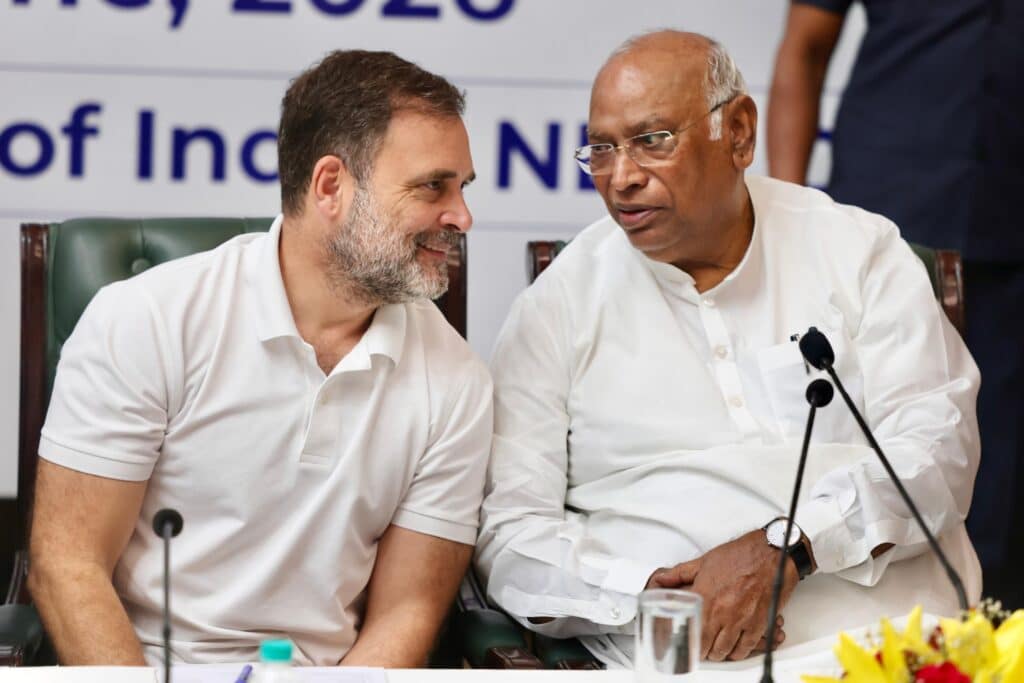
Leaders from 25 opposition parties gathered in New Delhi on Sunday for a crucial INDIA bloc meeting aimed at reviving coordination among alliance partners and shaping a common political strategy ahead of upcoming electoral battles.
The gathering ended with a public display of unity and an agreement on a shared political agenda. Yet discussions behind closed doors revealed growing unease over Congress’ leadership style, differences over campaign priorities and concerns among regional parties about the future direction of the opposition alliance.
The meeting also produced an unexpected political moment. Amid discussions on electoral strategy and governance issues, leaders reportedly referred to the rise of the Cockroach Janta Party, a youth-led protest movement that has emerged from examination-related controversies and anti-establishment activism.
Despite the disagreements, the alliance left the meeting united, reaffirming its commitment to challenging the BJP and strengthening cooperation among opposition parties.
A Bloc Seeking Relevance
The meeting came at a significant moment for the INDIA bloc.
Since its formation, the alliance has faced recurring questions about its cohesion, coordination and long-term viability. Electoral setbacks in several states, public disagreements among partners and periods of inactivity have fuelled speculation about whether the coalition could maintain political momentum.
Sunday’s meeting was therefore about more than symbolism. It was an attempt to demonstrate that the opposition alliance remains politically relevant and capable of functioning as a coordinated national platform.
Leaders from Congress, the Samajwadi Party, Rashtriya Janata Dal, Trinamool Congress, National Conference, PDP, Left parties and several regional groups participated in the discussions.
The scale of attendance reflected the continuing importance many opposition leaders attach to the coalition despite its internal challenges.
Congress Under Fire
One of the most significant developments during the meeting was the criticism directed at Congress by some alliance partners.
According to leaders familiar with the discussions, representatives from the RJD and Left parties raised concerns about Congress’ recent political approach and questioned whether alliance partners were being adequately consulted before major political decisions and public campaigns.
The concerns reflected a long-standing tension within opposition politics.
While Congress remains the largest national party in the alliance, regional players continue to guard their political space carefully. Several leaders reportedly argued that effective cooperation requires greater consultation and coordination rather than unilateral decision-making.
For many regional parties, the challenge is not merely defeating the BJP. It is doing so while preserving their own political identities and state-level influence.
The criticism underscored a reality that has shaped opposition alliances for decades: Congress may be the coalition’s largest player, but it cannot afford to ignore the concerns of regional partners if the alliance is to remain intact.
Vote-Chori Faultline
The sharpest debate centred on Congress’ campaign around alleged electoral irregularities, often referred to by party leaders as “vote chori”.
Rahul Gandhi reportedly expressed disappointment that several INDIA bloc partners had not actively supported Congress on the issue despite repeated attempts to build a broader campaign around electoral transparency.
The discussion focused heavily on concerns related to electoral roll revisions and the Election Commission’s Special Intensive Revision exercise.
Congress leaders argued that voter-list management and election-related procedures require greater scrutiny and should become a central issue for the opposition.
However, not all alliance partners appeared equally enthusiastic.
Several regional parties reportedly maintained that while electoral transparency remains important, opposition politics cannot be defined by a single issue. Leaders from multiple parties argued that unemployment, inflation, social welfare, education and governance concerns continue to resonate more strongly with voters.
The debate exposed a deeper strategic divide within the coalition.
Congress wants stronger backing for institutional and electoral issues, while many regional allies favour a broader campaign focused on everyday concerns affecting citizens.
Akhilesh’s Unity Message
The Samajwadi Party emerged as one of the strongest voices for opposition unity during the meeting.
SP chief Akhilesh Yadav reportedly emphasised the importance of fighting political battles collectively, particularly in Uttar Pradesh, India’s most politically significant state.
His message carried weight because Uttar Pradesh remains central to any opposition strategy aimed at challenging the BJP nationally.
Yadav is understood to have stressed that opposition parties must avoid weakening one another and should work together wherever possible to maximise electoral effectiveness.
The intervention reflected a practical political calculation shared by several regional leaders.
While disagreements with Congress persist, many opposition parties recognise that fragmentation within the alliance would ultimately strengthen the BJP’s position.
The emphasis on teamwork also highlighted growing concerns that public disputes between allies could undermine voter confidence in the coalition.
Common Agenda
While disagreements dominated much of the discussion, the meeting also produced concrete outcomes.
Congress president Mallikarjun Kharge announced that the alliance had agreed on a common agenda covering electoral roll revision concerns, examination-related controversies, governance issues and matters linked to democratic institutions.
Leaders agreed to coordinate more closely on these issues both inside and outside Parliament and to strengthen joint political campaigns in the coming months.
The alliance also decided to institutionalise regular coordination by holding meetings every two months. The next INDIA bloc meeting is expected to take place in Hyderabad in August.
The decision was widely viewed as an attempt to address criticism that the coalition had lacked consistent engagement and strategic planning since its formation.
The inclusion of examination controversies in the common agenda was particularly notable.
Several opposition leaders argued that education-related grievances, recruitment delays and examination management issues continue to generate widespread public concern, particularly among young voters.
When Cockroaches Entered The Room
One of the more unusual moments of the meeting was the reported mention of the Cockroach Janta Party.
The reference was politically significant because it reflected growing awareness among mainstream political parties of emerging forms of youth-led political mobilisation.
The Cockroach Janta Party began as a satirical movement focused on examination controversies, educational accountability and frustrations among students and job aspirants. Over time, it evolved into a broader platform expressing dissatisfaction with governance failures and institutional shortcomings.
Its appearance in discussions among senior opposition leaders suggested that traditional political parties are paying increasing attention to movements operating outside conventional political structures.
The timing was particularly relevant.
As opposition parties discussed examination controversies and youth concerns as part of their common agenda, the rise of a movement built around similar issues served as a reminder that political frustration among younger voters is creating space for alternative forms of mobilisation.
The significance of the Cockroach Janta Party lies not in electoral strength but in its ability to influence public discourse and capture attention on issues that established parties are increasingly being forced to address.
United, But Not Aligned
By the end of the meeting, INDIA bloc leaders projected unity and reaffirmed their commitment to working together against the BJP.
Yet the discussions revealed an alliance still searching for a common political narrative.
Congress wants stronger support for its campaigns on electoral transparency and institutional accountability. Regional parties continue to prioritise local political realities and voter concerns related to jobs, inflation, welfare and governance. Left parties remain focused on economic and social issues.
The decision to adopt a common agenda and hold regular meetings may help bridge some of those differences.
Whether that translates into a coherent national political strategy remains uncertain.
For now, the INDIA bloc has succeeded in preventing internal tensions from becoming a public rupture. The larger challenge will be transforming a coalition united against the BJP into one united around a shared political vision.
The meeting ended with consensus, but it also highlighted the question that continues to hover over the opposition alliance: can the INDIA bloc move beyond unity of purpose and achieve unity of strategy?


