

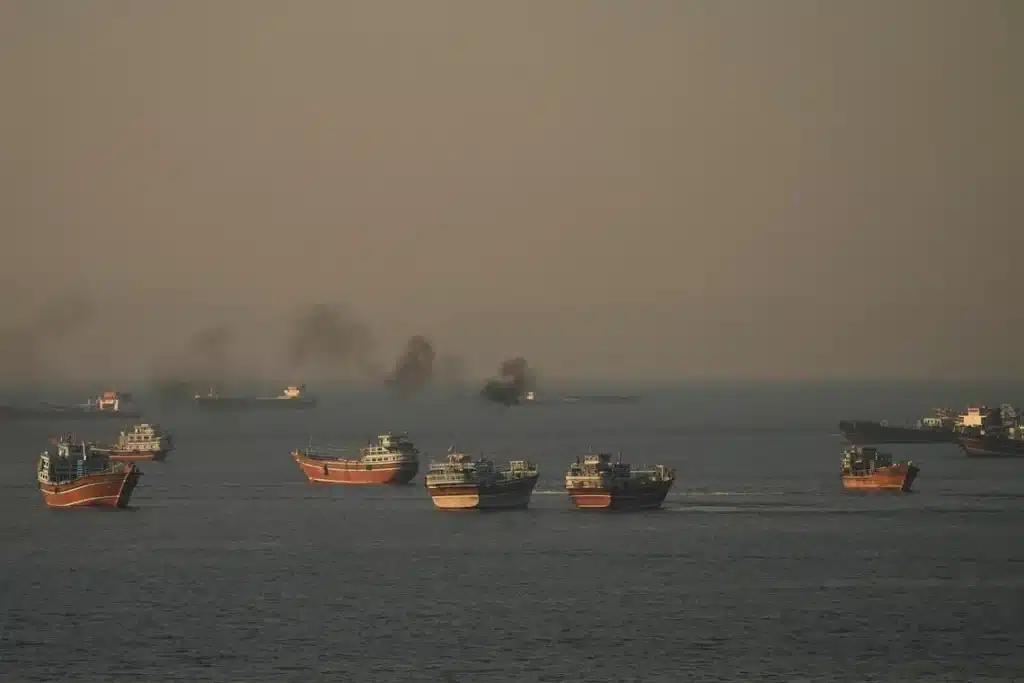
The fragile US-Iran peace deal is already beginning to alter the global economic mood. After 107 days of military confrontation, both sides have agreed to a preliminary ceasefire, raising hopes that the Strait of Hormuz, one of the world’s most vital energy routes, could soon return to normal.
For India, that possibility carries enormous weight.
The Strait of Hormuz handles nearly one-fifth of global oil trade, and for an economy that imports over 85% of its crude requirements, any disruption there quickly translates into higher costs at home. During the conflict, oil prices surged, freight charges climbed and war-risk insurance premiums jumped, putting additional pressure on India’s import bill.
Now, with tensions easing, crude prices have started to cool.
That opens up a wider economic question. Could the reopening of Hormuz reduce inflation, strengthen the rupee, cut India’s energy bill and create a broader economic advantage for New Delhi?
The answer could shape India’s economic trajectory in the months ahead.
Why Hormuz Matters
The Strait of Hormuz remains one of the most strategically important waterways in the world. It connects the oil-rich Gulf states to global markets, making it central to international energy security.
For India, its importance is even more direct.
A significant portion of India’s crude imports from Iraq, Saudi Arabia, the UAE, Kuwait and Qatar flows through Hormuz. Any interruption in this route affects not just supply timelines but also the final landed cost of oil.
That became clear during the recent conflict.
Shipping activity slowed as security concerns rose. Insurance premiums on tankers increased sharply. Freight charges moved higher. Together, these factors pushed up the cost of imported crude for India and other Asian buyers.
Petroleum Minister Hardeep Singh Puri said India had managed the crisis better than before because of greater diversification.
“India now sources crude from nearly 40 countries. That diversification gives us flexibility and resilience in times of geopolitical stress.”
That shift has been critical, especially after India increased imports from Russia in recent years.
But Gulf crude still remains more efficient in terms of shipping time and cost.
A stable Hormuz means lower uncertainty, faster supply chains and more predictable pricing.
Oil and the Rupee
The first and most visible impact of peace has been in oil markets.
Brent crude prices have fallen sharply as traders responded to expectations of restored Gulf supply. For India, even a small decline in oil prices creates large economic effects.
Every $10 drop in crude prices is estimated to cut India’s annual import bill by $13 to $15 billion.
In rupee terms, that could mean savings of nearly ₹1.8 lakh crore if prices remain stable at lower levels.
That matters for the rupee.
A lower oil bill means India needs fewer dollars to pay for imports. That reduces pressure on foreign exchange reserves and strengthens the domestic currency.
During the conflict, the rupee weakened as crude prices climbed and import costs rose.
A reversal in oil prices could improve that trend.
Reserve Bank Governor Sanjay Malhotra has warned repeatedly about imported inflation risks.
A stronger rupee combined with lower crude creates a powerful economic cushion.
It lowers import costs, improves investor sentiment and stabilises financial markets.
That could become one of India’s biggest short-term gains from the peace deal.
Inflation and Households
Oil prices affect far more than fuel stations.
In India, energy costs ripple through transport, logistics, manufacturing and food distribution. That means lower crude prices can directly slow inflation across multiple sectors.
The effect begins with transportation.
Lower diesel costs reduce freight expenses. Lower freight costs make supply chains cheaper. That eventually helps reduce retail prices.
For households, the benefits could be visible quickly.
India also imports significant quantities of LPG and LNG from Gulf countries. These are crucial for cooking gas, industrial fuel and electricity generation.
A stable Hormuz could lower gas prices and reduce volatility in domestic energy markets.
That matters politically.
Cooking gas remains one of the most sensitive household expenses in India. A reduction in LPG prices would offer direct relief to millions of families.
There is also a major agricultural angle.
Natural gas is a core input for urea production. If LNG prices fall, fertiliser manufacturing becomes cheaper, potentially reducing subsidy burdens and lowering farming costs.
Agriculture Minister Shivraj Singh Chouhan recently stressed this connection.
“Stable fertiliser pricing is vital for agricultural productivity and farmer confidence.”
That makes the Hormuz reopening relevant not just for city consumers, but for rural India as well.
Iran and Strategy
The peace deal could also reopen long-term strategic opportunities.
Before sanctions tightened, Iran was among India’s most important oil suppliers. Iranian crude offered favourable pricing, easier payment terms and reliable supply.
That relationship ended under US sanctions.
Now, if the peace process eventually leads to sanctions relief, Indian refiners may once again look at Iranian crude as a serious option.
That would increase competition among suppliers and strengthen India’s bargaining power.
But Iran matters for another reason.
India has invested heavily in Chabahar Port, which remains a crucial strategic asset. The port provides India with access to Afghanistan and Central Asia while bypassing Pakistan.
External Affairs Minister Subrahmanyam Jaishankar has repeatedly underlined its importance.
“Connectivity projects like Chabahar are essential for regional stability and economic access.”
But Chabahar is also part of a larger strategic rivalry.
It serves as India’s counterweight to China’s growing presence at Pakistan’s Gwadar Port.
If Iran stabilises, Chabahar could gain renewed momentum, strengthening India’s regional influence.
The Bigger Impact
The economic effects of peace could go far beyond oil.
A stable Gulf means stronger regional trade, safer shipping routes and lower geopolitical risk. That matters because millions of Indians work across the Gulf and send billions of dollars back home every year.
These remittances are a major source of foreign exchange.
A stable Gulf economy means stable jobs and stronger remittance flows.
That supports India’s external balances.
Trade could also improve.
India exports pharmaceuticals, machinery, food products and manufactured goods across West Asia. Lower regional tensions usually improve logistics and reduce shipping costs.
There are also policy implications.
Lower crude prices could weaken the economics of India’s ethanol blending programme, where higher oil prices usually make ethanol more competitive.
That may force policymakers to review fuel strategy calculations.
At the same time, the risks remain.
US President Donald Trump described the deal as “an important step toward regional peace.”
Iranian officials have called it “conditional and reversible.”
That reflects the reality.
The peace remains fragile, and any breakdown in talks over sanctions or nuclear oversight could quickly push oil prices higher again.
For now, though, India appears well positioned.
If Hormuz fully reopens and stability returns, the benefits could be far-reaching: cheaper energy, lower inflation, a stronger rupee, improved fiscal stability and deeper strategic access in the region.
India stayed out of the conflict.
But if peace holds, it may still emerge as one of the biggest economic winners.


