

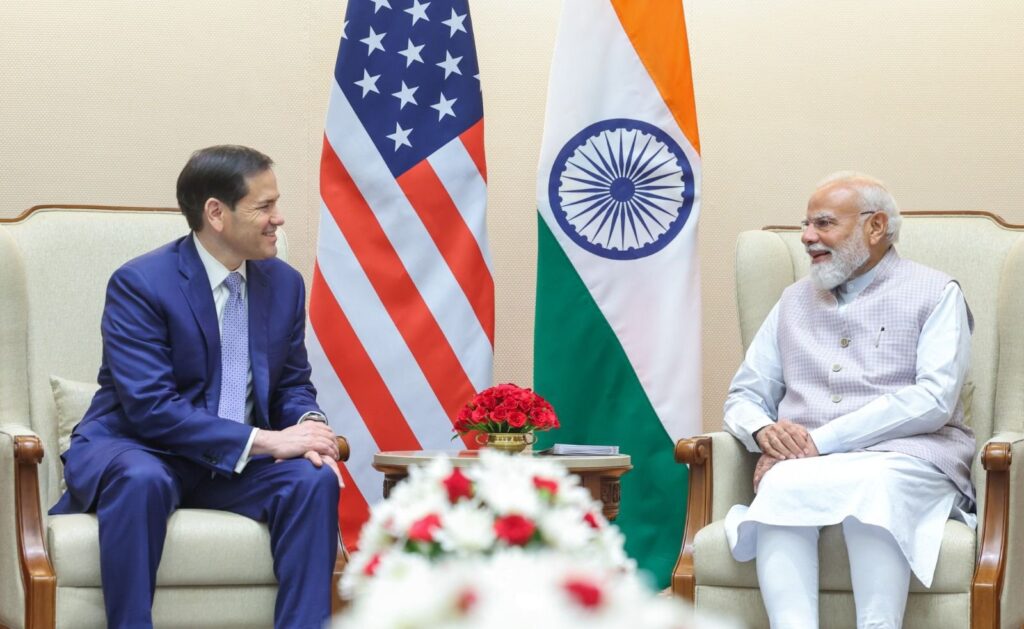
U.S. Secretary of State Marco Rubio began his first official visit to India on Saturday with a carefully choreographed diplomatic gesture at the headquarters of the Missionaries of Charity in Kolkata, signalling Washington’s attempt to combine humanitarian outreach with an urgent strategic reset in relations with New Delhi. Rubio’s four day India visit comes at a particularly sensitive moment for both countries as they navigate tensions over tariffs, immigration policy, energy security and geopolitical competition with China, while simultaneously attempting to deepen cooperation through the Quad alliance and broader Indo-Pacific strategy.
Instead of opening his visit with formal meetings in New Delhi, Rubio chose to begin at Mother House, the global headquarters of the humanitarian organisation founded by Mother Teresa. The symbolism was immediate and deliberate. Before discussions on trade disputes, oil supplies, defence partnerships and regional security, Washington projected an image rooted in compassion, cultural diplomacy and people to people engagement.
The visit also marks the first time in 14 years that a sitting U.S. Secretary of State has travelled to Kolkata. Rubio’s itinerary includes New Delhi, Jaipur and Agra alongside participation in high level strategic meetings with Prime Minister Narendra Modi, External Affairs Minister S. Jaishankar and Quad foreign ministers from Japan and Australia.
The broader backdrop to the visit is increasingly complex. The Trump administration is facing pressure over immigration restrictions, tariff disputes and instability linked to the Iran conflict, while India continues balancing its relationships with the United States, Russia and emerging energy partners such as Venezuela. Rubio’s trip is therefore being viewed in diplomatic circles not simply as a ceremonial visit, but as a critical effort to stabilise one of Washington’s most important strategic partnerships in Asia.
Kolkata Diplomacy
Rubio arrived in Kolkata alongside his wife Jeanette Rubio and was received by U.S. Ambassador to India Sergio Gor before travelling directly to Mother House. Founded in 1950 by Mother Teresa, the Missionaries of Charity has become one of the most internationally recognised humanitarian organisations associated with India, operating orphanages, shelters and care homes for vulnerable communities across multiple countries.
During the visit, Rubio interacted with nuns and officials associated with the congregation and later visited Nirmala Shishu Bhavan, a children’s home run by the organisation. He also paid respects at Mother Teresa’s tomb, an image that quickly became the defining visual of the opening phase of his India tour.
The Kolkata stop immediately drew political attention because of its timing. Rubio’s visit is expected to focus heavily on defence cooperation, energy security, tariffs and Indo-Pacific coordination, yet Washington deliberately chose to open the tour with humanitarian symbolism instead of hard diplomacy.
Diplomatic observers believe the move was designed to soften the tone of what are expected to be difficult strategic discussions in New Delhi. Rubio himself has frequently spoken publicly about faith and humanitarian values, making the visit personally resonant as well as politically significant.
U.S. Ambassador Sergio Gor described the moment as reflective of the “shared values” underpinning India U.S. ties. “The spirit of service and compassion represented here transcends borders,” Gor said during the visit.
The stop in Kolkata also reinforced eastern India’s growing strategic importance because of its proximity to the Bay of Bengal and its role within broader Indo-Pacific connectivity discussions.
Strategic Reset
Despite the humanitarian imagery, Rubio’s visit is fundamentally centred on geopolitics and strategic coordination.
Washington increasingly views India as a critical partner in balancing China’s growing influence across Asia. Rubio’s meetings in New Delhi are expected to focus on defence cooperation, semiconductors, emerging technologies, maritime security, supply chain resilience and Indo-Pacific strategy through the Quad framework involving India, the United States, Japan and Australia.
Before arriving in India, Rubio described New Delhi as one of Washington’s most important partners in Asia. “India is a great ally and partner,” Rubio said ahead of the visit while emphasising deeper strategic coordination between the two democracies.
The visit also comes amid signs of strain in bilateral ties following disagreements linked to tariffs and trade policy. Analysts in both countries increasingly describe Rubio’s visit as a repair and reassurance mission aimed at preventing economic tensions from weakening broader strategic cooperation.
Reuters reported that Rubio’s trip is intended partly to repair ties strained by tariff disputes and shifting geopolitical signals from Washington, including concerns in New Delhi over America’s changing posture toward China and Pakistan.
Prime Minister Narendra Modi has repeatedly framed India U.S. relations as one of the defining partnerships of the century. During previous bilateral engagements, Modi stated, “India and the United States are bound by democratic values, strategic trust and a shared commitment to global peace and stability.”
Rubio also stressed the growing importance of the Quad grouping before meetings in Delhi. “The Quad is more important than ever,” Rubio said during discussions linked to the visit, underlining Washington’s continued emphasis on Indo-Pacific coordination despite broader uncertainty in U.S. foreign policy.
Trump and Modi
One of the most politically significant moments of Rubio’s visit was the formal invitation conveyed from U.S. President Donald Trump to Prime Minister Narendra Modi for a future White House visit.
The invitation signals Washington’s continued reliance on personal diplomacy between Trump and Modi despite disagreements over trade and immigration policy. Rubio publicly praised the relationship between the two leaders and suggested that their political chemistry remains an important stabilising factor in bilateral ties.
“The relationship between President Trump and Prime Minister Modi remains an important foundation for long term cooperation,” Rubio said during interactions linked to the visit.
The Trump Modi relationship has historically played a central role in India U.S. diplomacy, particularly during events such as the “Howdy Modi” rally in Texas and Trump’s Ahmedabad visit in 2020. Those moments projected unusually close political coordination between the two leaders and elevated bilateral ties beyond traditional diplomatic engagement.
Diplomatic analysts believe the renewed White House invitation is designed to reinforce political trust at a time when both governments are attempting to ensure that disagreements over tariffs and immigration do not disrupt broader strategic cooperation.
For Washington, India remains indispensable to long term Indo-Pacific planning. For New Delhi, maintaining strategic autonomy while expanding cooperation with the United States continues to be a delicate balancing exercise.
Energy and Immigration
Energy security and immigration policy have emerged as two of the most sensitive dimensions of Rubio’s India visit.
Global energy markets remain volatile because of the Iran conflict and disruptions affecting shipping routes and oil supplies. Washington has increasingly encouraged India to expand purchases of American energy exports while reducing dependence on Russian and Iranian crude.
At the same time, India has significantly expanded oil imports from Venezuela, which has recently emerged as the country’s third largest crude supplier. Venezuelan crude is currently trading at a discount of nearly $5 to $8 below Brent prices, making several cargoes cheaper than comparable Russian shipments.
However, Russia continues to remain India’s most strategically important oil supplier because much of India’s refining infrastructure is specifically optimised for Russian Urals crude and similar medium sour grades. Analysts believe Venezuelan oil can supplement India’s energy basket, but cannot fully replace Russian supplies at scale because only limited Indian refining capacity is configured for heavier Venezuelan crude.
Rubio’s discussions with Indian officials are expected to focus heavily on long term energy cooperation, LNG exports and supply chain resilience as Washington attempts to increase its influence in India’s energy market.
Immigration policy has also emerged as a politically sensitive backdrop to the visit following concern among Indian professionals over proposed changes to U.S. Green Card processing rules.
In an interview during the visit, Rubio clarified that the new framework was not specifically targeted at India. “This is not about India,” Rubio said while defending the Trump administration’s broader immigration overhaul. He argued the changes were part of a wider restructuring of verification and residency procedures rather than an India specific measure.
The issue carries major political significance because Indian nationals remain among the largest recipients of H 1B visas and employment based Green Card applications in the United States. Concerns over visa backlogs, stricter immigration scrutiny and long waiting periods have increasingly become central to India U.S. people to people relations.
Defining Partnership
Rubio’s visit ultimately reflects the extraordinary transformation of India U.S. relations over the past two decades.
What was once a cautious bilateral relationship has evolved into a multidimensional strategic partnership covering defence cooperation, semiconductors, clean energy, artificial intelligence, maritime security and Indo-Pacific coordination.
Yet the opening stop in Kolkata demonstrated that symbolism continues to matter deeply in international diplomacy. Before discussions on tariffs, military strategy and geopolitical competition, Washington chose to frame its India outreach through the humanitarian legacy of Mother Teresa.
That contrast captures the current reality of India U.S. relations itself. Publicly, the partnership is presented through democratic values, humanitarian engagement and people to people ties. Beneath that layer lie difficult negotiations involving trade barriers, energy dependence, immigration policy and strategic rivalry with China.
As Rubio moves from Kolkata’s humanitarian symbolism to high stakes negotiations in New Delhi, the message from Washington appears increasingly clear. The United States sees India not merely as a regional partner, but as a central pillar of its long term geopolitical strategy in Asia.


