

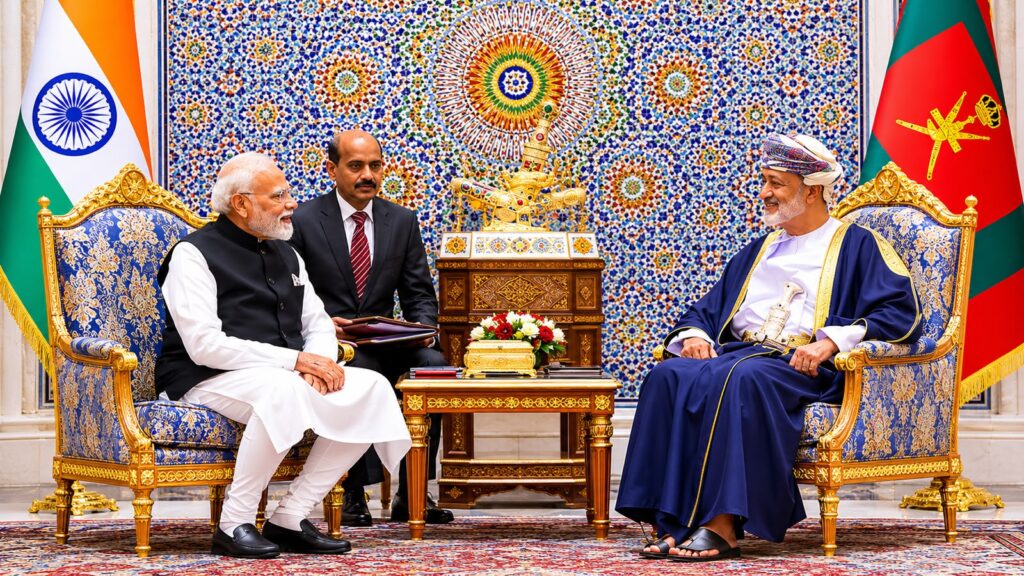
The entry into force of the India–Oman Comprehensive Economic Partnership Agreement (CEPA) on June 1 marks one of the most significant developments in India’s engagement with the Gulf region in recent years. While the agreement has largely been discussed in terms of tariff reductions and export opportunities, its importance extends far beyond trade. Coming at a time of heightened geopolitical uncertainty, concerns over maritime security, and renewed focus on energy resilience, the CEPA is increasingly being viewed as a strategic framework that connects economic growth with national security interests.
The agreement enters into force against the backdrop of growing global attention on the Gulf, where developments around key shipping corridors continue to influence energy markets and international commerce. For India, one of the world’s fastest-growing major economies and a leading energy importer, building resilient partnerships in the region has become a strategic necessity. Oman, with its stable political environment, strategic geography and deep historical links with India, occupies a unique position within that calculation.
Addressing the CEPA Entry into Force Ceremony, Union Commerce and Industry Minister Piyush Goyal underscored the broader significance of the pact. “The India-Oman Comprehensive Economic Partnership Agreement is not simply a trade agreement; it is a statement of civilisational trust,” he said.
The remark reflected the central theme surrounding the agreement. Signed in Muscat six months ago and now formally operational, the CEPA seeks not only to expand trade and investment but also to strengthen a partnership that both governments increasingly regard as strategic in nature.
A Partnership Built On History
The relationship between India and Oman is among the oldest in the Gulf region. For centuries, merchants and sailors crossed the Arabian Sea, linking Indian ports with Omani coastal cities through thriving trade networks that facilitated the exchange of goods, culture and ideas.
Those historical connections continue to shape contemporary relations. Oman hosts a large Indian community that has played a significant role in the country’s development and remains one of the strongest people-to-people bridges between the two nations. During the CEPA ceremony, Piyush Goyal highlighted the digitisation of nearly 7,000 historical diaspora documents preserved in Oman, describing them as evidence of the enduring ties that bind the two societies.
The agreement’s signing in December 2025 was accompanied by another notable diplomatic milestone. During Prime Minister Narendra Modi’s visit to Muscat, Sultan Haitham bin Tariq conferred upon him the Order of Oman (First Class), the Sultanate’s highest civilian honour.
Referring to the recognition, Goyal said, “We received it as an honour to 140 crore Indians.”
The symbolism was significant. The honour reinforced the political trust that has come to define India–Oman relations and highlighted the growing strategic importance both sides attach to the partnership. Unlike many international trade arrangements driven primarily by commercial interests, the CEPA is being presented as the next chapter in a relationship built on history, trust and long-term cooperation.
Trade, Investment And Economic Opportunity
At its core, the CEPA is designed to unlock new economic opportunities for both countries.
Under the agreement, India secures duty-free access on 98.08 per cent of Oman’s tariff lines, covering more than 99 per cent of India’s exports to the Sultanate from the very first day of implementation. The arrangement is expected to benefit a wide range of sectors including textiles, garments, pharmaceuticals, engineering goods, chemicals, processed food products, medical devices, automobiles, gems and jewellery.
The agreement goes well beyond conventional tariff reductions. It contains provisions relating to services, investment facilitation, professional mobility and regulatory cooperation, reflecting the increasingly comprehensive nature of modern trade agreements.
Bilateral trade between India and Oman has already crossed the $11 billion mark, but policymakers believe the CEPA can significantly expand that figure in the coming years. The pact is expected to stimulate investment flows, encourage business partnerships and create opportunities across sectors ranging from manufacturing and logistics to technology and healthcare.
The agreement comes at a time when Oman is becoming increasingly important in India’s trade basket. According to trade data cited by economic analysts, India’s imports from Oman have surged by more than 246 per cent in recent years, rising from approximately $430 million to nearly $1.5 billion. The increase has been driven largely by crude oil, fertilisers and industrial inputs, highlighting Oman’s growing role in India’s economic landscape.
Despite Oman’s relatively modest domestic market compared with larger Gulf economies, many analysts argue that the agreement’s true value lies beyond trade volumes. Its strategic importance stems from its ability to strengthen connectivity, diversify supply chains and provide India with greater economic flexibility in a rapidly changing global environment.
The pact also carries diplomatic significance. India has become only the second country after the United States to secure a bilateral trade agreement of this scale with Oman, underlining the importance Muscat places on its relationship with New Delhi.
The Hormuz Factor And Strategic Geography
The timing of the CEPA has added a geopolitical dimension that cannot be ignored.
The agreement enters into force amid renewed concerns surrounding the Strait of Hormuz, one of the world’s most strategically important maritime chokepoints. Roughly one-fifth of global oil trade passes through this narrow waterway linking the Persian Gulf to international markets. Any disruption has the potential to affect energy prices, shipping costs and supply chains across Asia, Europe and beyond.
For India, which remains heavily dependent on imported energy, reducing vulnerability to maritime disruptions has become an increasingly important strategic objective. In this context, deeper economic integration with Oman is being viewed as a means of enhancing resilience during periods of regional uncertainty.
Trade experts argue that Oman’s geographic position gives it a unique strategic advantage.
“Unlike most Gulf countries, which rely on shipping through the Strait of Hormuz, much of Oman’s coastline lies outside the Strait, allowing ports such as Salalah and Duqm to remain accessible even during disruptions,” said Ajay Srivastava, Founder of the Global Trade Research Initiative (GTRI).
His assessment reflects a broader view among analysts that Oman offers India valuable strategic flexibility at a time when governments around the world are increasingly focused on supply-chain security and maritime resilience.
Oman’s location also provides direct access to major trade routes connecting Asia, Africa and Europe. This has transformed the Sultanate into an increasingly important logistics and connectivity hub, giving the CEPA significance that extends well beyond bilateral commerce.
Ports, Energy And The Gulf Strategy
The strategic value of Oman is closely linked to its maritime infrastructure.
Ports such as Duqm, Sohar and Salalah have emerged as important logistics centres serving international trade routes across the Indian Ocean. The Port of Duqm, in particular, has attracted significant attention because of its location outside the Strait of Hormuz, making it a valuable asset during periods of regional instability.
Together, these ports provide access to shipping corridors connecting Asia, Africa and Europe while strengthening Oman’s role as a regional gateway. For India, deeper engagement with these facilities aligns with broader efforts to enhance maritime connectivity and secure diversified trade routes.
The CEPA also reinforces an area central to India’s long-term interests: energy security.
Oman has emerged as an important supplier of critical commodities to India. Recent trade data show that India’s imports from Oman include crude oil valued at approximately $1.6 billion, liquefied natural gas worth around $1.2 billion, fertilisers valued at roughly $843 million, methanol worth about $465 million and ammonia valued at approximately $424 million.
These figures illustrate why the relationship is increasingly viewed through the lens of strategic security as much as commerce. Stable access to energy resources, fertilisers and industrial inputs remains essential for sustaining India’s economic growth and industrial expansion.
The agreement also aligns with the broader development visions of both countries. Oman continues to pursue economic diversification under its Vision 2040 programme, while India is advancing its Viksit Bharat 2047 ambition to become a developed economy by the centenary of independence. The CEPA creates a framework through which these long-term goals can increasingly intersect across sectors including renewable energy, manufacturing, logistics, healthcare, digital services and advanced technology.
A Partnership For An Uncertain Future
The first consignments benefiting from CEPA preferences have already begun moving through Indian ports, providing an early indication of the commercial opportunities the agreement is expected to generate. Yet the broader significance of the pact may only become clear over the coming decade.
The agreement stands out because Oman has emerged as an exception to broader regional trade trends. While trade flows with several Gulf economies have experienced fluctuations amid global economic uncertainty, India’s economic engagement with Oman has continued to strengthen. This trajectory has reinforced the perception among policymakers that the bilateral relationship possesses both economic depth and strategic durability.
Increasingly, analysts argue that the CEPA should not be viewed solely as a free trade agreement aimed at boosting exports. Instead, it forms part of a wider framework connecting trade, logistics, maritime security, energy resilience and geopolitical cooperation.
“From day one, India will secure duty-free access on 98 per cent of Oman’s tariff lines, covering over 99 per cent of India’s exports to Oman,” Piyush Goyal said during the launch ceremony.
The economic gains from that market access are substantial. Yet the broader importance of the CEPA may lie in its ability to strengthen one of India’s most trusted partnerships in the Gulf at a time when global trade routes, energy markets and geopolitical alignments are undergoing profound change.
As uncertainty continues to shape the international order, the India–Oman CEPA is emerging as more than a trade agreement. It is a strategic framework that links commerce, connectivity, energy security and regional stability— positioning Oman not merely as a trading partner, but as a pivotal pillar of India’s long-term Gulf strategy!


