

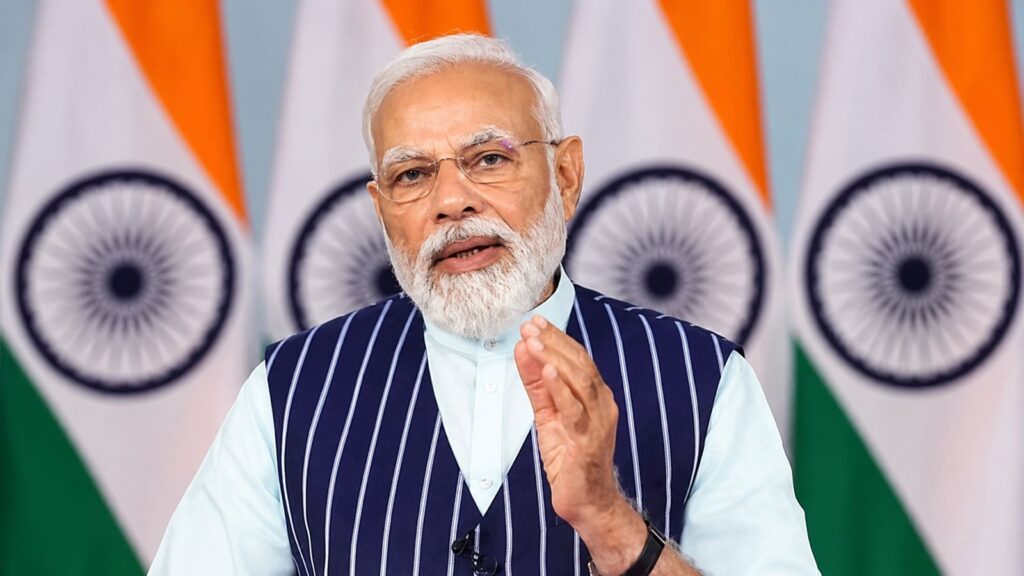
Prime Minister Narendra Modi on Saturday distributed more than 51,000 government appointment letters under the 19th edition of the Rozgar Mela, using the large-scale recruitment programme to project India’s economic transformation, technological expansion and growing global influence in manufacturing and innovation-led industries. Conducted virtually across 47 locations nationwide, the recruitment drive brought together newly selected candidates joining ministries and public sector organisations including Railways, Home Affairs, Health, Financial Services, Higher Education, the Department of Posts and state-owned energy firms such as GAIL and HPCL.
The latest distribution takes the total number of appointment letters issued under the Rozgar Mela initiative to nearly 1.3 million since the programme was launched in October 2022. The Centre has repeatedly described the initiative as a major step towards transparent and merit-based recruitment, while opposition parties and labour economists continue to question whether public sector hiring alone can adequately address India’s long-standing employment pressures.
The event arrives at a crucial moment for the Indian economy. While India remains among the world’s fastest-growing major economies and continues to attract global investment in semiconductors, electronics manufacturing and renewable energy, unemployment among educated youth remains a politically sensitive issue. Millions of young Indians continue to compete for limited formal-sector opportunities, particularly in government departments where employment is associated with financial security, stable income and long-term social mobility.
During his address to newly recruited candidates, Modi linked the recruitment drive to India’s broader economic rise and the government’s “Viksit Bharat” vision aimed at transforming the country into a developed economy by 2047. “The world today is watching India’s youth with confidence and optimism,” Modi said. “India’s young generation is becoming the driving force behind innovation, technology and economic growth.”
Recruitment Expansion
The 19th Rozgar Mela covered recruitment across a wide range of ministries, departments and public institutions, with appointments made through examinations and selection processes conducted by agencies such as the Union Public Service Commission, Staff Selection Commission and Railway Recruitment Boards.
Government officials said newly selected candidates would join operational, technical and administrative roles in railways, healthcare institutions, defence establishments, public banking services, postal departments and educational institutions. Several departments had been operating with significant staffing gaps due to delayed examinations, retirements and pending recruitment procedures over recent years.
According to official statements, the Rozgar Mela initiative was introduced to accelerate government hiring and improve efficiency in filling vacancies across central institutions. Multiple editions of the programme have been organised since 2022, with appointment letters distributed in batches ranging from approximately 50,000 to more than 100,000 recruits during certain phases.
Addressing candidates during the event, Modi described the newly appointed recruits as contributors to India’s long-term development journey. “You are not merely joining government service. You are becoming active partners in nation-building,” he said.
The Prime Minister also emphasised the role of transparent recruitment systems, arguing that faster and technology-driven hiring processes were strengthening public trust in government institutions. Supporters of the initiative have pointed to the programme as evidence of administrative reforms aimed at reducing delays and improving accountability in recruitment.
Public sector employment continues to carry enormous significance in India, particularly among middle-class and rural households where government jobs are seen as pathways to financial stability and upward mobility. Competitive examinations for railways, banking and civil services regularly attract millions of applicants annually, reflecting both the demand for secure employment and the intense competition within India’s labour market.
Technology and Growth
A significant portion of Modi’s speech focused on India’s changing economic identity and the government’s attempt to align employment generation with emerging technology sectors and industrial expansion.
The Prime Minister said India was witnessing rapid progress in artificial intelligence, semiconductor manufacturing, digital infrastructure, electronics production and green energy industries. He argued that the country’s youth population was becoming one of India’s strongest global advantages as international companies increasingly shifted investment towards India.
“The world is excited about India’s progress in AI, semiconductors and green technology,” Modi said. “Global confidence in India is rising because of the capability, talent and innovation of our young people.”
The Centre has increasingly framed employment generation within the broader narrative of industrial transformation and global supply chain diversification. Government officials have repeatedly highlighted India’s semiconductor projects, electronics manufacturing incentives and clean energy investments as examples of industries expected to generate long-term employment opportunities.
Modi also linked India’s employment ambitions to international economic partnerships and growing foreign investment. The government has argued that rising geopolitical shifts and changing global production networks are creating opportunities for India to emerge as a major manufacturing and technology hub.
The Prime Minister further said India’s startup ecosystem and digital economy were expanding rapidly, creating opportunities beyond traditional public sector employment. Analysts note that the government’s messaging increasingly combines job creation with technological advancement, positioning India’s youth as central to the country’s global economic strategy.
Skill Development
Alongside recruitment, the government has placed growing emphasis on workforce training and digital learning through the Karmayogi Prarambh platform, which newly recruited candidates will now access as part of their induction process.
The platform operates under Mission Karmayogi, the Centre’s flagship civil service reform initiative designed to modernise governance systems and create a more technology-oriented administrative workforce. Officials say the digital platform provides access to more than 400 online courses covering governance practices, communication skills, digital administration, leadership development and workplace efficiency.
Government representatives have repeatedly argued that India’s employment challenge extends beyond recruitment and increasingly involves preparing workers for rapidly evolving technological and industrial environments. The platform allows employees to access learning modules through mobile devices and computers, creating what officials describe as a continuous learning ecosystem within public administration.
During his address, Modi said India’s workforce would need to adapt quickly to changing global economic conditions and technological disruption. “The capability and innovation of India’s youth are becoming the identity of New India,” he said.
The government’s focus on digital governance and workforce upskilling reflects broader concerns about automation, artificial intelligence and the future of employment. Economists and industry experts have repeatedly stressed that future job growth will depend not only on economic expansion but also on the ability of workers to adapt to specialised and technology-driven sectors.
Political Debate
Despite the scale and visibility of the Rozgar Mela initiative, employment remains one of the most politically sensitive issues facing the government.
Opposition parties and labour economists continue to question whether government recruitment drives can meaningfully address the scale of unemployment pressures facing India’s youth population. Critics argue that many of the vacancies being filled are replacements for retiring employees rather than entirely new positions generated through economic growth.
Questions have also been raised over delays in recruitment examinations, pending vacancies across departments and the gap between economic growth and large-scale employment generation. Analysts note that while India’s GDP growth remains strong, unemployment among educated youth continues to remain a major concern, particularly in urban areas where competition for stable formal-sector jobs remains intense.
Labour market experts have repeatedly warned that government employment alone cannot absorb the millions of young Indians entering the workforce every year. India possesses one of the world’s youngest populations, placing enormous pressure on policymakers to create sustainable and high-quality employment opportunities at scale.
At the same time, supporters of the government argue that the Rozgar Mela demonstrates administrative efficiency and reflects a more streamlined recruitment process compared to earlier years. They also point to infrastructure expansion, manufacturing incentives and startup growth as evidence that the broader employment ecosystem is gradually strengthening.
Political observers note that employment is expected to remain central to national debate as India attempts to balance rapid economic growth with the challenge of ensuring inclusive job creation for its expanding workforce.
Bigger Employment Challenge
The 19th Rozgar Mela has once again brought India’s larger employment debate into sharp national focus. For the 51,000 newly appointed recruits, the programme represents financial security, social mobility and access to long-term career opportunities within government institutions. For the Centre, the initiative provides a visible demonstration of governance delivery, administrative reform and youth outreach.
However, economists argue that India’s long-term employment future will ultimately depend on far broader structural changes beyond periodic recruitment drives. Sustained job creation, analysts say, will require deeper industrial expansion, labour-intensive manufacturing growth, stronger private-sector hiring, increased entrepreneurship and large-scale investment in skill development.
India’s emergence as a global technology and manufacturing destination has significantly strengthened its economic profile internationally, but the pressure to convert that growth into mass employment continues to intensify. The challenge remains particularly significant because of the scale of India’s youth population and the rising expectations attached to economic growth and technological progress.
As the government positions India as a major global economic power, the question facing policymakers is no longer limited to growth alone. Increasingly, it is whether that growth can generate enough stable and high-quality opportunities for one of the world’s largest and youngest workforces.


