

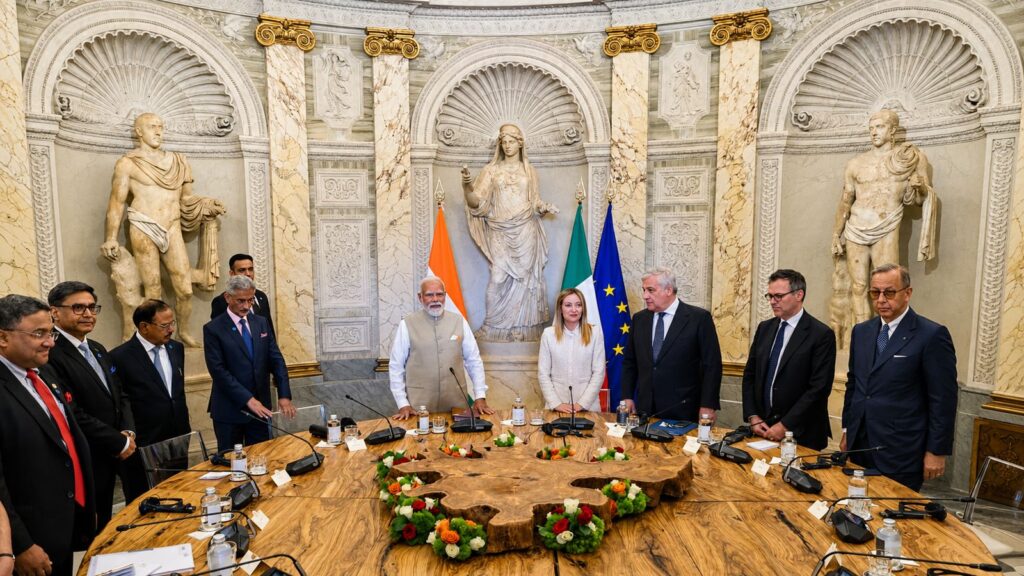
India and Italy on Wednesday elevated their bilateral relationship to a “Special Strategic Partnership”, marking one of the most significant diplomatic upgrades between New Delhi and a European power in recent years. The announcement came after wide-ranging talks between Prime Minister Narendra Modi and Italian Prime Minister Giorgia Meloni in Rome, where both leaders outlined an ambitious roadmap focused on defence cooperation, trade expansion, technology partnerships, connectivity, clean energy and strategic coordination across the Indo-Pacific and Mediterranean regions.
The high-profile meeting also carried strong symbolic messaging, with Meloni speaking in Hindi during a joint media appearance while highlighting the growing partnership between the two countries. The Rome summit also reflected the increasingly warm political chemistry between Modi and Meloni as India and Italy attempt to transform diplomatic goodwill into a deeper geopolitical alignment amid rising global uncertainty.
Strategic Upgrade
The elevation of ties to a “Special Strategic Partnership” signals a decisive shift in the India-Italy relationship from conventional diplomacy towards structured long-term strategic cooperation. Both governments announced plans to strengthen collaboration across defence manufacturing, maritime security, logistics, innovation, artificial intelligence, energy transition and industrial supply chains. Officials familiar with the discussions said the new framework is intended to create stronger institutional coordination between governments, industries, research sectors and strategic agencies in both countries.
During the joint press interaction, Modi said India and Italy had decided to build a partnership that goes beyond traditional economic cooperation and responds to emerging global challenges. “We have decided to elevate our ties to the level of a Special Strategic Partnership,” Modi said, adding that both nations would work closely in sectors including defence, semiconductors, clean energy and critical technologies.
Meloni described the relationship as entering what she called “a decisive phase”, arguing that Rome and New Delhi were now rewriting bilateral ties “at speed” amid changing geopolitical realities. “India and Italy are closer than ever,” she said during the media briefing in Rome.
The two sides are also expected to institutionalise annual Prime Minister-level meetings under the new strategic framework, a move diplomats view as a major structural upgrade in bilateral engagement.
Meloni-Modi Chemistry
While the talks focused heavily on geopolitics and economics, much of the public attention centred around the increasingly visible personal rapport between Modi and Meloni. The Rome visit revived the now-viral “Melodi” diplomatic narrative that first gained international attention during the G20 Summit in 2023.
Ahead of official talks, Modi and Meloni visited the Colosseum together, exchanged gifts and appeared in social media videos that generated massive online engagement. In one widely circulated moment, Modi gifted Meloni a packet of Indian “Melody” toffees, prompting laughter and playful exchanges between the two leaders.
Speaking about her relationship with the Indian Prime Minister, Meloni said, “I have met PM Modi seven times over the last few years. We have gotten to know each other deeply with a genuine friendship. I have developed a deep appreciation for his leadership and how popular he is in India.” The remarks underlined the increasingly personal dimension of the India-Italy relationship, which diplomats believe is helping accelerate cooperation across strategic and economic sectors.
Meloni also addressed the media using Hindi phrases to underline the growing closeness between India and Italy. “Parishram hi safalta ki kunji hai,” she said while praising India’s economic rise and describing the efforts being made by both governments to strengthen bilateral cooperation.
Despite the lighter public moments, officials stressed that the growing personal chemistry between Modi and Meloni is increasingly translating into concrete policy coordination and strategic engagement.
IMEC Takes Centre Stage
A major focus of the Rome talks was the India-Middle East-Europe Economic Corridor, or IMEC, which both countries now view as a central pillar of future economic connectivity between Asia and Europe. The corridor, first announced during the 2023 G20 Summit, aims to connect India to Europe through the Gulf region using integrated rail, shipping and logistics infrastructure.
For India, IMEC represents a strategic opportunity to deepen access to European markets while reducing logistical vulnerabilities exposed by disruptions in the Red Sea and wider West Asia tensions. For Italy, the corridor offers the possibility of becoming one of Europe’s primary Mediterranean gateways for Indo-European trade flows.
Modi said connectivity projects such as IMEC would play a major role in strengthening economic resilience and expanding commercial integration between democratic nations. “Connectivity initiatives can become engines of growth, stability and prosperity,” he said during discussions in Rome.
Italian officials also described IMEC as a long-term geopolitical and economic project capable of reshaping trade architecture between Europe and Asia. Analysts believe the corridor has gained renewed urgency as countries seek alternatives to vulnerable global supply chains and increasingly unstable maritime routes.
Defence And Trade Push
Defence cooperation emerged as another major pillar of the upgraded partnership. India and Italy agreed to expand collaboration in defence manufacturing, maritime security and industrial cooperation, reflecting growing strategic convergence between the two nations.
Officials said discussions included naval systems, logistics, aerospace technologies, cybersecurity and industrial production partnerships. The emphasis on maritime cooperation comes amid rising concerns over shipping security, Indo-Pacific stability and tensions in West Asia that continue to impact global energy and trade routes.
Beyond defence, both countries announced ambitious economic targets. Bilateral trade, which has already crossed €14 billion, is now expected to reach €20 billion by 2029 under the new partnership framework.
The Rome talks also resulted in agreements covering maritime transport, agriculture, higher education, critical minerals, museum cooperation and efforts to combat economic and financial crimes. Business leaders from both countries participated in industry discussions alongside the political meetings, with a strong focus on manufacturing, AI, clean energy and innovation partnerships.
Italy is increasingly positioning India as a key economic and industrial partner as Europe seeks to diversify supply chains and reduce overdependence on a small number of global manufacturing hubs.
Beyond Symbolism
The Rome meeting carried significance far beyond bilateral diplomacy. The upgraded partnership comes at a time of growing geopolitical fragmentation marked by conflicts in Ukraine and West Asia, increasing global trade uncertainty and intensifying strategic competition between major powers. Both Modi and Meloni presented the India-Italy relationship as part of a wider democratic alignment aimed at strengthening economic resilience and geopolitical stability.
During his remarks, Modi drew a cultural parallel between Rome and Varanasi, describing them as “eternal cities” linked by deep civilisational heritage. “When two ancient civilisations come together, their decisions rise above temporary agendas,” Modi said, highlighting the broader historical and cultural dimension of the partnership.
The visit also formed the final major stop in Modi’s broader European outreach tour, underlining India’s accelerating diplomatic engagement with Europe. For Rome, closer ties with New Delhi reflect Italy’s ambition to play a larger strategic role connecting Europe, the Mediterranean and the Indo-Pacific.
The announcement of the Special Strategic Partnership ultimately represents more than a diplomatic milestone. It signals a wider geopolitical recalibration in which India and Italy increasingly see each other not only as economic partners, but as long-term strategic stakeholders in an increasingly uncertain global order.


