

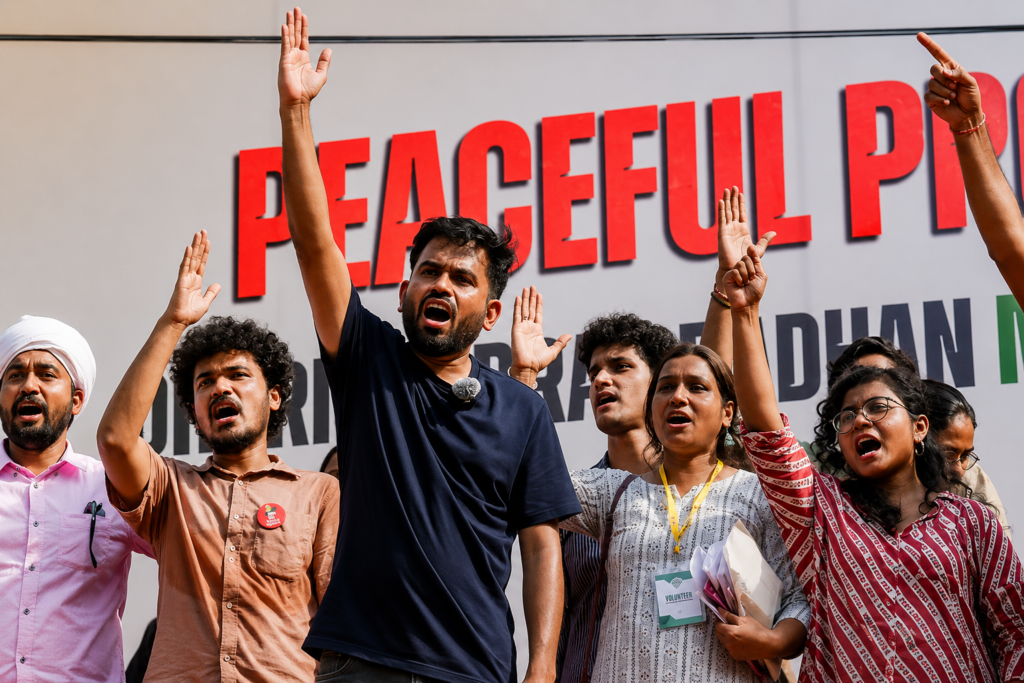
On the fifth consecutive day of protests at Jantar Mantar, thousands of students and supporters remain on the streets demanding accountability over the NEET-UG 2026 paper leak, with no direct political response yet from the Indian government. There has been no resignation, no formal assurance from Prime Minister Narendra Modi, and no public acknowledgment of responsibility from Union Education Minister Dharmendra Pradhan.
That silence is now driving the movement harder than the paper leak itself.
What began as outrage over a compromised national medical entrance exam has rapidly evolved into a wider confrontation over institutional trust, political accountability and the right to dissent. At the centre of it is Cockroach Janta Party founder Abhijeet Dipke, whose movement has grown into one of the most visible youth-led agitations in India this year.
On Wednesday, Dipke appeared before the Ministry of Electronics and Information Technology after CJP’s X account was blocked in India. Emerging from the hearing, he delivered what has now become the movement’s most viral statement.
“You can block our accounts, but you cannot block the anger of students.”
That line has quickly become the defining slogan of the protest, shared widely across social media and protest sites.
No Accountability
The core demand remains unchanged. Students want Dharmendra Pradhan’s resignation over the NEET paper leak, which triggered national outrage after irregularities were confirmed and investigations launched. But protesters argue that while systems are being reviewed, no political accountability has been fixed.
For five days, demonstrators have remained at Jantar Mantar, many sleeping overnight and refusing to leave until action is taken. Yet neither Pradhan nor Prime Minister Modi has formally addressed the central demand.
That absence has only intensified the protest.
“Students lost careers, lost years and some lost their lives. But no one in power has taken responsibility,” Dipke told supporters, a statement that has now become one of the movement’s strongest rallying cries.
Political analysts say prolonged silence during a youth-led protest often increases public sympathy, especially when the issue affects millions of families.
Terror Remark
The political confrontation escalated sharply after Dharmendra Pradhan, in remarks aired by NDTV and later amplified across multiple news platforms, described the Cockroach Janta Party as the “B-team of terrorists.”
The remark triggered immediate outrage among protesters.
For many at Jantar Mantar, it marked a turning point. Instead of engaging with demands over examination integrity, they argue the government chose to attack the credibility of those raising questions.
Dipke directly challenged the minister.
“Aren’t you ashamed to call students terrorists? We are demanding justice, not violence.”
The statement spread rapidly online and further expanded the protest’s reach beyond Delhi.
Pradhan has not withdrawn or clarified his remarks.
Streets Harden
The protest itself has become increasingly organised and symbolic. What began with speeches and placards has now expanded into indefinite sit-ins, plate-banging campaigns and mass overnight gatherings.
Dipke has made it clear the movement will not retreat.
“Nobody will move till Dharmendra Pradhan resigns. If there are lathis, I will take the first one.”
That message has resonated strongly among students who now see the protest as representing a larger frustration with India’s exam system and institutional failures.
Police presence at Jantar Mantar remains heavy, with protesters alleging restrictions on movement and water access. Yet the crowds continue to grow.
Violence Spreads
The movement took a darker turn last week when Dipke was attacked during a protest in Jaipur. Video footage showed him being slapped repeatedly by unidentified men while addressing supporters.
Police detained six people.
The incident became a major rallying point.
Supporters say it reflects a growing atmosphere of hostility around student-led dissent.
Dipke used the incident to intensify his criticism.
“Physical attacks show fear. If they had answers, they would not need violence.”
The central government has not commented on the Jaipur attack.
For many protesters, that silence has become part of the wider pattern.
Big Names Join
The movement has expanded well beyond students. Environmental activist Sonam Wangchuk joined the agitation earlier this month, adding significant national credibility.
His warning was blunt.
“If students lose trust in examinations, a country loses trust in its future.”
Popular educator and YouTube personality Vijender Chauhan has also joined the movement, urging students to stay united and disciplined.
His support carries weight among millions of exam aspirants.
Other online educators, including Abhinay Sharma and major coaching influencers, have amplified the protest across YouTube and Instagram, helping transform it into a nationwide campaign.
According to AP, CJP’s online following has now crossed 22 million, making it one of the fastest-growing youth-driven political movements in India.
A Bigger Test
This is no longer simply a protest over one leaked exam.
It has become a wider test of how India’s institutions respond when trust collapses.
Students are no longer asking whether the paper leak happened. That has already been established.
They are asking why no one has yet been held politically accountable.
And as the government remains silent, the movement continues to harden.
What began as an education scandal is now becoming a national reckoning over responsibility, transparency and trust.
For now, the streets remain full, the slogans continue to rise, and the pressure on the government continues to grow.
At the centre of it all remains one question that India’s students say can no longer be ignored.
Who will take responsibility?


