

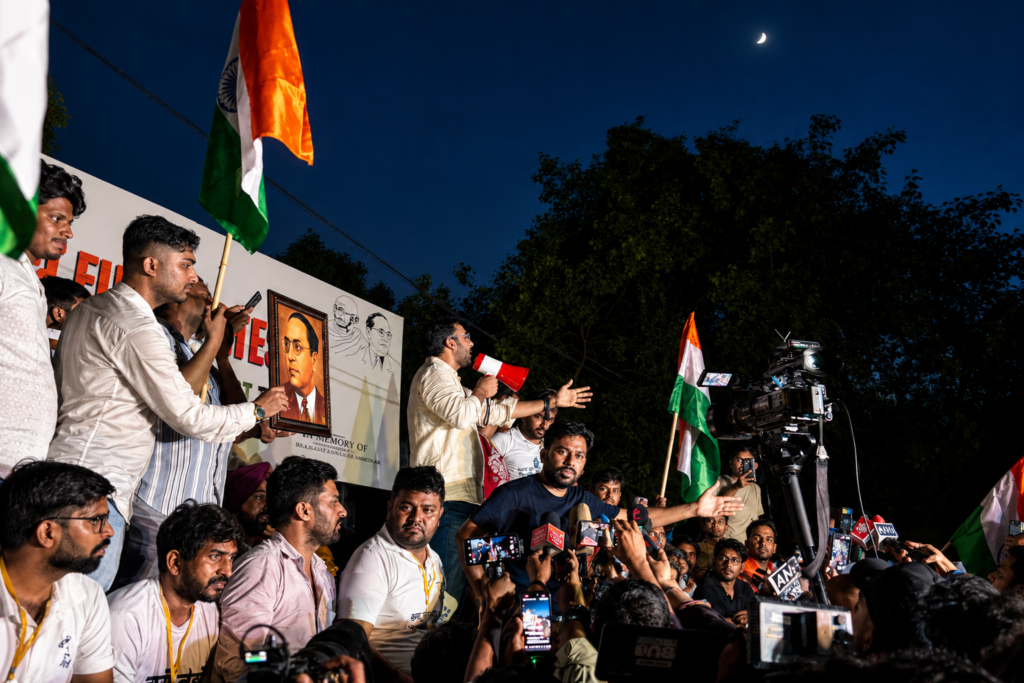
A tense overnight standoff unfolded at Delhi’s Jantar Mantar on Saturday after hundreds of students and supporters of the Cockroach Janta Party (CJP) refused to disperse even after police permission expired, turning a planned daytime protest into one of the sharpest youth-led agitations India has seen in recent months.
At the center of the protest was Abhijeet Dipke, whose fiery declaration, “We won’t leave Jantar Mantar until Dharmendra Pradhan resigns,” quickly became the defining slogan of the movement. The protest, built around the NEET-UG 2026 paper leak scandal, has now evolved into a broader outcry over exam leaks, institutional failures, and growing distrust in India’s education system.
Protest Standoff
What began as a permitted demonstration changed dramatically after 5 p.m., when Delhi Police denied protesters an extension and ordered the site cleared. Dipke refused to move, calling the order unjust, and hundreds of supporters remained at Jantar Mantar in defiance.
According to Dipke and multiple eyewitnesses, police responded by cutting electricity, blocking food and drinking water, and restricting access to washrooms. Protesters switched on their mobile flashlights as darkness fell, turning the protest site into a sea of lights while chants of “Go Pradhan Go” echoed through the barricaded zone.
Supporters also banged steel plates and spoons, a tactic Dipke had urged in advance, turning the protest into a symbolic accusation that the government had remained silent over repeated exam irregularities.
Heavy police deployment and barricades surrounded the area through the evening. Reports suggested Saturday’s turnout was significantly larger than CJP’s earlier protest this month, a sign that the anger is spreading beyond students directly affected by NEET.
NEET Leak Fallout
The immediate trigger for the agitation was the cancellation of the NEET-UG 2026 exam after allegations surfaced that question papers had leaked before test day. The National Testing Agency (NTA) later announced a re-examination for June 21, placing millions of aspirants under renewed pressure.
NEET is India’s single largest medical entrance exam, with over 22 lakh candidates appearing this year. For many families, preparing for the test involves years of coaching and massive financial sacrifices. The cancellation meant all that preparation was suddenly thrown into uncertainty.
Investigators are probing allegations that papers were circulated through encrypted digital channels before the exam. In response, authorities have tightened security for Sunday’s re-test, including biometric verification, CCTV surveillance, and GPS tracking of exam materials.
But for students at Jantar Mantar, the issue has gone beyond one leaked exam paper. Many said this was only the latest in a long series of exam controversies that have shaken trust in public institutions.
Jail Bharo Call
One of the most significant moments of Saturday’s protest came when Dipke called for a nationwide “Jail Bharo Andolan” if police detained him.
Speaking to supporters, he urged students and unemployed youth across India to voluntarily court arrest in solidarity. That announcement marked a major escalation, transforming what began as a student protest into the early shape of a national civil disobedience movement.
Dipke has increasingly framed the fight as one for India’s forgotten youth, students and job-seekers trapped in what he calls a broken system.
His Cockroach Janta Party itself emerged after a controversial courtroom remark by Justice Surya Kant, who reportedly compared unemployed youth to “cockroaches.” Dipke turned that insult into a political identity, and in just weeks, thousands of young Indians have rallied behind it.
Bigger Support
The protest widened beyond student circles when education reform activist Sonam Wangchuk arrived at Jantar Mantar and paid tribute to students who allegedly died by suicide following the NEET cancellation.
His presence added significant moral weight to the agitation and linked the issue to broader concerns about education reform.
Actor Prakash Raj also publicly backed the protest, helping amplify its message nationwide. Their involvement suggests the movement is beginning to move from student unrest into mainstream political and social discourse.
This broader support is one reason the government is watching the protest closely.
Rising Pressure
Dipke has repeatedly claimed that at least 11 students died by suicide in the fallout of the NEET controversy, demanding ₹1 crore compensation for each affected family.
While officials have not independently verified all those cases, the emotional toll on students has become central to the protest narrative.
On Saturday, another NEET aspirant was found dead in Ghaziabad just hours before the re-exam, although police said there was no immediate evidence linking the death directly to exam stress.
The political pressure is also rising. Rahul Gandhi urged authorities to conduct the re-exam without glitches and demanded transparency, adding another layer of scrutiny to the government’s handling of the crisis.
At the center of that pressure remains Education Minister Dharmendra Pradhan, whose resignation has become the CJP’s primary demand.
What Next
Sunday’s NEET re-exam is now about far more than admissions.
If it proceeds smoothly, the government may limit the immediate fallout. But any fresh irregularity, even minor, could deepen what is already one of the biggest credibility crises India’s examination system has faced in years.
At Jantar Mantar, under phone lights and surrounded by barricades, protesters made one thing clear: this movement is no longer just about a paper leak.
For millions of students across India, it has become a referendum on trust, fairness, and whether the institutions shaping their future can still be believed.


